Menu Close

Charlie and Steve's Excellent Adventure

Tasting the world one meal at a time

While you were working – From Little Acorns, Nara, Japan

 There’s many Japanese truisms but none more concrete than one we are living today, the four T’s of Japanese tourism: Travel, trains, towns and temples. Our time in Japan thus far has seen us living on the edge, but not in an adrenaline junkie sense; the question that lives heavy in the air of every waking moment is undoubtedly: Can we see just one more temple. Do we want to? Our plunge into Asia has seen a great change in the faith landscape; from Latin America’s blind faith in Catholicism to Africa’s possibly even more insidious twisting of the pseudo Christian cash cow concept, our last five months have been immersed in the far more difficult to dismiss tenets of Buddhism. While Japan has a strong Buddhist history there’s another kid on the faith block with Shinto shrines occupying much of the landscape. On the train to the old capital of Nara the question remains a fait accompli, there’s to be no avoiding temples today.

 We all know that Tokyo is the capital of Japan, some of us know that this is the case largely due to the Tokugawa clans rule from 1603-1868 moving the seat of power from the former capital Kyoto. What few know however is that from 710-784 the capital was in fact Heijokyo, the ancient city where current day Nara now stands. Housing the first Buddhist temple in Japan, the worlds largest timber structure and an undisturbed forest dating to the year 841, modern day Nara abuts a world from a time before this small nation perceived the light of the rising sun shining on the whole world. Great oaks from little acorns grow, goes the saying; through the modern streets of Nara a paved road signals our step into a cluster of eight UNESCO world heritage sights. The acorn of the eighth century awaits.  

Charlie Winn

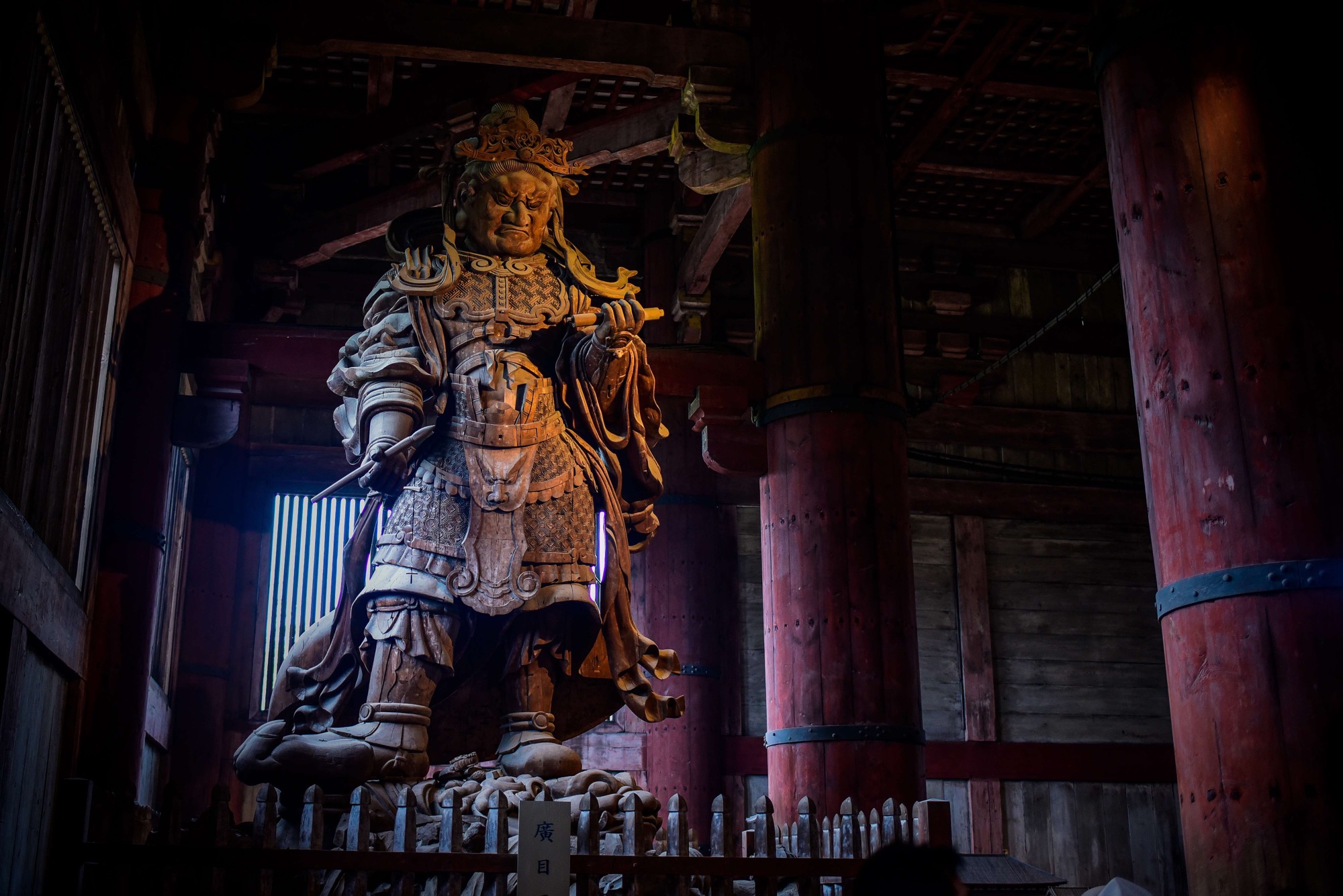
Guardian, all 10m high and made completely from wood. Nara, Japan.

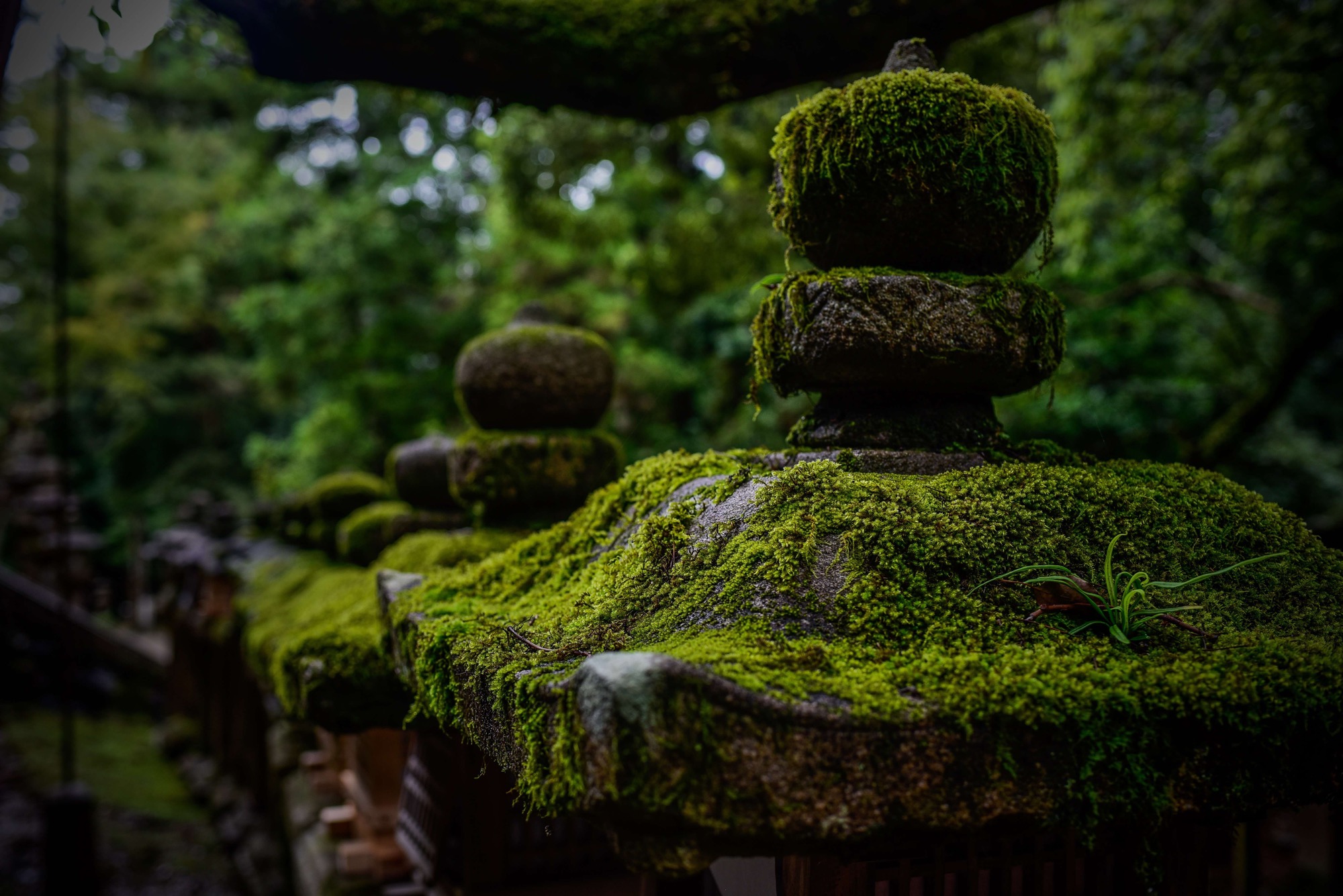
  To the east of Nara city our life changes colour, no longer does concrete grey, bitumen black and metallic steel surround us as an iridescent green from centuries past persists as if in a capsule. Vibrant moss covers stones like an authenticity seal confirming their unmoved position over the centuries to donate a green that seems too green to be natural. Black darker than ink reflects our view from the inquisitive eyes of deer who stroll the streets not yet scorched of life by human occupation. And of course timber in shades of brown through to silver replace the cool aloofness of concrete that refutes any accusation of personality. 

 Heijokyo may be a little acorn in it’s position along the timeline of greatness of Japan but diminutive scale was not the forte of the powerful forebears of this great nation. Reaching to the sky to a height higher than I can hazard a guess at, a timber gate houses timber guardians surely more than 10m tall with none of the simple suggestive forms that great sculpture often adopts: these warriors are ready to jump down from their imposing perches to defy what our eyes tell us. It seems that Heijokyo’s ambition was not limited to scale alone, surely these are the most detailed and elaborate artworks of this size anywhere, ever. But a great gate that captivates our eye can only be a precursor to a great temple, and so it is for Daibatsuden.  

Charlie Winn

Moss covered stone lanterns, lining the paths to the multiple Shinto shrines in Nara. Japan.

  We’ve seen big buddhas but this one is the cherry, even grander than the staggering reclining buddha in Wat Pho, Bangkok. As staggering as the Buddha itself is, the building housing it is all the more so for its scale; sometimes there’s no amount of elegance or grace that can override sheer size. Then there’s places that sacrifice none of that elegance or grace in their size. Living in a permanent state of being ‘templed out’, any thoughts of dismissing Daibatsuden as just another temple are cast aside just as the water of this rainy day is cast over the rolling edges of the roof high above, to disperse to raindrops as if falling from the sky for a second time. The scale is breathtaking and the notion that this structure is a rebuild at just two thirds the size of the original is a waiting unfathomable headache like trying to understand what a wormhole really is.

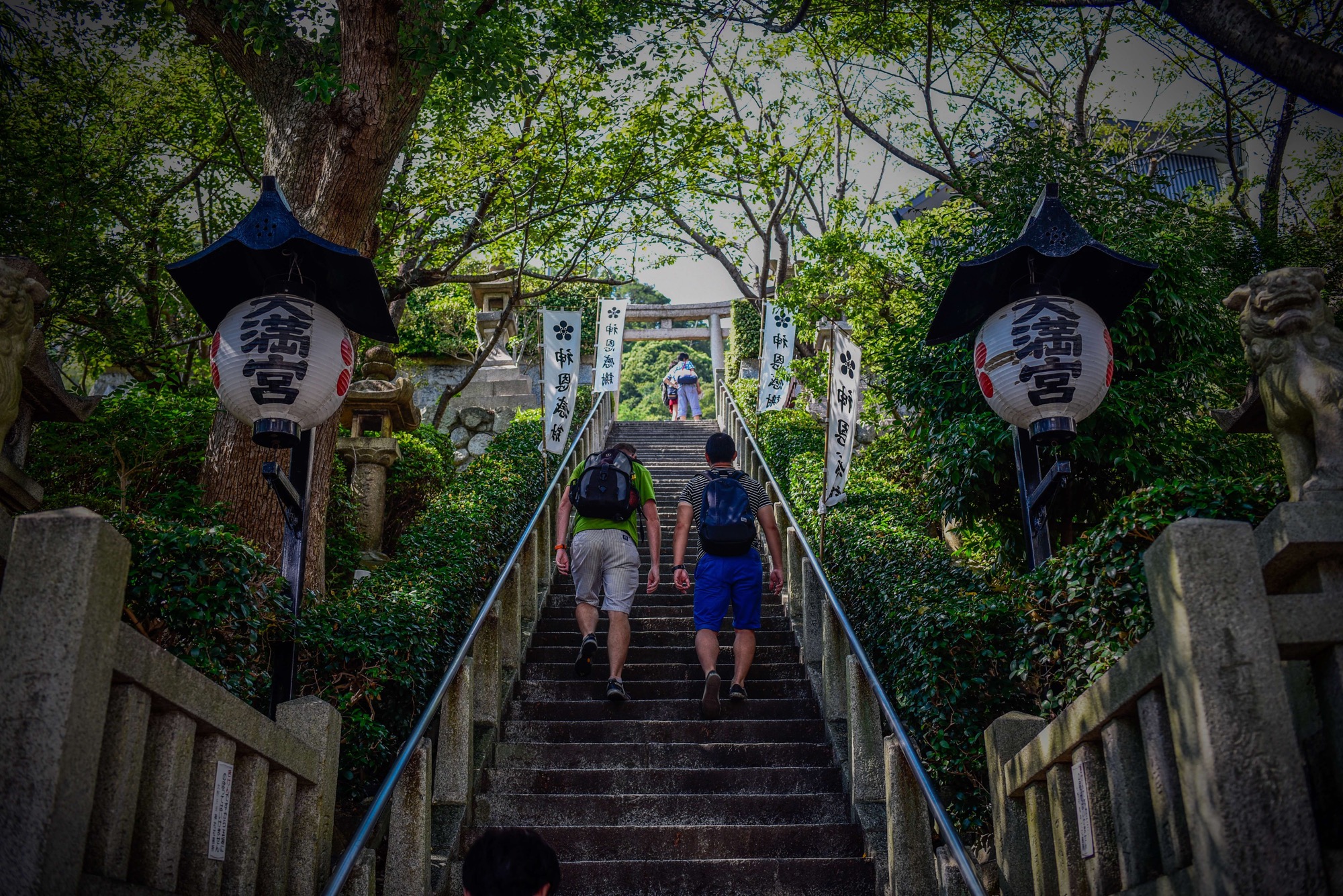
 Templed out? possibly, but not today. The odd quirk of visiting Nara is that you don’t really visit Nara; it’s the acorn of Heijokyo we now find ourselves in the midst of, the grand ambition planted in the soil here to feed this moss covered world and wrap us up in a life so foreign. There’s no modern world on which we stand to cast our eyes out to a wonder reduced to an attraction, just stone lanterns by the thousands, steps that saw the rise and fall of Emperors and Empresses and a world that touches the sky from a little acorn that thought big. It’s in this immersion that we venture, into air that’s cooler and wetter in this seat of great power that even forces of nature seem to bow and take their leave from.  

Charlie Winn

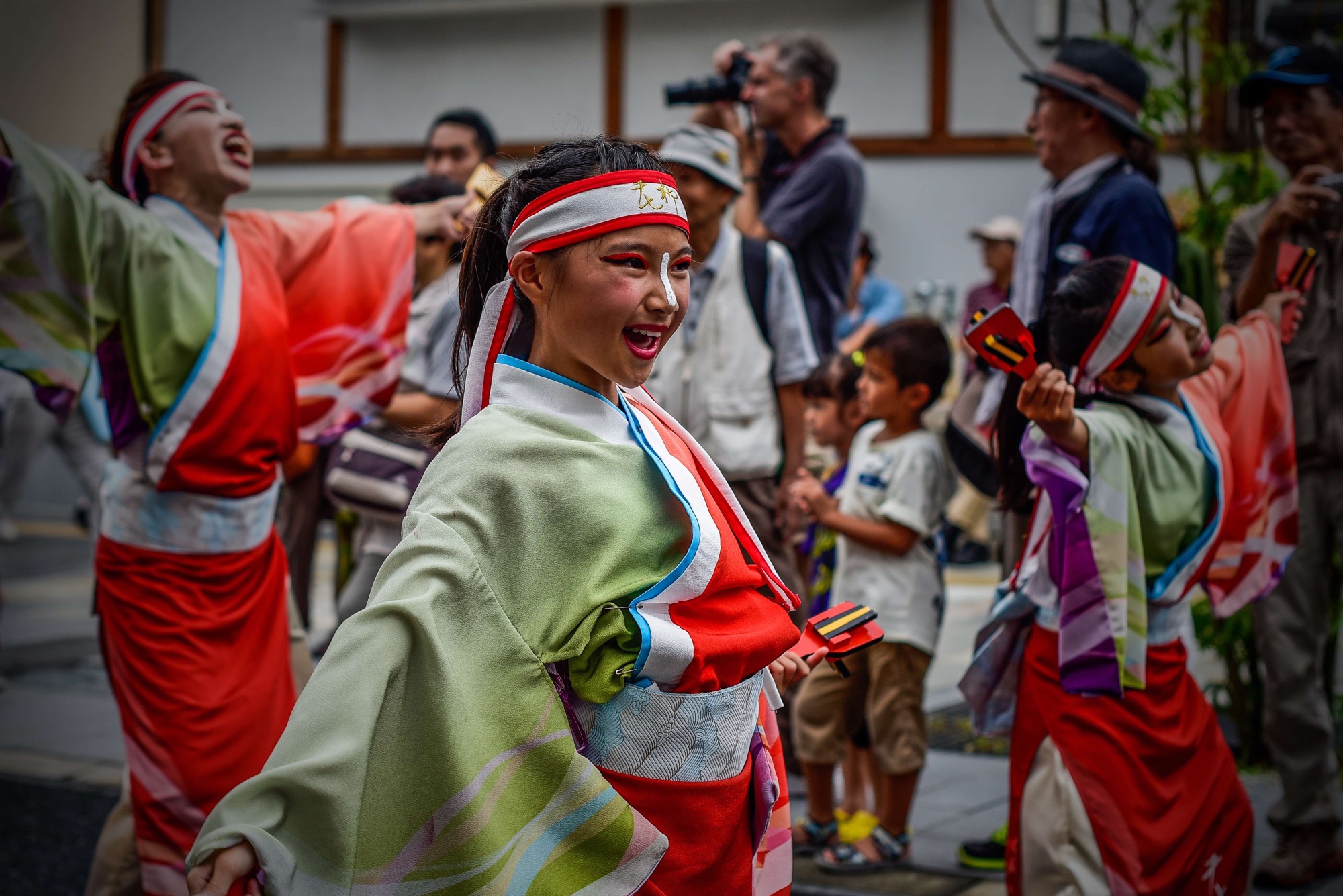
Dancers in elaborate costumes, Nara, Japan.

  There’s temples all around but it’s a world that invigorates rather than tires, taking one single stone lantern from the endless promenades would be the treasure of our garden but line up like fenceposts here. Countless stairs to intriguing spaces remove the everyday feeling that often makes temples stand out as so different; in truth the temple idea here isn’t defined to a building, a shrine, an oversized bell or a treasured garden, it’s by definition indefinite. Shinto and Buddhist beliefs collude with a somewhat pagan ethos to create a world where a natural temple is the temple we all come to see, in every tree, stone and drop of water that trickles all around. Maybe we’ve been doing it wrong all this time, viewing temples rather than being wrapped within them. Or maybe centuries have picked the flesh from great places leaving just a few scant remains to call us back to a former glory. In the destruction of cultures the world over, great civilisations remain only as relics, but in Heijokyo an unbroken line lies to the little acorn that grows still; all the way to Tokyo and beyond. 

 Still we count the procession of grand stone lanterns that almost define this place, under the sacred bows of a primeval forest undisturbed for over a thousand years and just the few more steps into modern day Nara. There’s a festival of sorts on today, dancers in elaborate costumes perform on the street just metres from a world that feels so far away, or at least it should; or shouldn’t. Far from being pushed behind security fences or severed from the validity of life that exists outside of the advertised opening hours, Heijokyo exists not as a relic or a reminder but a pulsing life that feeds beyond it’s roots still to this day. Be they evil deeds or great influences, Japan has cast the light of the rising sun across the world, all from the little acorn with big ambitions and one too many stone lanterns covered in moss.  

Gluttony expedition – Centre Stage, Kobe, Japan

 Just when we thought that this great adventure was taking its final bow with the spotlight slowly dimming to cast the once bright features into shadowed shapes, a little visit to the island of Miyajima set fire to the stage for an encore to thrill the crowd. Far from the introspective amble that followed our minds which have already cleared customs in Sydney we’re back in the game and back into squeezing the last drops of adventure from this trip that’s all of a sudden not over yet. Our senses are once again heightened, our eyes are wide open staring at the spotlight and most importantly our taste buds are rustling the familiar call for attention. On our way from the very sobering and serene Hiroshima region, we’re off for a little stopover in Kobe before heading back to Osaka once again. Like piecing a puzzle together we’re in Kobe, Aki is popping across to meet up for the day and we’re desperate for food: if this is a puzzle, the box is surely marked ‘for 2-4years’, there’s only one option. In culinary terms, Kobe plus hungry boys equals the famous Kobe beef.

 In a twist that we’re likely to never let him forget about, Aki leaves us stranded at Shin-Kobe train station unable to contact him and not sure where he’s booked for lunch. It appears that the one of this trio that can speak and read Japanese caught the wrong train, enough said on that matter. The encore has commenced, the concert hall is hushed and we are temporarily left stranded on stage staring at an expecting audience with no music yet to cue us in. A bashful Aki struts with a little more purpose than usual towards us, apologising all the way to finally rescue us; the show must, and will go on.  

Charlie Winn

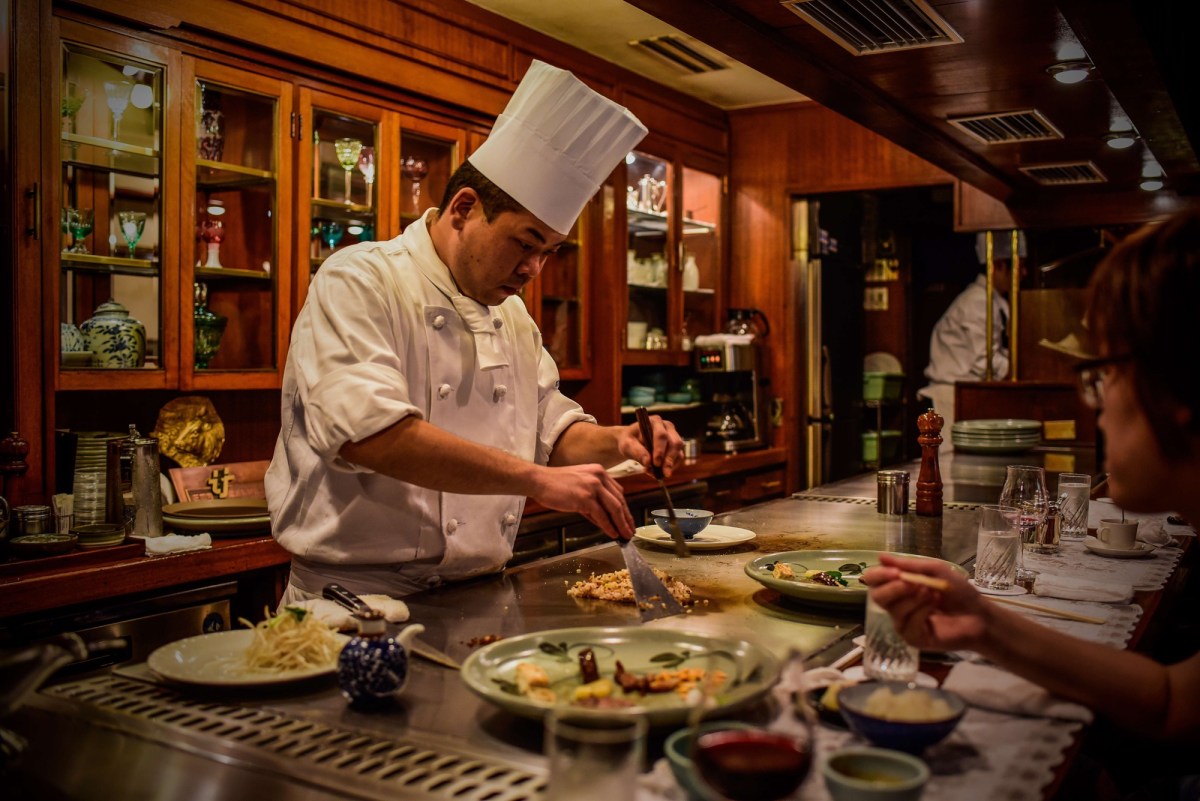
Kobe beef being disected on the hot plate, Kobe, Japan.

  Walking the few blocks feels a little like the very average start up band that fills the gap before the headline act takes the stage; something something architecture, cute gardens, cool shopfronts, shrines with inserted clever parallel to Japanese culture or history. Fill in the blanks for us will you, there’s little on our minds beyond beef, cow, wine, steak and- or meat. From an otherwise benign street of clean footpaths and linear buildings that carry little charm, we step under a domed red awning that invades the footpath with the arrogance of a celebrity spotter hotel to three tight little steps that crush the outward flamboyance. In a rush of air conditioning we move from Japanese urban conservatism, past celebrity pomp and through a door that feels like a broken secret into a posh English pub with a dash of sexy gentleman’s club. Surrounded by dark timber and old world brass fittings our dimly lit room glows from the hot plate that is the bar as much as from the lights overhead. The stage is no longer this adventure, it’s the shining metal expanse before us awaiting the real star we’ve all come to see.

 On a neat little timber board the stage glows as the headline act all but drinks the light from the room; it’s Kobe beef. It’s possible we’re being a little dramatic and it’s reasonable to accuse us of being a little hungry but all eyes are on the thin slabs of beef that seem more marbled fat than meat; yes this starlet is a plus size dame and we nearly burst into applauds to defy the demure space. With a sizzle the star sends this audience of three into rapture, as they say in showbiz, she owns the stage. Hisses and bubbles exude sultry desire as we’re all fixed to the spot watching the star dance about the stage at the push of spatula and the slice of knife; this really is show business.  

Charlie Winn

Walking off the lunch and bottle of wine…in Japan, checking out the local shrine. Kobe, Japan.

  From the slab of marbled beef the chef expertly slices away the fattiest parts to sit at the slightly cooler side of stage to render to deliciousness while the pieces that threaten to have some flesh in between the fat are returned to the timber board to await the second act. As sections of fat sizzle and dissolve this steak is not placed on our plates whole. As each mouthful sized section is just perfect to be eaten, it’s placed on our large ornamental platers to be enjoyed with garlic, salt, pepper or one of two sauces at our choosing. The chef, the director, makes the star dance balancing the cooking process, picking off pieces to be eaten directly from the plate to our mouths as they touch the moment of readiness. Not a mouthful of this wonder enters our mouths unless its at the exact perfect moment to be consumed. Eating also acts as a reminder to stop us gaping for the need to chew. But we don’t need to chew, it dissolves into a sizzling cloud in our mouths but we chew from habit all the same. 

 The star dances, the fatty parts render to a crisp and the fleshy ensemble rejoins the stage as the narrative of this theatre is played out to a climax of excitement that threatens to become downright sexy. We’re not eating steak, we’re witnessing a theatrical journey being fed a piece of perfect cow, mouthful by sumptuous mouthful. Just like a brilliantly composed script we’re delivered twists and narrative turns at all the right times, dissolving flavour bursts are followed by fleshier texture to be capped off by decadent fatty explosions as the threat of sexiness becomes a mere threat no more. I feel like a cuddle and a warm hand towel. 

Charlie Winn

A hard days travelling…Kobe, Japan.

  As the director literally takes his bow the show draws to a close and there is a star on the stage no more. We exit back onto the street as if from a great show, alive and gossiping excitedly about our take on the performance. This morning we felt like the stage was alight again and our show was back under way but there’s always a brighter star. For now these greedy little boys are happy to wait in the wings for the spotlight to shine brightest upon another, the plus size star that dances no more the dance we’ll never forget. 
  

While you were working – Gap Filler, Miyajima, Japan

 One of the three best views in Japan, who makes these lists anyway, who takes considerable effort to corral such wildly subjective opinions into measurable lists? Tourism Japan does, that’s who, just like the tourism boffins in every other country around the world. Well it has worked, we’re here with an ATM full of tourist dollars to spend, flies caught in the web like all the other dollars, euros, pesos and rupees drawn like moths to the flame. The last few days have been somewhat introspective ones for us as a years worth of adventure presses the next two weeks into near insignificance. We’ve started feeling like gap filler in a tube pressured by the weight of experience behind us, the fleeting moments before us just delaying the inevitable squeeze into the small space we occupy back at home. Three best views: what rubbish; it’s lucky we haven’t become cynical. 

 Best view or not, Myajima certainly is a pleasant place to be. Just a short ferry ride across from Hiroshima we see the sprawling city slick to the mountainside over the water while we amble the freshly swept promenade abutting the sea wall of this mystical island. On one side, a pure ocean produces the famed Hiroshima oysters and the other, a world of bursting green reaches out to us in a delicate balance of natural ruggedness and cultivated elegance. Differing influences of passivity surround us while stone lanterns and imposing gates highlight this grand seaside walk that feels like a whimsical stroll through a forest on account of the wild deer that wander close for a pat along their dotted flanks. Oh look, there goes the ferry carrying our travellers fatigue back to the mainland.  

Charlie Winn

Wild deer in front of the Miyajima gate, near Hiroshima, Japan.

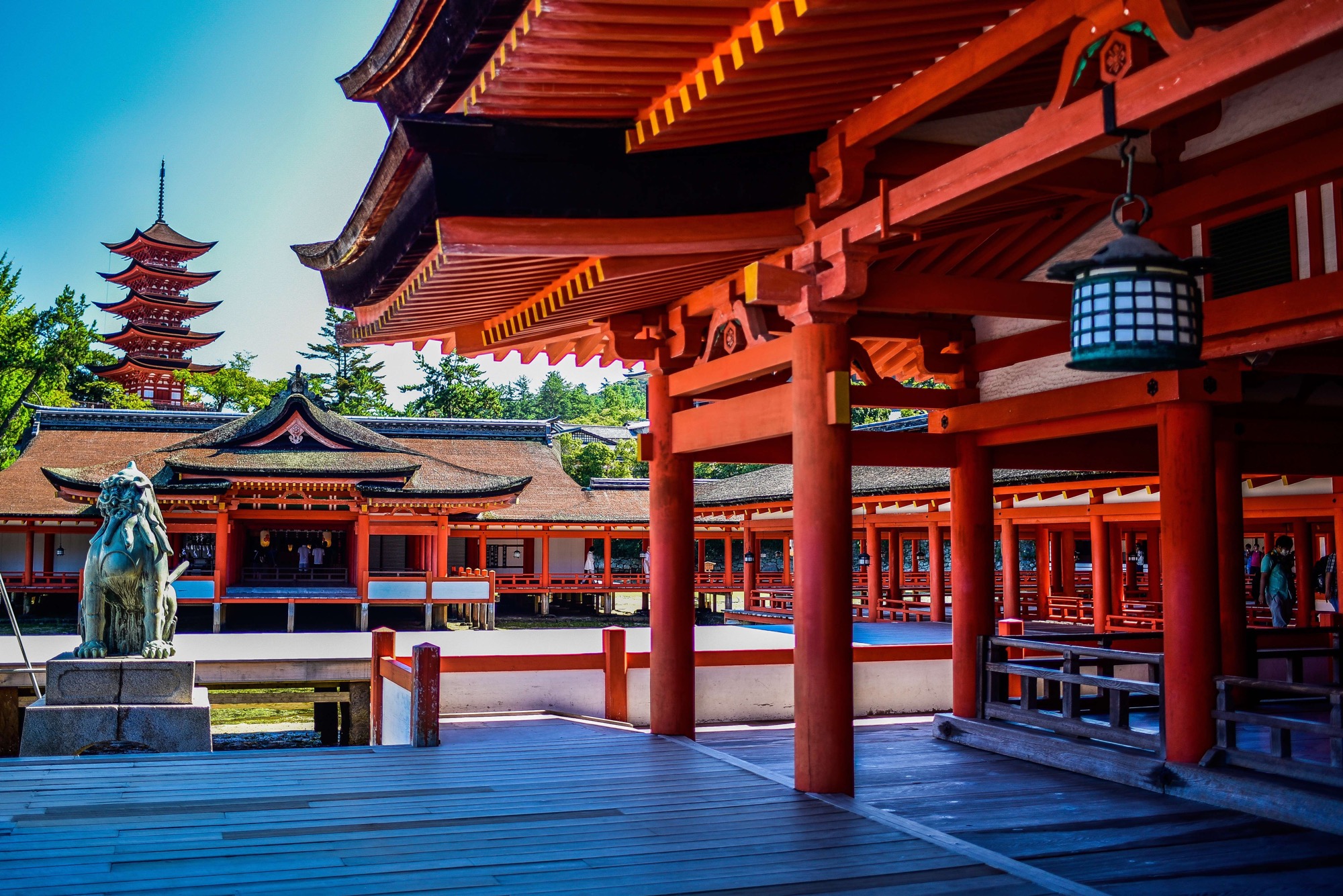
  In the few hundred metres or so it takes us to get to the gate, the famous floating gate that we’re all here to see, the transformation has taken place, we are gap filler compressed in a caulking gun no more. Past stone lanterns nearly five metres high and under the watch of fearsome granite lions that tower overhead we round the head of a small peninsular where intimidating imperiousness meets Bambi to lead our eye to the floating gate of Itsukushima-Jinja shrine. Dating from the 6th century, this shrine exists on piers with the entry gate rising far above the sea out in the bay to greet those arriving by boat as setting foot on this sacred island was forbidden for common folk.

 An eternal flame that has burned for 1200 years still burns high on the sharp mountains above, this very flame was the ceremonial origin of the flame in the peace park in Hiroshima that also persists today. The view atop the mountain is commanding and the walk down takes us past impressive temples, gates, shrines and gardens that blur the lines between wild and cultivated as elegantly as only Japanese design can. The view out to the floating gate is a grand one, one of the top three I am beginning to see less cynical objection to, but notably it’s Miyajima itself that is the real drawcard. So pure that schooling fish teem in open stormwater runoff I’d have little objection to drinking, so low-impact that wild deer graze beside the footpath and find shade at the bus stop like they’re waiting for the 2:20 bus to town, so finely balanced that the pagodas, wide coarse sand paths, bridges and trained trees bring zen garden exactness to natural informality.    

Charlie Winn

Shinto priest in the Miyajima Shinto shrine, near Hiroshima, Japan.

  Making our way around the extensive shrine, the gate that calls us all here remains shadowed by the island too precious to tread foot upon yet keeps catching our eye. With some huge, freshly steamed oysters right from the sea and a beer in hand, the island that feels too perfect to carry our feet slowly bids good night on a sunset and high tide that takes the floating gate from supporting act right into the spotlight. The blazing orange gate is backdropped by mountains crowned by a blazing sky in a scene so grand we immediately feel no conflict with the silly notion of a best view in Japan. Oysters deliver the fresh taste of this pure ocean while occasional squeals pierce the dusk from onlookers surprised by a deer coming in for a close forage for a piece of their octopus cake or bean shortbread. 

 It still feels a little trite to declare anywhere the best view of somewhere or other, but sitting on the foreshore here as the sun dips below the mountains and the ocean glows to lift the blazing orange gate onto a cloud of etherial sea it’s only objection that seems trite. The view is grand yet it’s the sacred island of Miyajima that deserves the accolades, like watching an amazing opera that has the show stolen by a theatre too grand to be outshone. Another hungry deer and another squeal pierces the day that slips to darkness as the stone lamps that line the foreshore ignite and the spotlight shines on the stage. Countless photos have been taken of this scene, this one of three views, and it’s time for us to get the ones that are our own and time for my special talent to come to the fore: no one can erect Charlie’s tripod quite like I can.   

Charlie Winn

Shinto shrine and five tiered pagoda, Miyajima, near Hiroshima, Japan.

  The beer slips down easily and the occasional prod from a friendly deer farewells this day as the glowing gate rises from the darkening sea and onto a cloud, it’s so easy to see why this is called the floating gate. It feels but a moment ago that our thoughts were for home, the weight of experience banking up behind us was forcing us to a finish line a few steps too early. The floating gate is mesmerising and far from a fleeting gimmick, it’s held our eye the whole time here, but it’s this island that contains the magic too pure to walk upon. With careless ease, Miyajima presents a halting hand to 50 weeks of experience pouring forth to draw a deep breath for a final two weeks that only now isn’t just waiting to be squeezed into a gap, but balances the pressure that felt so irresistible. Two weeks now are just as big as the fifty that came before, delivered through the gate of the best view in Japan.  

While you were working – A Crowded Room, Hiroshima, Japan

 Tall stacks of aged red brick reach to the stormy sky, pillars of industry that have stood the test of time endure against the storm. Our post storm adventure takes us to Saijo, the home of sake making in Hiroshima province one day after the storm. A typhoon has hit Hiroshima but instead of delivering its deadly force we were spared the worst, receiving just a heavy shower from the edges of the tempest. After dramas in Peru and walking out unscathed from the Nepal earthquake I confess to feeling a little invincible; I was looking forward to seeing a typhoon batter the world outside our room for a day. But alas, a cloudy sky and sake breweries are what the world has delivered us from a gentle day that invites us outside to play. 

 As with many Japanese cities, Saijo architecture harks from a time that style forgot in the surging push towards development and industrialisation; functional architecture can be such a lenient expression. Drab town or not, it’s time to finally get into some sake, the drink we enjoy but know little about. Apparently the water in Hiroshima prefecture is particularly clean so it’s the right place to draw from natural springs the mother water as it’s called. Rice is ground down to lose the proteins found in the outer parts of the grain to leave a clean polished white core, sometimes losing up to 60% of the rice. From here the precess shares some similarities with beer, the rice is introduced to a culture, yeast and left to ferment, all with tender loving personal care we’re assured by the promo video.  

Charlie Winn

Aged red brick reach to the stormy sky, stacks that signify sake breweries. Saijo, near Hiroshima.

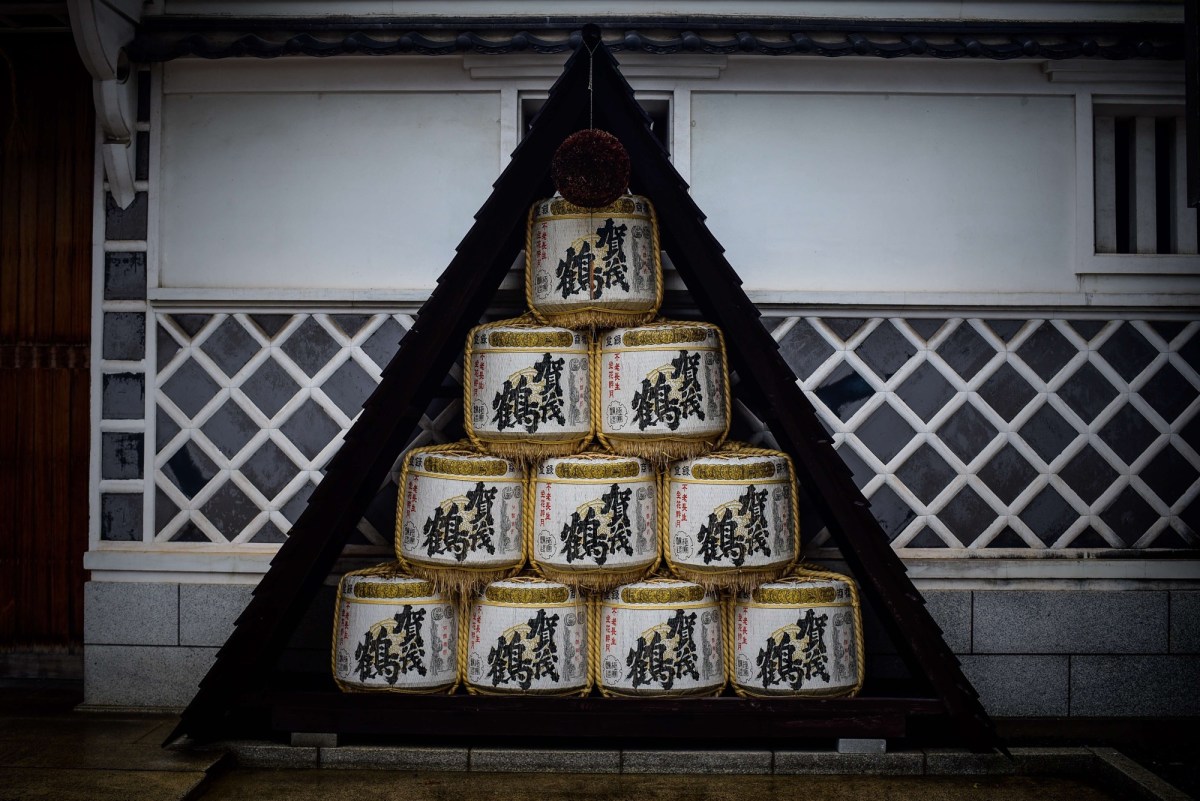
  Like visiting wineries, we walk about town darting into beautifully made up old buildings to taste, learn and get a bit tipsy chasing big balls, great big balls of of cedar needles perched above doors. Traditionally these balls of fresh cedar were placed above doors when the new sake was made; when the arranged cedar wilted from green to brown it served as a sign that the sake had matured and was ready to drink. Everywhere has a dried bunch of cedar today. Through sweet, dry, cleansing and potent tastes we find agreater range than just the gentle alcoholic burst that we know it to be in an education that is only now beginning. The aftermath of the typhoon lingers overhead but with a belly full as we plod untroubled back up the stairs to the train station with our few bottles of sake in tow, cleansed by the pure waters that run off the mountains after the storm that never really happened. 

 There’s water slicked roads below and brooding skies above us in Hiroshima which also dodged the storm but shrinks a little into calm passivity all the same. We’ve found a non smoking cafe, a rare treat in Japan, to indulge in the short term fix of a familiar environment in place of that escapist urge we carried so heavily to the airport upon leaving for this adventure. We’re sitting close enough to touch as we habitually do nowadays, a famed psycho-pop necessity of the human condition, human contact in permanent supply. There’s a world outside this cafe but as always the world feels like just two people: Charlie and I, me and Charlie; a global population of two. I push the foam around in my coffee that’s nearly finished and starts to dry and stick to the sides of the small cup, the coffee and this great adventure alike, similarly drawing to a close to. There’s no need for more coffee. 

Charlie Winn

Breweries also need small shrines to ensure the best sake. Saijo, near Hiroshima.

  Coffee is finished now, I ponder as we walk the many things we sought from this adventure; mostly they were the obvious ideals but some we struggled to place a name to, distraction had wedged us apart a little but we were too distracted to notice. Dinner comes to us as slabs of meat on a timber board just like a Sydney pub meal; and wine, actual red wine, so much more to us now than it actually is as we create a little piece of what feels like home. After a ragged 2010 we planned for years for this escape, this evacuation into the world but more importantly away from lives we now look forward to returning to, a calendar year to wipe clean the cluttered lives for a new version as pure as Hiroshima water. The lives that wait for us at home look similar to the ones we so eagerly left behind but are they the same, or just look the same? After one year and 19 countries we hope to make reality from a grammatical cliche: Australia is just country number 20 on this adventure that lasts much longer than a coffee.

 With a sky that weighs down on the cold grey buildings of Hiroshima like a press squeezing the juice from a half orange, we walk in step closer than when we left home behind. In this city known for the destruction of its former self we tasted the purest of water from a land famous for radioactive fallout, a city possibly more alive than it ever was as disaster played catalyst to rebirth. In just two weeks we’ll return home from this trip for two, on the cusp of evolution from our own minor version of disaster in 2010; we’ve learned to be alone together and in doing so, learned how not to be lonely. This global population of two that already feels like a crowded room is heading home soon from this city of great renewal: to waiting distraction or will life and adventure no longer be opposing ideals? 

While you were working – Fairytale Nightmare, Hiroshima, Japan

 The most amazing thing happened to us this morning, we walked into a building and through a door into a capsule; then voila, we’re in another town. It’s called a train here, the same name as the thing we have at home and although there are similarities the result is oh so different. Trains are all vaguely moist seats, suspicious sticky handles, foul smells from the drunk guy that vomited on the red-eye last night and outdoor voice bogans proudly displaying their horrendous parenting. Oh the joys of trains. These magic capsules though have none of the rustic sense of danger, escaping without a skin disease or reduced faith in humanity is no challenge at all. Oh the humble Japanese calling these wonders ‘trains’, I do hope we get these things in Australia soon; or do we just need to eradicate the bogans? 

    For the sake of ease we’ll take on the local vernacular, good travellers as we are, and call them trains. Flung far across the country in greater comfort than a posh German car we leave Himeji station into blue sky and bright sunlight the likes of which we haven’t see in weeks. A cityscape of typical Japanese style unfolds before us, all orderly cleanliness upholding the linear image of mostly dated buildings to a neat aesthetic that edges close to urban fatigue but escapes with a sense of precision and minimalist retro charm. Down the arrow straight street our eyes are drawn unerringly to what we’ve come here to see, Himeji castle.  

Charlie Winn

Himeji castle from Jõnan-sen, Himeji.

  Like Nagoya castle, Himeji castle calls forth images of the grand powers of the Shoguns from the Edo period with warrior tales clinging to every arched gable and refined art expressed by every reach of trained tree branch. Across an impressive timber bridge and through the impressive gate we approach the impressive ramparts to the gleaming white Himeji castle that makes the term impressive seem rather insipid. I think we just found where fairytales of princesses and brave knights came from, and it’s a long way from Europe. Crowning high stone walls that taper to the sky, Himeji castle feels a little like an overly ornate scale model that instantly popped into life size with it’s impossible overhanging eaves, picture perfect symmetry and gleaming facade that glows like it’s sprinkled with fairy dust. 

 A pathway winds its way up into the castle in very indirect fashion, twisting and turning drawing us in, mouths agape all the while. Up tight staircases and through rooms dripping with dramatic scale timber we poke through small windows at the modern city that sprawls far and wide catching more than the occasional whim of living in a place like this. The child in me wishes more than just once that we could lift this whole castle and plant it into the Blue Mountains of Australia. Six floors of dreamlike escape takes us to the crowning top where the spines of hulking roofs lead our view out to ornate sculptures and a real world far far away. From here we can see the station that we’re soon to go to but for a moment our inner child romps around the room playing noble samurai warrior rescuing the princess, or maybe the prince, but lets not get caught up in details.  

Charlie Winn

The white castle, Himeji.

  Down tight stairways we descend the floors and so we extract ourselves from the fairytale that is Himeji castle. Our world will be dated architecture, concrete and bitumen again soon but for one last glance its timber with centuries of stories and battlements upon which legends were made. Himeji castle is one of few grand castles left in Japan and after centuries of raids, natural disasters and WWII bombing that levelled this city the main keep has remarkably endured. A lack of great disaster or social collapse has kept an unbroken like of skills, knowledge and records making the recent restoration of Himeji castle as accurate as can be; guesswork from grainy old photographs are not necessary here. But fairytales pass, the captured prince remains locked at the top of the keep and I leave with my own prince charming not ruing the rush to reality on the way back down that arrow straight street once again. 

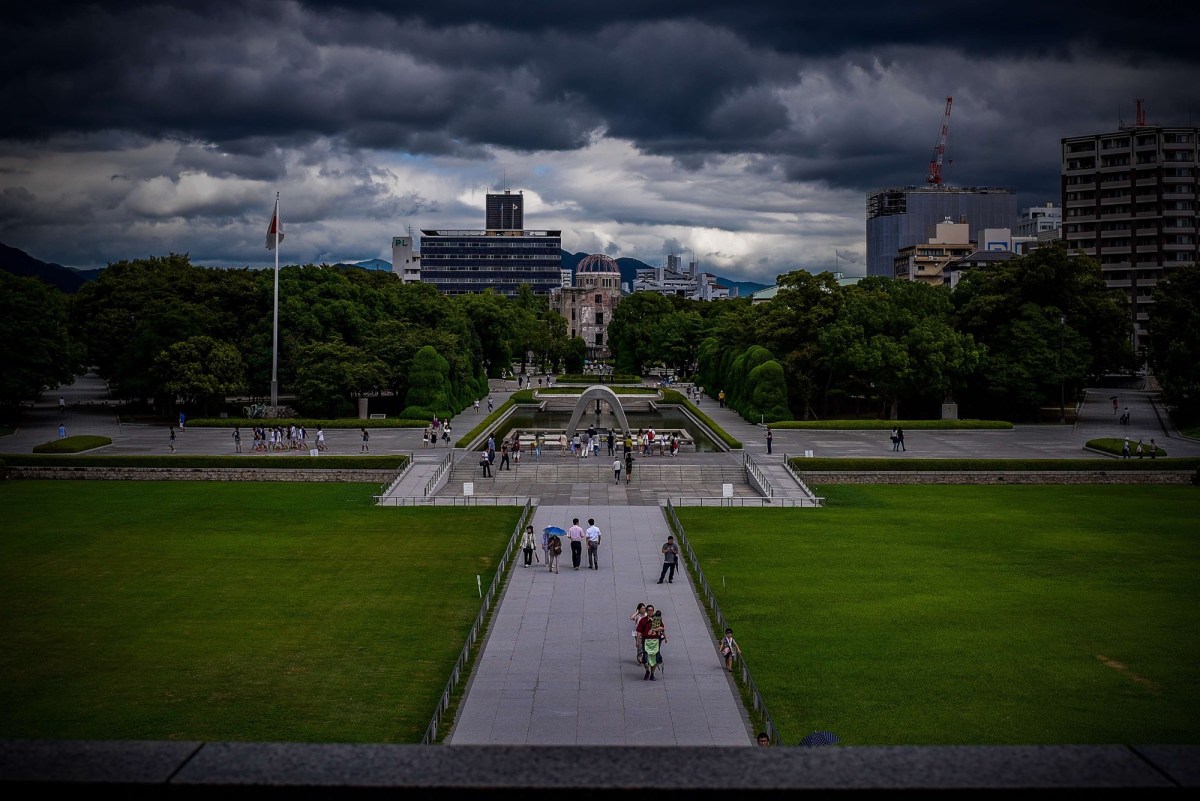
 Back in the magic ‘train’ we shoot towards our final stop for the day still staggered at the way we can zip around this country so easily. From fairytale Himeji we are all too swiftly in an all together different kind of place; the buildings are similar to most other cities we’ve seen but there’s no grand castle full of stories to be found here. No castle but the story is far more famous, for all the wrong reasons. On August 6th, 1945, at 8:15am the otherwise un-noteworthy city of Hiroshima became one of the most well known cities in the world, from obscurity to fame, quite literally in a flash.                      

Charlie Winn

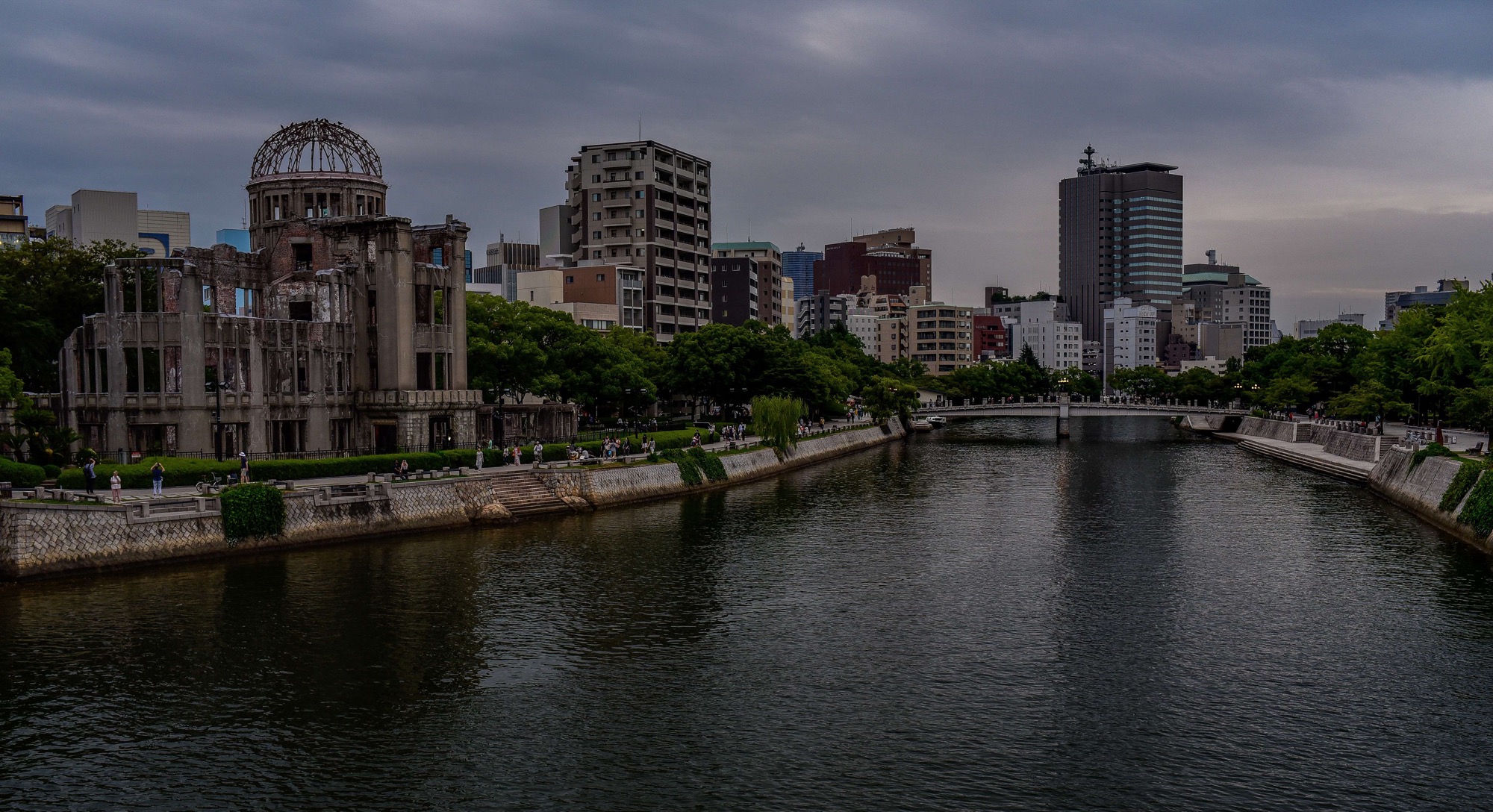
The A-Dome (left) which is a building that survived as you see it from the blast. Everyone inside died instantly. The photo was taken from the bridge which was the target. Hiroshima.

  The story is well known, Japanese military aggression poked the bear in its attack on Pearl Harbour and the bear bit back. The world saw its first ever A-bomb, nicknamed Little Boy, and was never to be the same again. The debate is a complicated one that rings out in school classrooms and bars alike: the human tragedy is undeniable, nor are the atrocities of the great forces of Japan. Did the A-bomb call a swift cessation to world war saving millions of lives or was it belligerent disregard for innocent civilian life by trigger happy faceless men? In Hiroshima peace park there is nothing to be heard of this philosophical roundabout, just a lingering truism that war is everything other than glorious and peace must be the goal for humanity.

 Walking the sombre procession of the Hiroshima Peace Memorial Museum is a somber experience, all the more so that Aki is with me silently downcast at remains of children’s clothing and parts of a cit destroyed; all similarly scorched. A scratchy memory from school tickles my mind of a watch that was found with the hands burnt to the face at 8:15am, the time of the blast. The watch sits here in a glass case, the hands at 8:15am such a powerfully poetic reminder of a moment that changed the world. Much of the information here draws back what I learned at school, it’s not necessarily an eye opener but a slap in the face. Aware of the severity of this place to a Japanese man I wait till we’re outside to venture an enquiry into his take on the events here. Silence for a moment, it’s obviously a hard topic for him, it is for anyone. In his time, the response ‘We don’t hate America, it’s war, just war is unacceptable’. On that elegant note the lingering remnants of Hiroshima are summarised. Hate is not harvested, retribution is not sought and Japan’s own failings are not shied from; peace is the focus that must remain.  

Charlie Winn

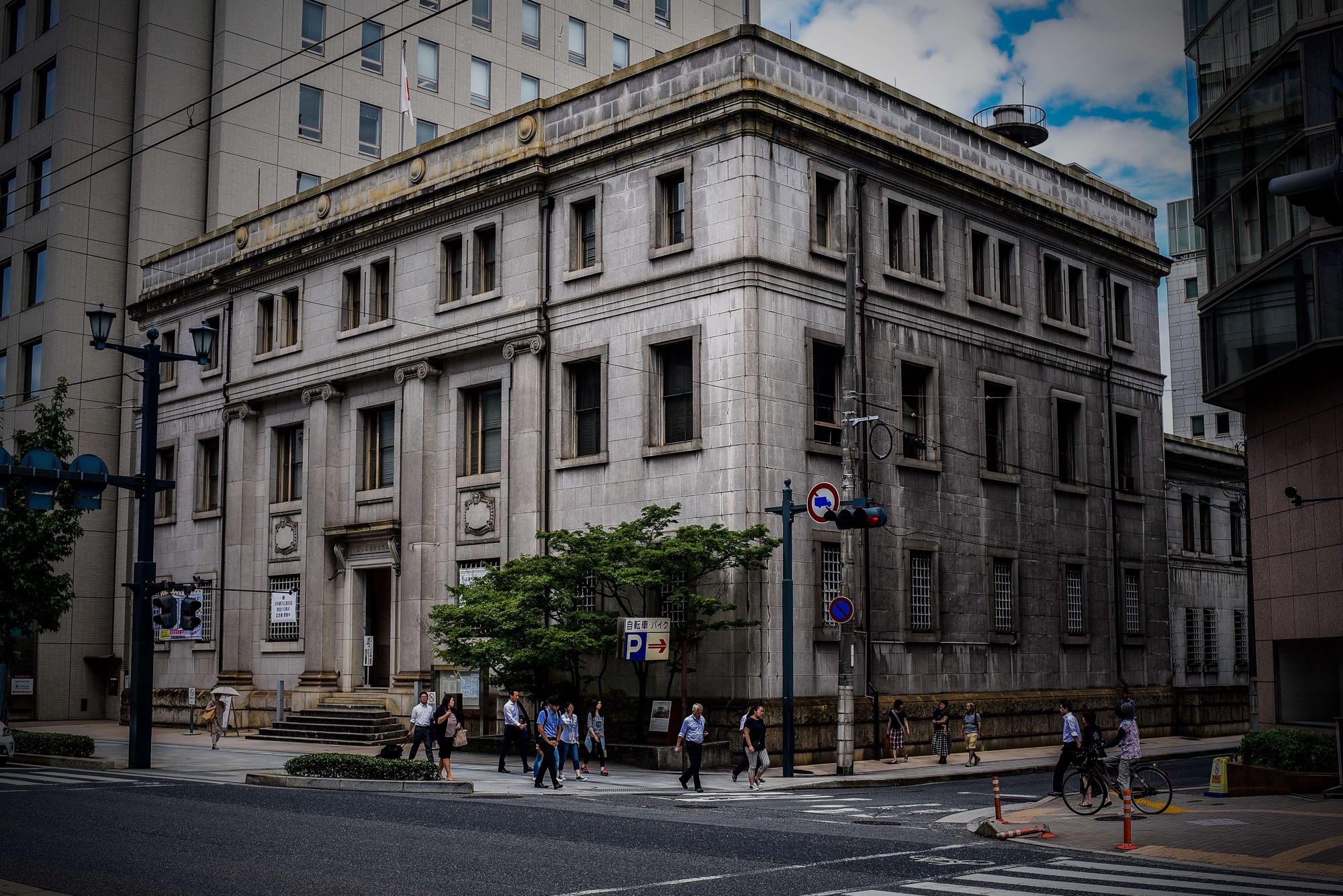
Bank of Japan, Hiroshima branch. The only building within 2km that survived the blast and is now habitable (museum). Hiroshima.

  The flame of peace burns here in this park and will continue to burn until there are no more nuclear weapons in the world; a vain hope it feels like right now but I guess the people of Hiroshima know better than anyone the need to persist in a fight that might seem hopeless at times. Reminders are everywhere here, the now famous A-bomb dome sits alongside the taller buildings of the city that has rebuilt itself again, the skeletal shell one of few structures left standing despite there not being a single survivor from inside the dome that stood up to the bomb. 

 Today we’ve ventured from a fairytale to a nightmare, from Japan’s powerful heights to it’s humble surrender, from past glamour to recent tragedy and present reminder, all on the magic train from the future. Himeji castle and the city of Hiroshima are both powerful images but for very different reasons, when paired with the staggering efficiency of Japanese trains we’re afforded the rare juxtaposition of seeing them virtually on opposite sides of a sliding door. Japan, like all nations, has a great many stories to tell; what’s uniquely Japanese is the unbroken lineage that binds them all together with no historical black holes or blind gaps of guesswork. From whimsical fairytale to heart squeezing horror, Japan is more than the old cliche of four seasons in one day: it’s a bedtime story that became a dream which descended into a nightmare and leaves us confused at a waking moment fighting today to conjure a hope for what tomorrow might be. 

While you were working – Orange Dreams, Osaka, Japan

 Our feet with the rubber thongs that carry too many rough traveller credits pad a little out of place on the wide paved footpath of Osaka’s central business area. Charlie’s green T-shirt has that little rip near the tag that is getting wider and wider by the country but it’s so warm at altitude while mine could do with a wash but we spin it out for just one more day; as we did yesterday. We do have fresh haircuts though that stare back at us in the reflection of the sparkling windows of the Mclaren showroom, the gaudy orange machine that costs more than our combined budget for this entire adventure sits mocking us with it’s opulence as our freedom mocks it in sharp rebuttal. 

 As if on cue, a growling Maserati of similar showy excess flexes down the road behind us leaving no mistake that in this part of Osaka, money is mana. In many ways this fiscal theme park acts as an elegant symbol for our adventure, all around us glamorous fashion stores sell dreams with no chance of evolving beyond hope while their windows reflect those holding dear to the dream after the hope has long since faded. Irony is such a clever devil at times, financial liberty has gifted us the good fortune to take this trip, a dream we turned into reality; yet we sit so out of place here among the sparkling excess that looks down at us for grasping the dream it sells. No one looks accusingly at us, it’s the place, not the people. Another time might draw a self conscious fixing of attire but not now, the bright orange Mclaren exists no more, just a mirror mirror on a wall: who’s the most fortunate of them all? 

Charlie Winn

Amerika-Mura area of Osaka, Japan.

  Maybe Osaka is a one-trick cesspit of social climbers in couture, then again maybe we turn a corner and our cheap rubber clad feet are grasping uneven pavement like unlikely mountain goats once more. In the time it takes to muse about the wonder of having our own bed at home, we’re back in our natural habitat and charading to a local cafe about how to make a piccolo from our vintage timber camping chairs on the road of a small laneway. Amerika-Mura sits just a street or two away from the vodka-colonic day spa of the business area exploding with haphazard neon and counter culture chic. A whimsical dress sits draped over a mannequin opposite us, not behind glass but on the street just like these chairs, so real; a dream so close, so touchable, a dream destined to be loved intensely for a time then discarded for another.   

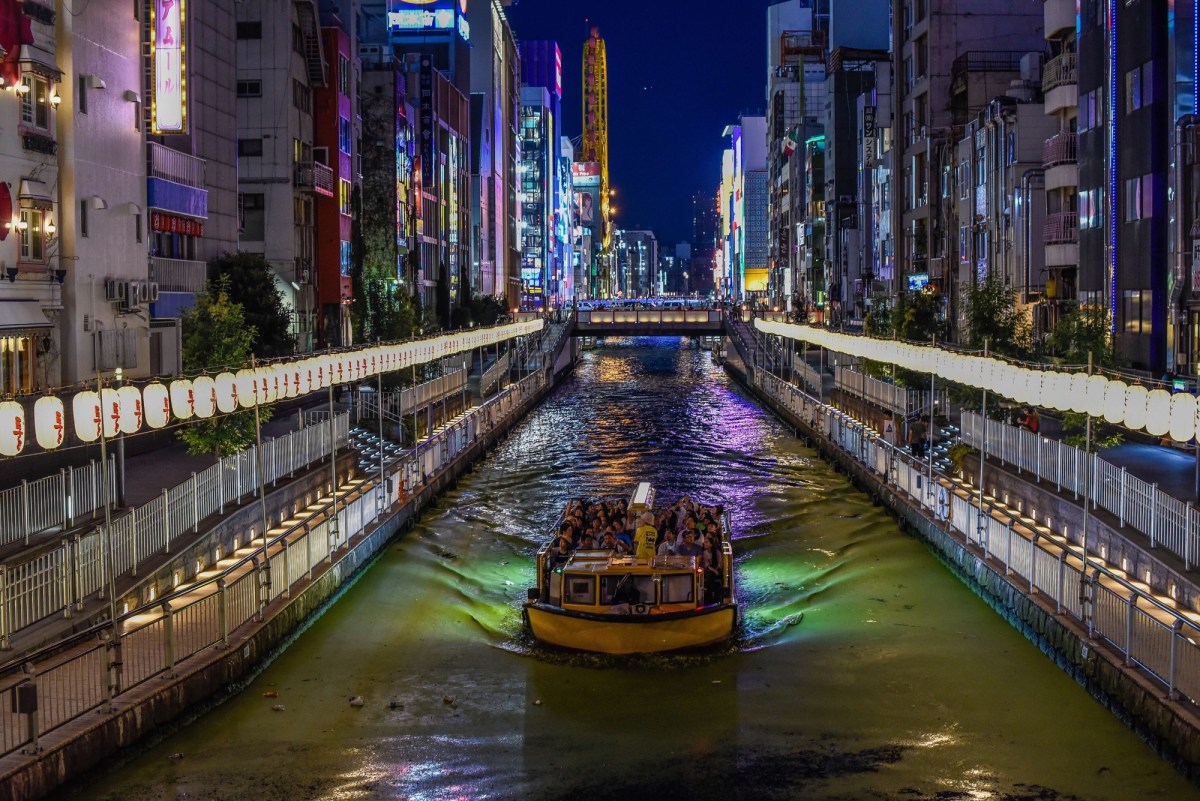
 Through tight streets past more than just the occasional suspicious looking character, our feet carry us to the canal carved banks of the Dotonborigawa river that slices through this city of many faces. Far from the out of sight stormwater of many city rivers, a procession of paper lamps line the waterway as a prelude to the tall buildings that encroach in towering cliffs of blinking light on this canal that has no night or day, just different kinds of bright. Through pumping crowds we forge our way to a bridge to join the pumping crowd gathering for a concert of sorts on the banks of the river, thrusting glow-sticks into the air seemingly not noticing that in this world of fluorescent light there’s little point in waving a glow-stick. The words are Japanese but the songs are ones we know. We sing out loud the anthem from the musical Annie, thinking little of the songs lament, only our ever so soon adventure back home: ‘Tomorrow, tomorrow, I love ya, tomorrow: You’re only a day away’.   

Charlie Winn

Colourful facades of Doutonbori St, Osaka.

  Through the throngs of Doutonbori street, a jam packed pedestrian street that feels more like a festival crowd, we push forward thinking of that plane ride home and the next country that feels more like an escalation of an adventure than the finish of one. Escaping the hubbub, we dart down a tight alleyway under a gate boasting a heavy timber sign we can’t read into a lamp lit cobbled alleyway to somewhere. Past small shopfronts all displaying the now typical Japanese aesthetic of discrete obscurity, we can’t see in and we don’t know what they sell or do; the effect so opposed to the crystal clear facades of the business area and far more effective. We want to go into each one but we settle for the wonders of this quiet escape just metres away from Doutonbori street that feels like a new city entirely. We share this new world not with the crowds but the clan of old men sipping drinks on an outdoor table in a small nook of this old world tucked away beside the new.

 Over the pavement of the chic business area, bitumen of trendy Amerika-Mura, the promenade of the flashing Dotonborigawa, through the crush of Doutonbori street and beyond the cobbles of the little lane that feels like ours alone, our rubbered feet have carried us, as they have all year. There was a time we might shy away from these discrete shopfronts so intimidatingly alluring, but not now; there comes a time for food and the wolf has returned to the door after the octopus dumplings from Doutonbori street. We press our bodies to the back wall and squeeze past the six or so other customers to make our way to the back of the bar now full for beer and our hosts suggestions of grilled something or other on a stick. 

Charlie Winn

Lamplit cobble stone back alley ways of Osaka.

  We’re only passing through Osaka, one night before we return in a few days, one night to scout out and taste this city known for food. On this one walk around this city our feet have carried us, as they have this whole trip, over thresholds into different places to so elegantly exemplify a summed up narrative to this adventure. We had cast off the luxury and trappings of money that we had and handed back the car keys and nicer clothes to abandon fashion and use our feet as we so rarely do anymore. Glamour, counter culture, dazzling cities, excitement, old time charm and braving new boundaries that seemed so daunting to eat all the while sounds like a tag line for this adventure; it’s also a tagline for Osaka. 

 Once we were trapped staring through the glass at that dream of orange metal that could never be real, a dream that perpetuated only more dreams. We stared, we dreamt until one day we caught the reflection in the glass that showed up the nightmare of a false dream chased with too much vigour. We were living the other side of the glass but remained trapped in the wide open world unable to remove ourselves from that glass, wishing so desperately to be trapped inside with the orange machine; my favourite colour. There was a time, we both remember it well, a conversation over expensive wine in expensive glasses where we decided to look at the reflection in the window instead of beyond it and the sight frightened us. We decided to leave the expensive wine in it’s expensive glass untouched on the table, trade the fine leather shoes for cheap rubber and listen to that mirror mirror on the wall. We stole our dreams back from the orange machine and stopped waiting for the answer from the mirror, we decided to be the most fortunate of them all to simply turn around, and start walking. 

Gluttony Expedition – Standards, Tado, Japan

It’s all very confusing this Japan thing, technology and culture just don’t get along, plastic single serve packaging rarely has anything to do with the warm fuzzy textures that make us human. Rounding the bend at the top of an informal cobbled pathway to the main street of Tsumago is one of those places that makes the old and new contradiction that much simpler; simpler because there’s very little of the new to do any contradicting. A slight slope leads down the bendy road that calls from a time before heavy earth moving became simple and disappears behind a quaint dark timber building and before a stone wall that is anything but perfect; or is it? The road is too narrow for cars, it wasn’t built for cars and the timber and white panel buildings open up closely to a street front dappled with micro gardens and water channels. Town planning as we know it is yet to visit Tsumago; lets hope it never does.

Originally Tsumago was a staging point for travelling dignitaries and people of influence, a rest stop of sorts. Walking this wending road lined with sweet stalls, tea houses and noodle shops it’s so easy to imagine common folk scurrying into buildings from the street, ahead of a grand samurai procession while innkeepers feverishly wipe down their best tables. Caught in the moment, walking must wait, we veer behind the discrete screens of a tea house to remove our shoes and sit cross legged on tatami mats for some tea. Set beside the timber slatted window the feeling of romance is only heightened, how many eager faces have peered from this window at elaborate characters carried in palanquins or sitting atop horse drawn carriages to catch a glimpse of yesteryear celebrity?

Charlie Winn

Water wheel, Tsumago, Japan.

Tea goes with rice gluten sweets before it’s back out to the 18th century and a walk into the mist shrouded nearby mountains. Walking just seems far too hard, much better to have noodles in rich broth and grilled rice cake lathered in miso and sesame sauce. Loaded up with local delicacies we must end this procrastination, time to walk. Nearby Magome lies at the other end of a mountain pass but we aren’t aiming that far today, just a short venture into the wild and back again, right after some window shopping and a stop off to the town temple. Eventually the quaint, historically accurate houses become sparse but the old time lifestyle remains thick in the air. Rice fields tended by hand sit aside paths notable only for their foot traffic wear and a blessed lack of safety signage; we’ve walked from the 18th century town right into a countryside without a change of date.

The fight against sweating like pigs was given up some time ago in the humid air but there’s a very real risk of fatigue so it’s vital that we turn back. With blood sugar levels threatening to become normal we scoff down one chestnut and one eggplant dumpling with Japanese tea to much bowing and thanks before walking right back in time with an ice cream that we’re just pretending was popular three hundred years ago. This ancient romance plays such a role in making Japan what it is today and so some delicate timber spoons just like we ate our noodles with make for our first Japanese souvenirs.

Charlie Winn

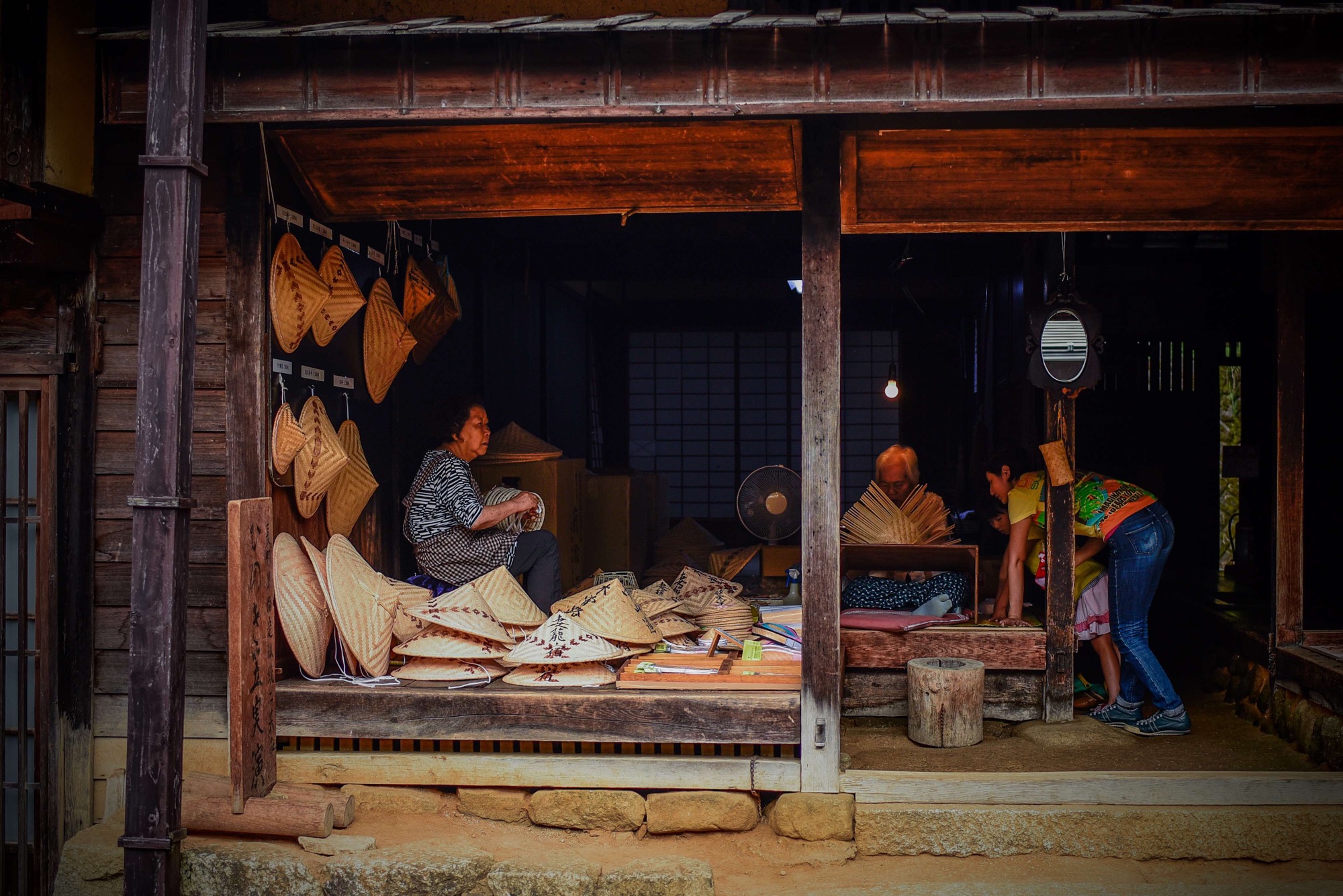
Older ladies, making and selling hats and other woven articles, Tsumago, Japan.

Pulled forward in time we now know how Marty McFly felt in the retro movie ‘Back To The Future’. It’s not the blazing lights of Tokyo but back in Kuwana has us Surrounded by all flavours of automated, motion sensored, hands free technology. We poke at random Japanese characters on the menu at the Yakitori bar and sip our beers, these little skewers and beer are a match made in heaven that those of the 18th century sadly missed out on. First cab off the blind guess rank, chicken sashimi. Yes, that’s right, a loin of chicken meat, entirely raw is sliced up and laid out on a bed of fine cabbage; I’d heard of this but was expecting some time to prepare myself before tasting it. Oddly enough it’s softer than a lot of fish and delicately flavoured making it far less confronting than we expected. A procession of chicken skin, fatty pork, eggs, meat of some other flavour and a big omelet type thing brings us to Aki walking in the door to pick us up.

We pull the handles of the compact car that feels like an oversized roller skate for the doors to open electronically to sit down to the console TV that Aki assures us is all very standard. This car of the future that looks like a very standard ‘small car’ brings us to Aki’s immaculate house, and more notably, his amazing bathroom. Enter the room and the light comes on, the motion sensor also activating the toilet lid to lift up automatically. If you’re after relieving number one’s, just press the button and the seat rises like magic with a soft green light to highlight the water as a tricky style feature. If it’s a number two long haul, water jets like dandelion kisses with variable pressure, heat and even aim are all at the touch of a button away. Of course flushing automatically prompts the hand washing tap on top of the cistern and when you leave the little ghosts return everything to normal as soon as you exit the room. Apparently this is all very standard too.

Charlie Winn

Tending the almost ready for harvest rice crop, Tsumago, Japan.

From an old time fable peering through the windows at the great Shoguns of the Edo era, a train ride plonks us into the high tech world borne of the Meiji restoration where Japan began to overlap development with tradition. More than anywhere else we’ve seen, Japan seems to retain, celebrate and enjoy history and culture without proclaiming culture to have only existed at one point in time. Yes societies can learn and change without abandoning culture, but so often we see culture as only existing in the past; any culture we call genuine anyway. From Tsumago time-warp to Tado tech-toilet time it seems that culture is not just the retention of an age old time, It can exist in the now, with the now. We don’t have to practice it all day, every day, the key element that Japan seems to understand so well is that culture is valid as long as you understand it and apportion value to it. Apparently this sophisticated understanding of history and culture is all very standard, if you have the right standards.


While you were working – Counting the Cost, Tado, Japan

 There’s a definite food hangover in Aki’s house, a hectic few days of hiking, eating and sightseeing has us sitting in the lounge room in front of the biggest TV I’ve ever watched to gorge on fat toast slices with ham and egg. We were going to do a short hike today but six sore legs have had their way so it’s a lazy sleep in and time to crack out some Vietnamese coffee. In the phins (Vietnamese coffee brewing apparatus) that Tung bought us in Hanoi as a souvenir, we brew up the potent syrup that makes the light Japanese coffee seem like nothing but water. Strong coffee, how we’ve missed you. 

 As glorious as a sleep in with strong coffee is, we can’t go a day in Japan without a train, it’s off to meet up with Ken and venture to Nagoya castle for sightseeing that doubles as a history lesson. Immense walls reminiscent of the imperial palace in Tokyo greet us under masses of green overgrowth as this grand moat and castle fights its way back to a former glory not seen since the Edo period that concluded in 1868. Modern restoration is under way, as much of an acknowledgement to carpentry as it is to the historical importance of this castle, one of few in Japan still in existence after a great many castles were bombed or burned down in the final stages of WWII. 

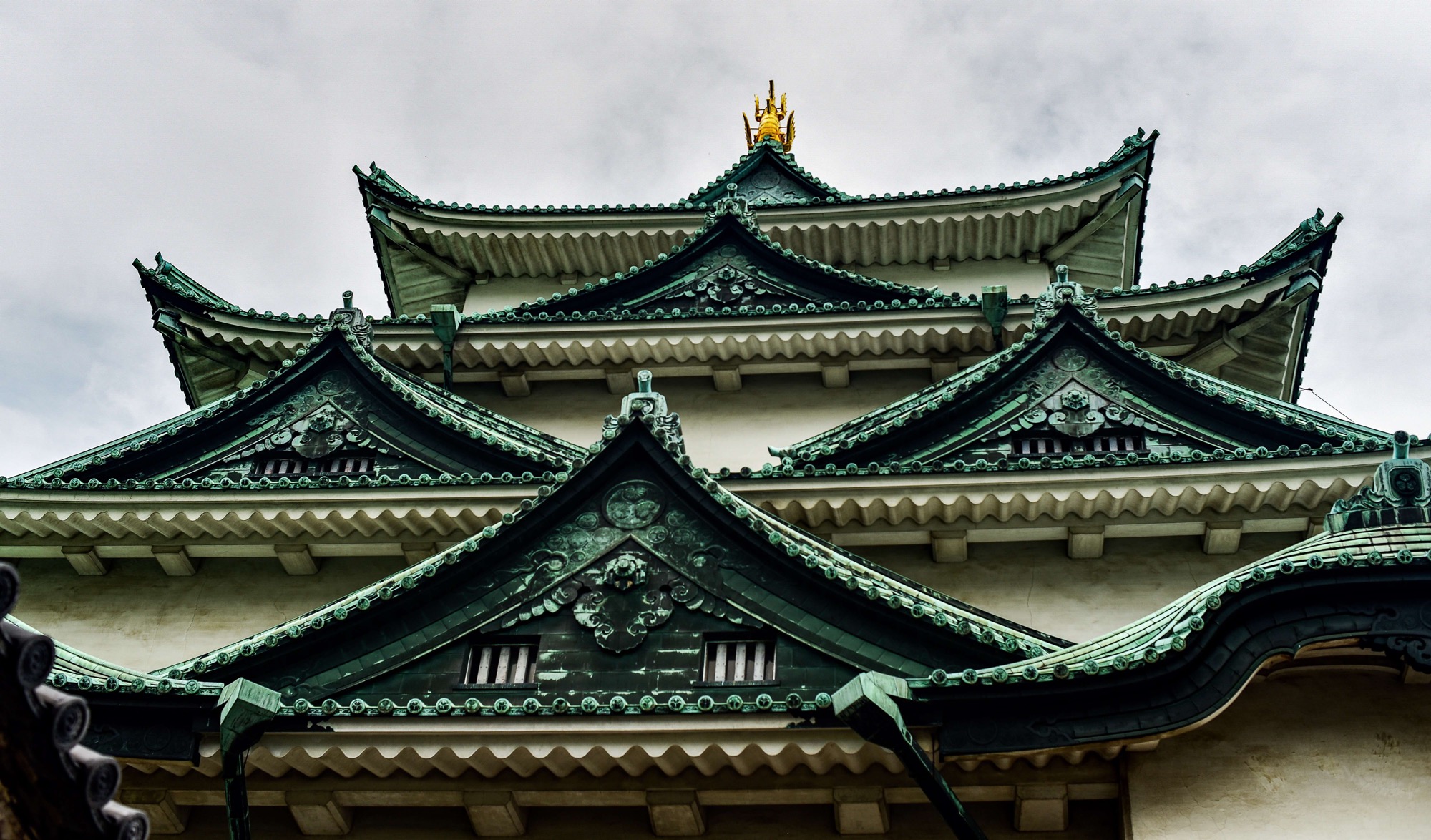
 Like castles anywhere, Nagoya castle not only housed the powerful but promoted their position, these elegantly arched roofs were once adorned with enormous dolphins of solid gold; even though the dolphins look more like goldfish. The power behind this castle was none other than the Tokugawa clan that ruled Japan in the Edo period of 1603-1868, a period of isolationist foreign policy, great wealth and a proliferation of art and culture. Through a tourists eyes, it seems that much of the beauty that we see in Japan today was born, fostered and refined in this period; powerful, influential, cultural and prosperous, the Tokugawa clan no doubt shaped Japan as we see it today. I assume terms like ruthless and aggressive also describe the Tokugawa’s but in a closed nation the rulers make the history; these terms are not to be seen. Standing in the upper floor of the commanding main tower the realm of the Tokugawa seems to stretch forever, beyond the moats now choked with weeds to an empire drawing back to this castle all the riches from as far as the eye can see. 

Charlie Winn

Facade of Nagoya castle, Nagoya, Japan.

  Immense power is never immense enough on its own, the Edo period came to a surprising close in a series of events called the Meiji restoration; or revolution, depending on who you ask. Falling behind the development of European powers, Japan was a traditional land not keeping up with the times and after American Commodore Perry sailed to Japan with warships laden with new technology the turning tide gained pace. Emperor Meiji, Meiji meaning enlightened rule, politically manoeuvred the Tokugawa’s out of power with an alarming lack of bloodshed leading to the then Shogun of the Tokugawa clan, Yoshinubu, to officially ‘put his prerogatives at the emperors disposal’. Through the entire Edo period there had always been an emperor in Japan but it had been little more than a title, from 1868 the emperor was truly in power and Japan was open for business. 

 Through the Meiji period, from 1860-1912, Japan industrialised and progressed into a modern nation with a blossoming economy to embrace a world of open trade. Due to the relatively peaceful transition from the Tokugawa clan to the Emperor, Japans rich culture and arts from the Edo period were blended with the new to take the first steps of the nation as we see it today. Of course it wasn’t all plain sailing, the samurai class had lost their power through the Meiji restoration and numbering more than ten times the french aristocracy in 1789 before the French revolution they were not to be cast down so easily. Oh, and they were samurai, not powdered toffs in fluer-de-lys embroidered gowns. And so the power ebbed and flowed with the new tide rising high. Japan, as we all know, was becoming a military force to be reckoned with in the early 20th century and the samurai swords were finally put back into their sheaths in favour of guns, planes and ships. 

 Civil war, change from feudal warlords to dictatorial government, isolation from the world through to industrialisation of a traditional culture; this sounds like the disaster that was/ is China. But it’s not, it’s Japan. In comparison to the train wreck that was a few centuries of China, the Japanese launch into the world seems relatively peaceful, bloodless; even contrite. Temples, art, books and cultural pursuits weren’t cast down or demonised, the population weren’t ritually tortured into oppressive mental degradation; instead a rich and refined culture became high tech while keeping hold of its traditions; Hello Kitty met Zen gardens and they got along famously. It’s nearly enough to make one weep to think of what has been lost from China, arguably the one ancient culture to better Japan for it’s art, history and creativity, now largely lost forever. 

Charlie Winn

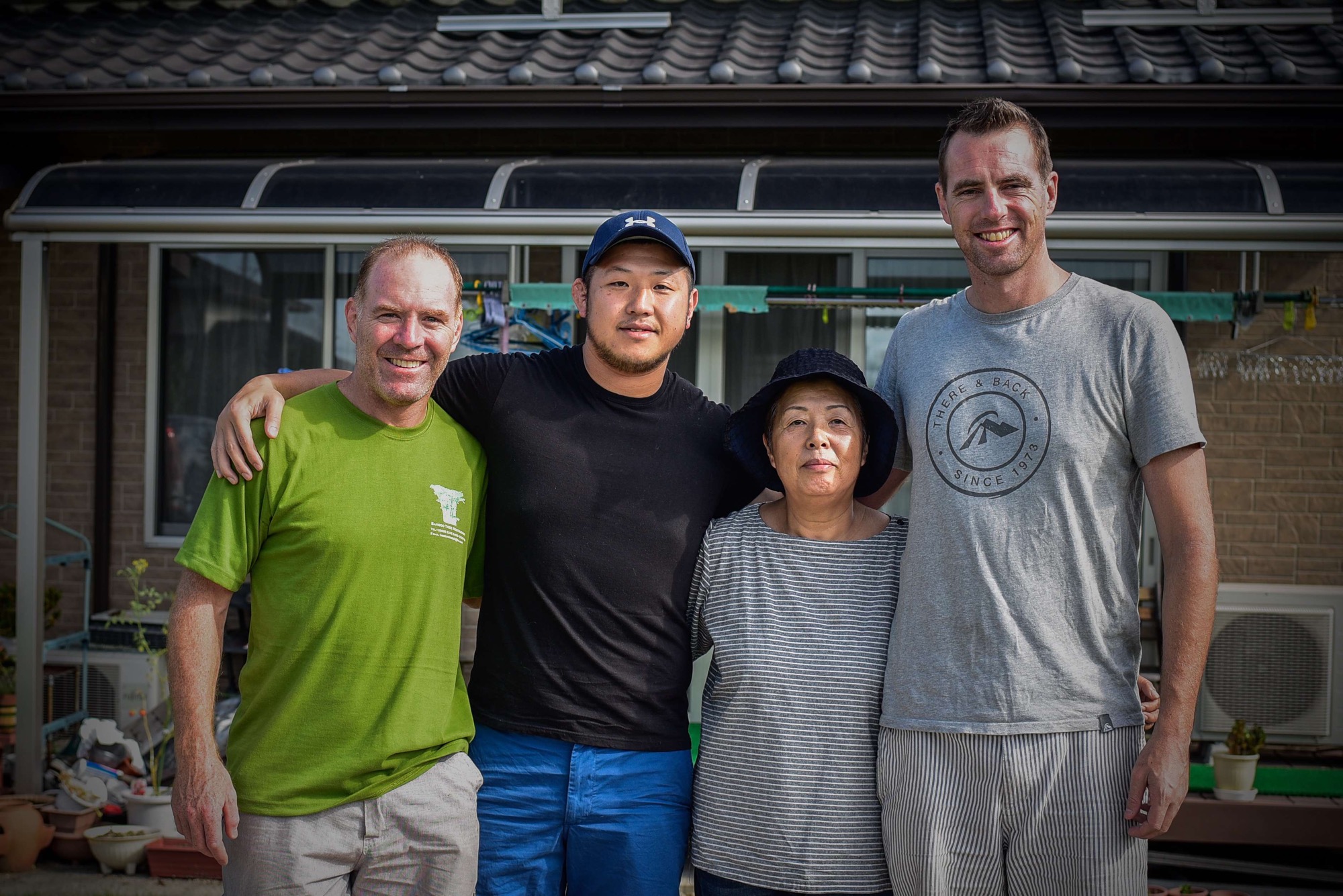
Charlie, Aki, Aki’s mum Mrs Mizutani and Steve outside the Mizutani house, near Kuwana, Japan.

  From the heights of Nagoya castle to, ironically, the little Chinese restaurant in Aki’s hometown, we’re tucking into a delicious meal hearing how Aki would like to move back to Japan one day; it seems you can take the boy out of Japan but not Japan from the man. It’s understandable why, the reasons are all around us. We chat also about why he moved, he saved for years because he heard of a rugby team that was open to gay players, a dream only in those times to a man in Tado town. From small town conservative Japan he caught a plane on a whim toward a dream after sending an email into the world wide web. Funnily enough, I was the one to get that email, on a Monday at my desk in Artarmon, Sydney: hating my job; I can still remember it. ‘My name is Aki, I want to play rugby for Convicts, I play prop’. Wasting words has never been his thing. An email Monday, a plane Tuesday, Training Thursday led to his first game on Saturday to complete a flight into the unknown of epic proportions.

 So why the flight from this perfect culture by this very Japanese man? The answer takes little guessing, conservative Japan isn’t a great place to be gay, or more accurately, different. To be fair, Japan is far from the worst offender in the world and it’s not only a gay issue, suicide rates are wildly inflated from a wide range of demographics that don’t fit into the perfect progression of a perfect nation that demands perfection. Japan is moderate, but not moderate enough to prevent a man from leaving his family, his culture, his life to chase the trail of an email sent to a frustrated employee on the other side of the world, someone he’d never met but would grow to know so well. Japan’s recent history is underpinned by relatively smooth progress and change; relatively smooth, but not smooth enough not to have a few casualties along the way. Conservatism the world over is defined by ignorance to difference, and the world over it comes at a cost. It’s a cost of lost or abandoned lives for perfection only visible if you don’t look too hard; ignorance expending difference to buy perfection for the ignorant.


Gluttony Expedition – Defining Beauty, Tado, Japan

 The band is back together, Ken doll is joining us and Aki who’s name henceforth is Barbie, for a day trip to Ise and the grandest, most important Shinto shrine in Japan, Ise Jingu. With amazing grace and beauty preserved in Japan at every turn it can be hard to know exactly where to look, this type of sightseeing is often somewhat mundane in other countries but with the sharp edge of design and grace that is Japanese culture on display, sightseeing is all that’s required. And lets face it, after two days of Fuji San kicking our ass the adrenaline can take a break; we’ll take pretty things and yearn for nothing more for just one day. 

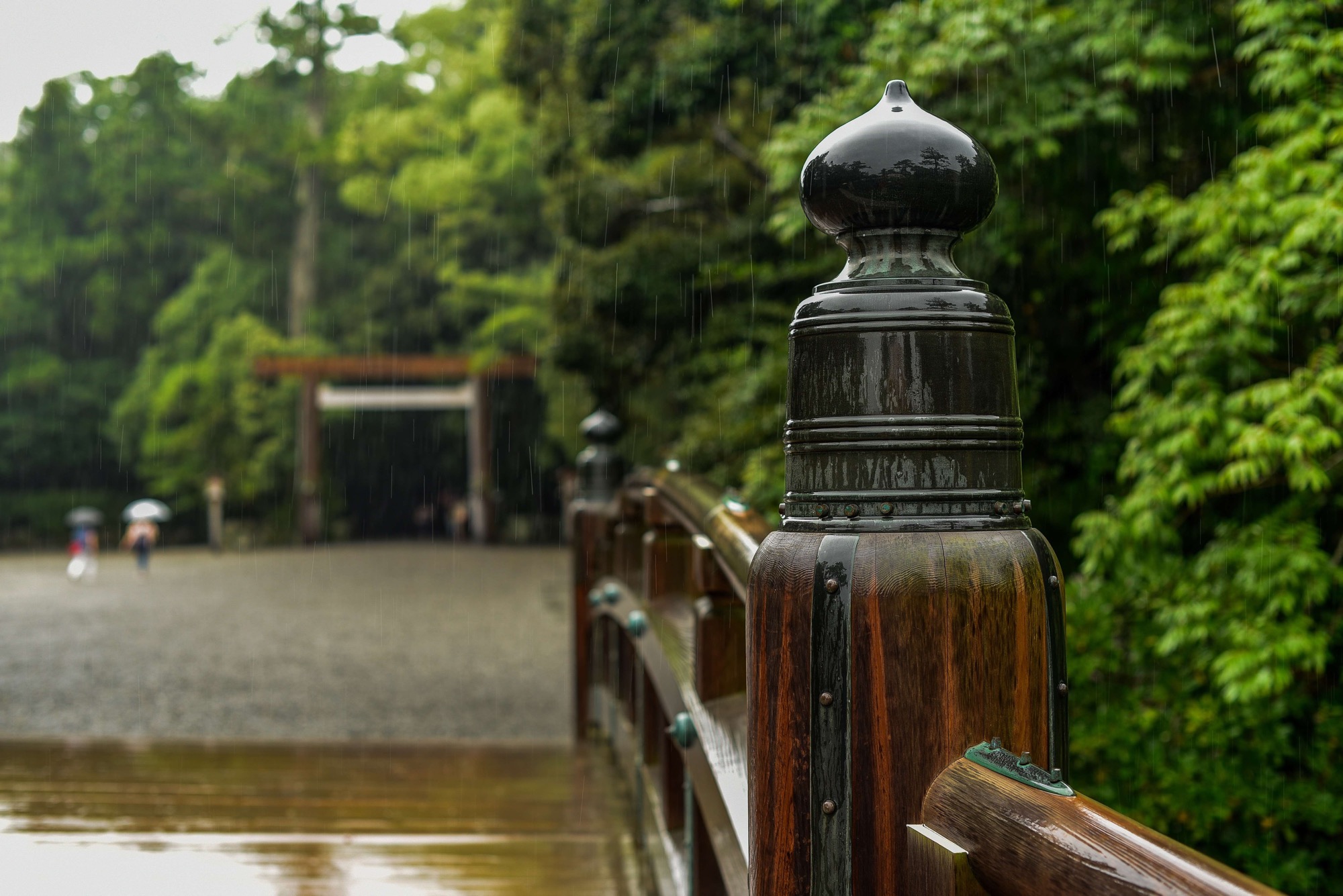
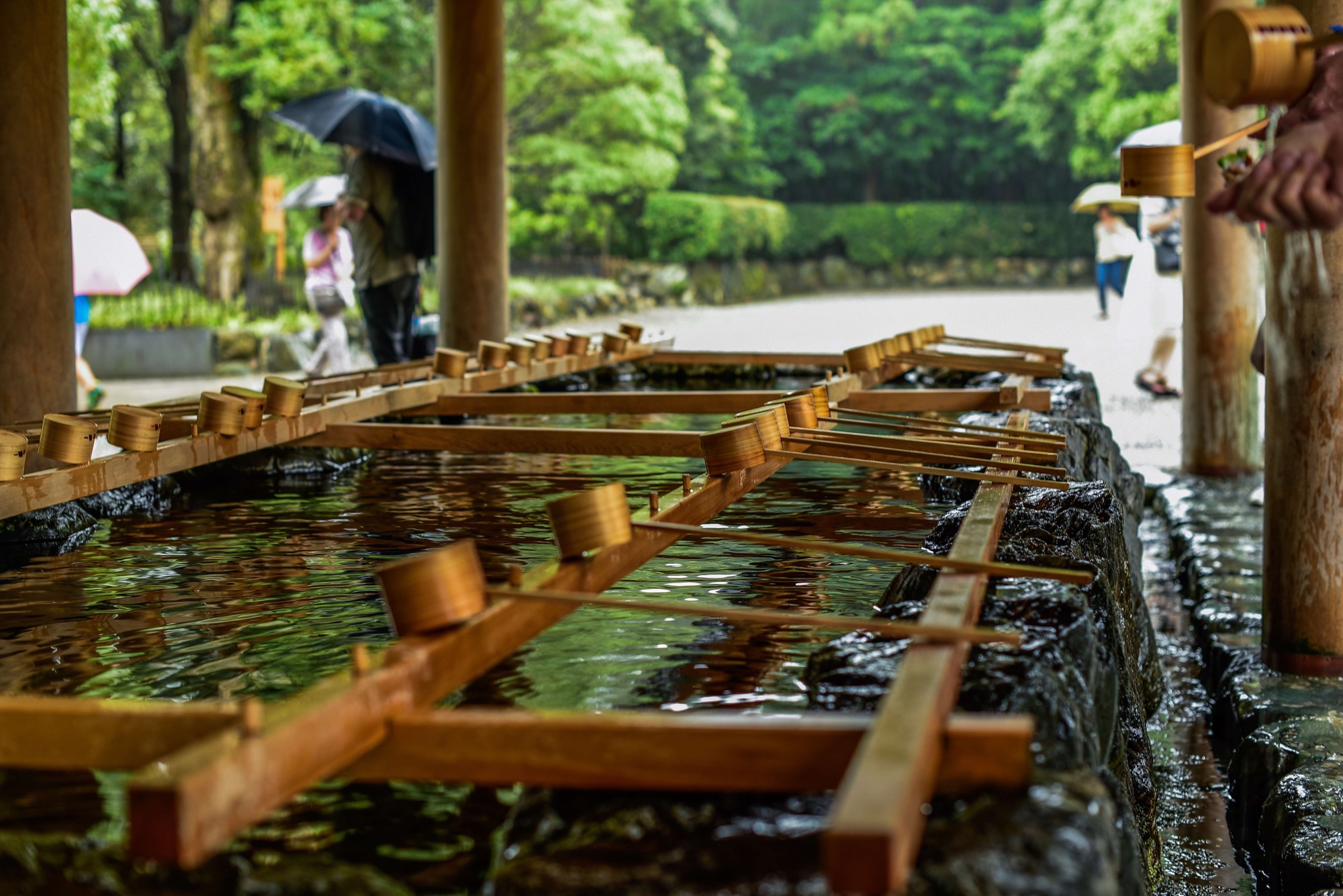
 Covering Japan is a breeze given the phenomenon that is Japan Rail, in a blink of time Ken and Aki are power walking towards the towering gates of Geku, it seems Ise Jingu isn’t just one temple. At the gates we’re pulled up short for our first culture lesson from Aki; at Shinto shrines you bow before passing through and never pass through the centre of the gate, only to the sides as if humbly sticking to the outer lanes. Through the main gate and over the timber bridge that demands a stop to just stand upon craftsmanship that can’t be overstated we’re at the wash pool. Japan does gates and bridges gloriously and standing at the raw yet refined arrangement of bamboo ladles atop the stone well it appears that wash basins are on the list of refined beauty too. 

Charlie Winn

Bridge towards Geku Shinto shrine, Ise, Japan.

  Time for culture lesson number two. Taking the small bamboo ladle we run some purifying water over the left hand, then the right, before washing our mouths and running water back down the handle to wash the handle clean. We’re now cleansed and ready to enter the shrine. For a non believer these rituals often run perilously close to childish patronisation but in the midst of craftsmanship and beauty it’s so easy to adopt what seems indulgent and take it as it is. I can’t say I have a sense of spiritual cleansing but the cool water, the beautiful well in these immaculate grounds and the process enjoyed by all does leave us feeling a little less like gawking tourists. On to the next gate with a bow. 

 Lets just keep adding to this beautiful stuff list shall we, Japan does carpentry and Japan can certainly do a roof. Shinto shrines are rebuilt every 20 years using only traditional methods; no nails or screws, just dowelling and joinery to fill the world with the delicate smell of cypress. Immaculate timber sits in perfect array, topped by ornate roofs that arch outward before rolling over at the nose, topped, trimmed and adorned by strong yet elegant detail. We bow twice, clap twice and bow once at the shrine before leaving not really understanding anything of what we just did but happy to be part of a gracious place that’s hard to define beyond just saying that it’s beautiful.  

Charlie Winn

Cleansing well, Geku shrine, Ise, Japan.

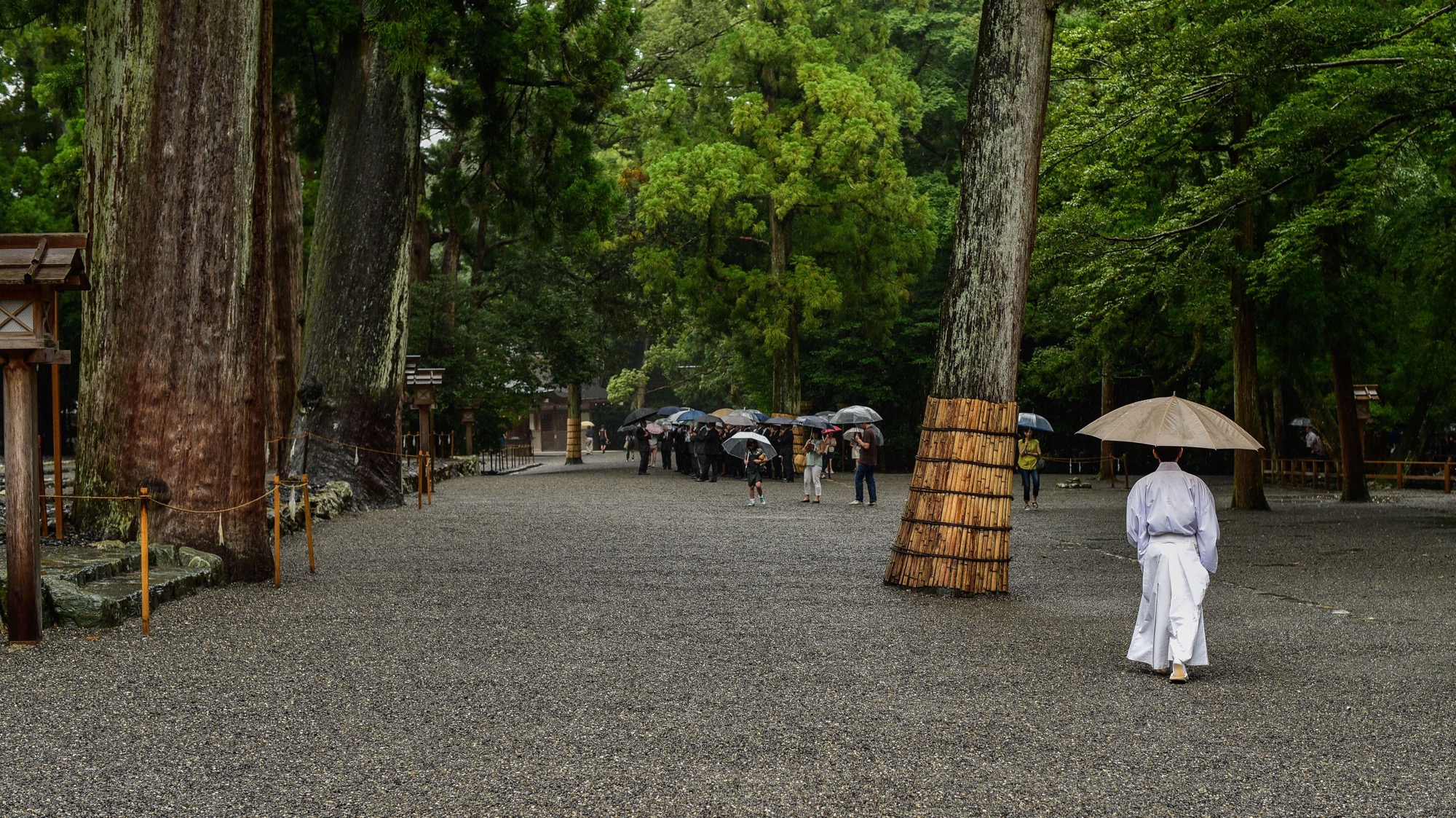
  Next stop Naiku, the inner shrine here dates from the 3rd century and houses the sun goddess, the ancestral goddess of the imperial family so funnily enough it’s bigger. The elegant bridge that captivated us feels like a kids toy now, a timber bridge of similar craftsmanship yet spanning a river about 30m across arcs elegantly over the river as we bow and walk to the sides of the gates like seasoned pro’s. This list is getting longer, lawns, gardens and grand stone staircases just seem to be a Japanese thing now along with trees that reach arrow straight to the sky. Trees are revered here with people seemingly praying to them all around, it’s believed that a god lives in each tree, god woods literally. If only more of the world held that irrational yet beautiful belief. 

 Beautiful, beautiful beautiful; it’s all just offensively perfect as we pass across the best bridge ever made and into Ise town. Are we on a movie set? a tight winding street pans out before us lined by traditional style buildings, all linear dark timber and white washed panels to rip us back a century or two. Let the food fest begin. A small lap through a tiny store sees us downing some smoked fish samples straight off the grill before it’s noodle time. Plump fat udon noodles swim in a bowl of soy and miso sauce topped with a massive tempura prawn to add crunch to the soft silkiness of the noodles. Of course rice gluten and red bean mochi’s keep us going until it’s time for green tea shaved ice. On a huge mound of shaved ice, sugar syrup and green tea reduction is lathered on to make a mountain of icy, sweet heaven with a little sweet bean surprise in the middle. Despite the binge we may have had prawn and octopus cakes on the way out, it would be rude not to try.  

Charlie Winn

Shinto priest walking away from the shrine, Geku shrine, Ise, Japan.

  Aki is in fine tour guide form today, we’re off somewhere but he’s not saying where to. A sugar coma nap on the bus and soon enough we’re walking the ocean shore of Japan past taste tests of marinaded squid and nori seaweed paste. We loosen our belts and waddle out along the shore taking in some sunlight barely making its way out for the first time today still unsure of where we’re going. Around a bend and our destination becomes clear, an image we’ve seen often while flicking through books about Japan: couples rocks. Two jagged rocks burst from the ocean close to the shore with heavy ropes wound around lashing them together in typically beautiful Japanese fashion. We need no interpretation, these rocks may be stationary but the symbolism of connectivity and partnership is unmissable. 

 We farewell couples rocks walking a little closer together for the long, quick journey back to Tado, all exhausted by this punishing day of eating and sight seeing. We’re skipping through this day laden with beauty taking little time to soak it up. Who knew being a tourist was so exhausting, maybe it has something to do with only arriving back from our climb up Fuji San yesterday. Punishing schedule or not it’s time for food and Aki has plans. He’s on a roll today so we’re gladly tagging along, it’s off to the pub we go. Well, sort of a pub, we walk past an immense barrel taller than me into a tiny immaculate garden that from the street is entirely invisible. This is not like any pub I know.  

Charlie Winn

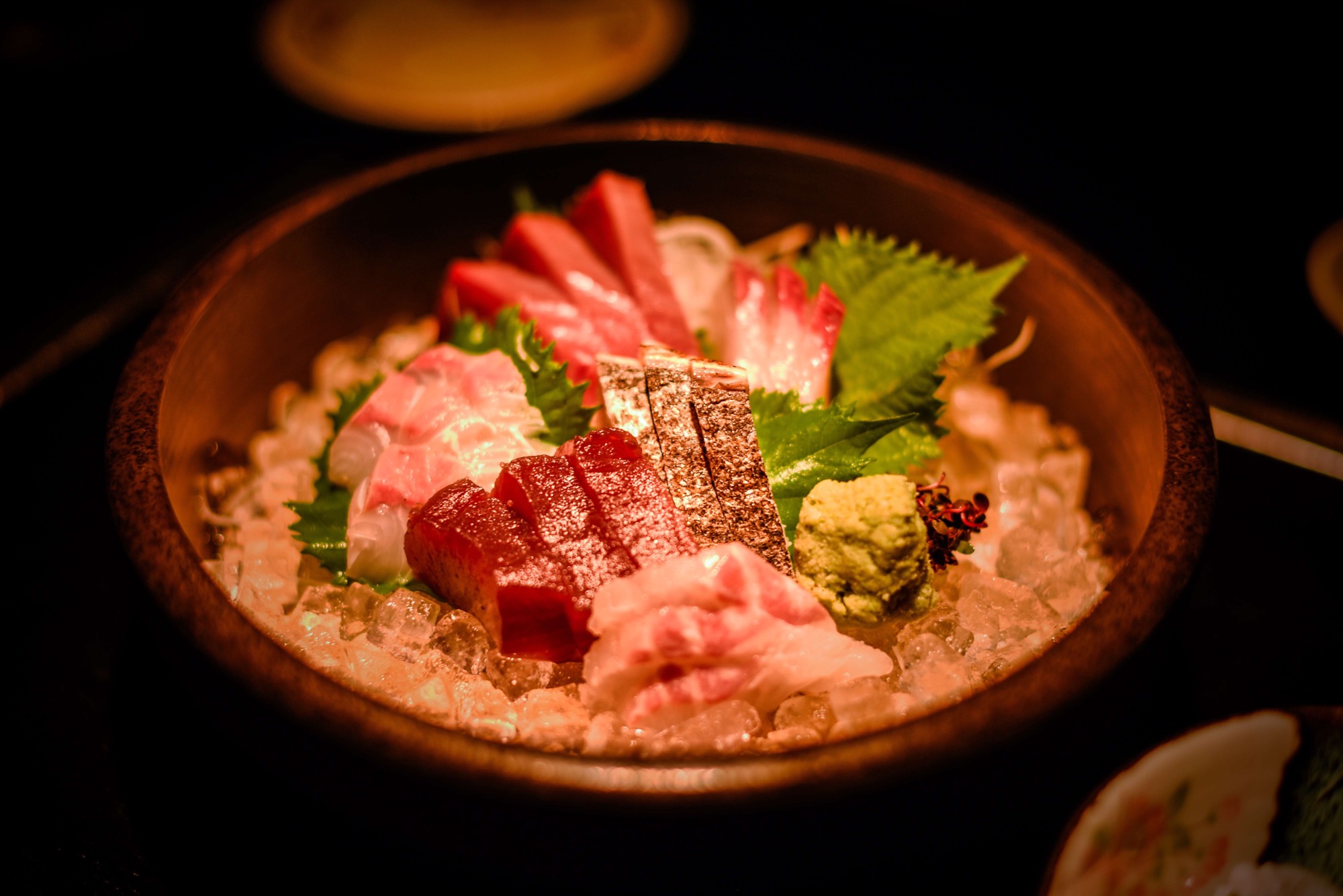
Sashimi plate in a traditional Japanese “pub”, Kuwana, Mie prefecture, Japan.

  In truth, calling this a pub is a bit of a stretch, we’re ushered through tight corridors lined with dark timber and paper screen walls and upstairs into the subdued lighting of our private room fitted with a low table atop a well for our legs to sit comfortably in. This beauty list is getting burdensome. Timber really has been the order of the day and in this tight room that elegantly makes the entire world about us four we gorge, as if we hadn’t gorged enough already today. Beer upon beer upon sake goes down with over twenty dishes as Aki keeps gleefully pressing the call bell for more food. Horse meat sashimi, beef tendon stew, fried chicken and crab croquettes are just a few of the avalanche that comes at the end of a long night of punishing the call bell. This is no cheap pub grub, each dish has a heart felt lack of pretentiousness with no small amount of fine dining dash. This is the place, the food, the beer, the company I had dreamed of for Japanese cuisine before arriving to these shores. 

 To describe a travel day to make me want to pull out my fingernails it might entail visiting shrines, wandering cute streets and catching trains all over the country. But this torment belongs only in countries that aren’t underpinned by the simple notion of beauty. As we sit to finish our sake and one last dish of rice in this room only for us it’s evasive to give a name to the beauty that doesn’t shout at us but calls us to it on whispers we cannot hear. Beauty has no function, no need; just a presence to attract overstated admiration from those with the mind to value the useless. In gates, wells, bridges, roofs, steps, food and trees the definition of Japanese beauty takes shape: Calling the admiration of the useless to the necessity of the useful. Just; beautiful.

While you were working – Please Rewind, Tado, Japan

 Love the sinner, hate the sin; that’s how the saying goes I believe. We love this mountain climbing thing but there’s no avoiding it, this 2:45am wake up is an abomination of biblical proportions. It’s not an abomination in the gay sex, eating shellfish or wearing different fabrics at once kind of way, that just gets death by stoning, this is truly damnable. Waking up at this hour is always hard, I’m finally awake about half an hour up the final steep rise of Fuji San (Mt Fuji), we’re just three of a steady string of people reduced to being little more than head torch lights in the dark. Aki is powering on and despite finding the going a little tough he refuses to show difficulty, but we can tell, we know him too well. Somewhere between not pushing Aki too hard and wanting to get to the top for first light we overtake other head torches like roadkill on a highway making great time. 

 There’s a guided tour ahead we can see, the distinct red flashing LED light sits apart from the other white orbs that bobble in the darkness, we’re chasing that red flashing light in the darkness through the whistle of a cold wind that exists only in places like this. Sand slowly gives way to pocked volcanic rock and the otherwise smooth slope of Fuji San becomes a rocky wonderland of inconsistent mounds on a mountain. Heavenly darkness beckons us still to the red flashing light that is salvation, still for the moment, giving up its flight perhaps. My head torch has died but my eyes have adjusted to the darkness that at this altitude is never really darkness, the red flashing light has tired, we move in for the kill. Less than 100m above us, our prey waits and the rocky lunar world evens out above to a black inky sky somehow a little lighter than the rock all around; the summit.  

Charlie Winn

Sunrise from the top of Fuji San, Japan.

  Aki persists, the red flashing light awaits its fate, and the ink black horizon slowly dips to reveal the unmistakable silhouette of a gate, two posts and a plank across the top can only mean one thing: were nearly there. Like a triathlete claiming gold we soon burst through the gate like a finish line, the immense crater of Fuji San mere metres before us as our world becomes so much more than just lights in the darkness. I launch the few steps back to Aki insisting on him closing his eyes for me to guide him to toe at the precipice of the crater that so often defines his homeland. He’s never climbed a mountain, nor a volcano and never been to the top of his native Japan, until now. On the count of three I take my hand away and the steaming inverted cone disappears below his toes at 3776m altitude. A short silence; ‘wow’, comes the response. Correct answer. We started hating the sin but just after 4:30am we’re loving this sinner, images of hell used to terrify children lie just below us after this epic ascent into heavenly darkness; who ever thought hell was tucked away up here in heaven.     

 The roaring wind rages with renewed vengeance, our red flashing prey has disappeared in the emerging light and after previously sending back most of our hiking gear we’re setting in for braving this cold for a few hours a little underprepared. We scoot around the eastern side to catch the sunrise and hunker down away from the wind that feels like it might pick us up and take us away into the clouds like an ancient fable; but colder. The world disappears below us from the edge of this perfect cone that seems so much rougher up here to contradict the countless artworks that idolise where we stand. From this side the wind comes in bursts as we huddle behind rock ledges in shorts looking like the most idiotic maverick climbers in history watching the strings of cloud whip and pull away from the summit behind us to disintegrate into tortured swirls like spun sugar being stretched apart. 

Charlie Winn

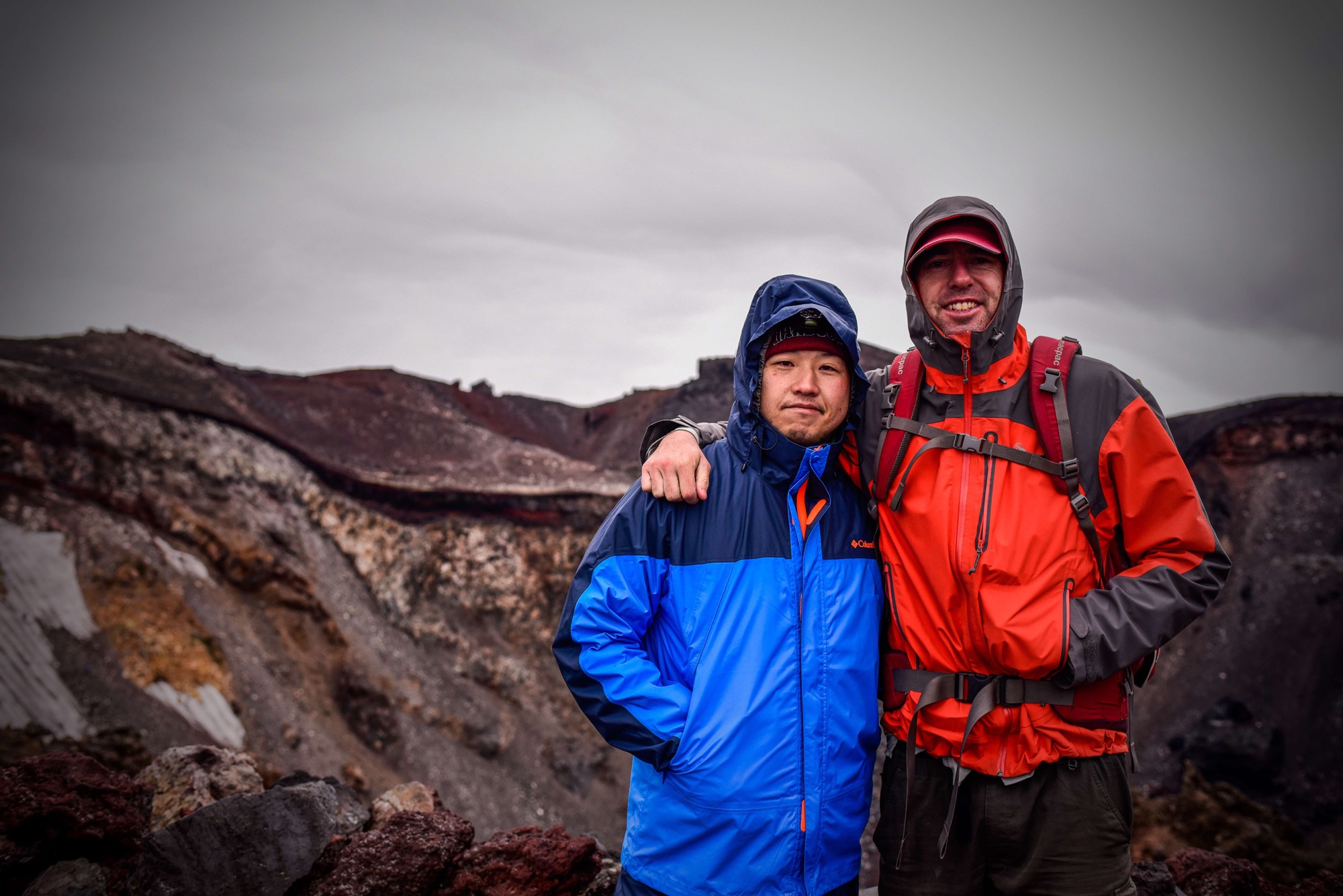
Aki and Steve on the rim of Mount Fuji.

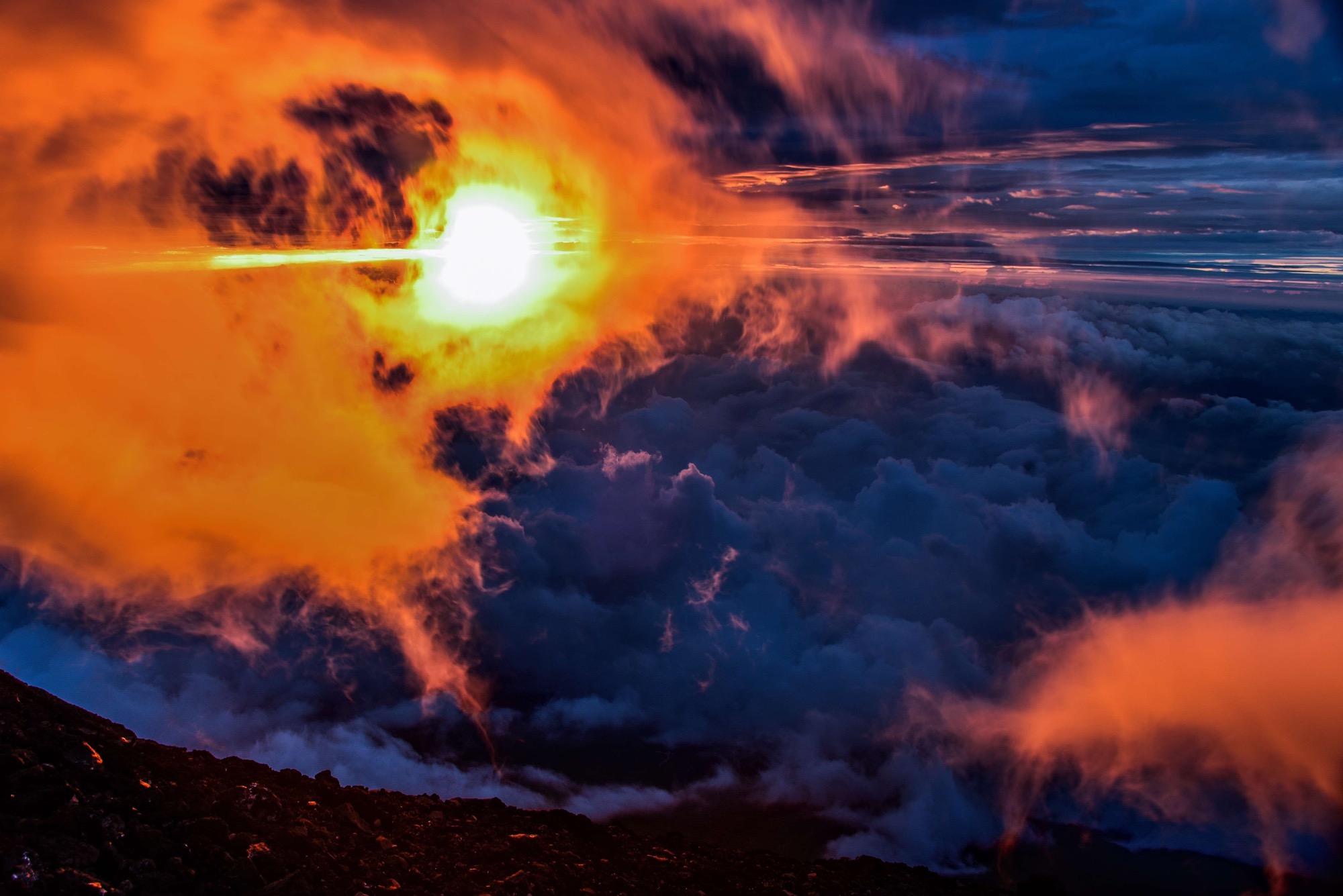
  We wait, we soak up the achievement and contemplate where we are as a new day becomes real for the first time. Blue twilight clouds lie below us puffy and distant like the sky of a world turned upside down, cold and frozen against the string of horizon blazing like the slice of a samurai’s katana in the sky. In pulsing waves the ever turbulent cloud swirls give us intermittent views of a horizon opening up like the wound of that slicing sword, blazing so out of place in this frozen world. In a fleeting moment between still night and warm day there is burning sunlight without the dense cloud of temperature change, a magic few minutes in the changeover between darkness and light. For that moment the hillside of Fuji San dances, the writhing webs of cloud being pulled over the summit by the ripping wind catch fire in the sun and dance like flames against the frozen cloudy world below; fire and ice in the moment between day and night. For now we feel no cold.

 A moment is all that’s on offer, daytime and heavier cloud takes over and our world is cast into a sparkling azure that now just seems like a muted grey after the show. We take in a few views of the crater and think that this can’t be an every day occurrence, it feels too amazing to be so common; it is far and away the most spectacular sunrise I have ever seen and I’m quite certain I’m not alone in that realisation. Atop Fuji San with Aki we witness the sunrise of sunrises over the land of the rising sun that needs only a moment to deliver divine epiphany. In the moment where fire and Ice, darkness and light, sky and earth, heaven and hell all blend to one, there seems no opposing forces in the world, no distance between ideas that can’t meet, just a window of perfection where balance is revealed in a way that we oft find it so hard to perceive. The moment passed too fast but the memory is a gift we will have forever, that moment on Fuji San where the world resolved itself.

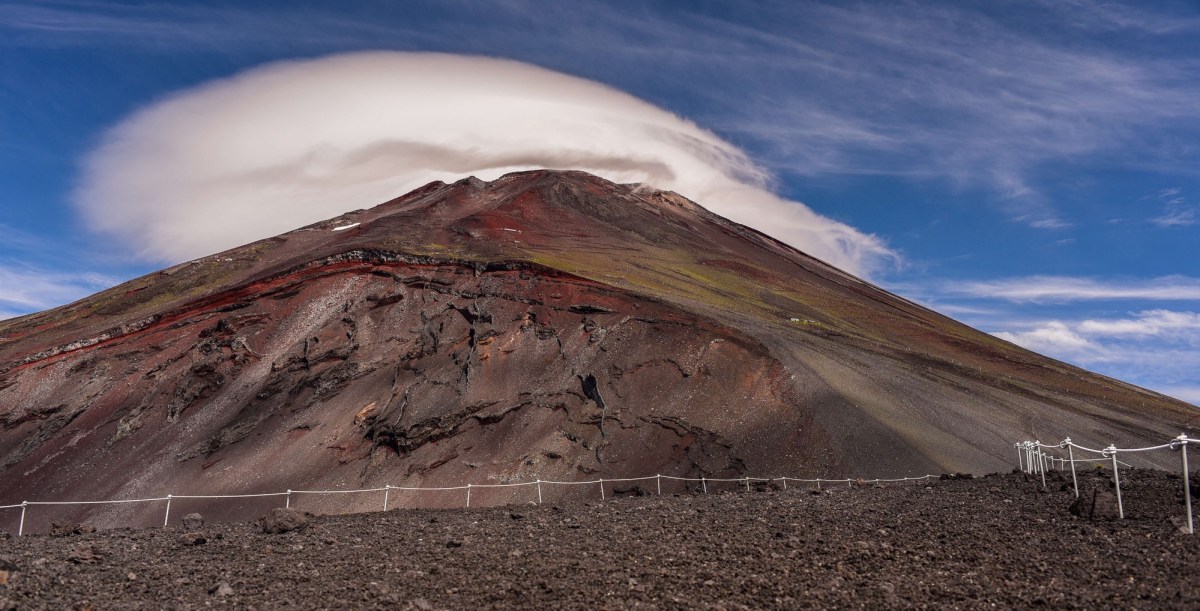
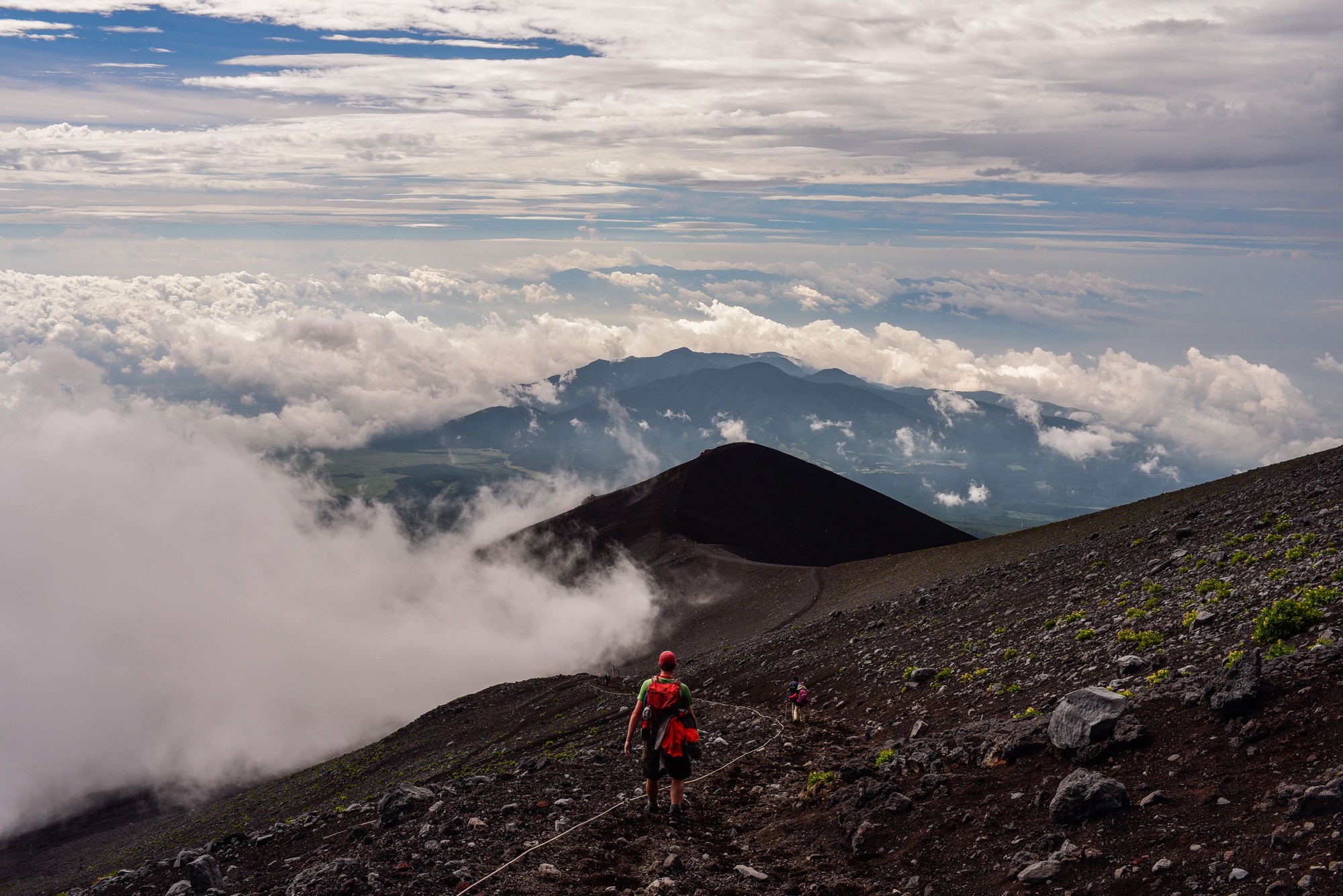
 Now for the descent. Like winding back an old VHS tape we farewell the horizon through the gate past the post office, yes there’s a post office on the summit of Fuji San, have food at last nights shelter and count down the numbers that marked our altitude on the way up. Through soft sandy scree we half walk, half skate our way back down in the blink of an eye; 24 hours of slog unravels so quickly as a clear day above and a cloudy day below farewells us with just a misty cap on Fuji Sans summit like a halo now high above. With the tape unwound we walk through the lower gate at the base of the mountain to stand on the black sand where we started with nothing to show for our troubles but a moment of epiphany that can’t be packed into a bag or stowed in an overhead locker. Like an ancient riddle we can hold it but can’t touch it. 
Charlie Winn

Descending Mount Fuji…into the clouds.

  Back in the real world below the cloud we’re sore and tired, two days that feel like one have spat us back out and we’re again hating the sin while trying really hard to love the sinner. A bus, a walk, a train, some beef tongue on rice, another train, a train again and we have wandered zombie like to Tado station, Aki’s home town. A pocket rocket of a woman roars to a racing halt in a pocket sized car to pick us up, Aki’s mum has arrived to take us back to town. Seeing Aki’s town, house and mum pads out our view of this man who holds such respect from both of us; Aki, our Tamagotchi samurai kamikaze warrior now a home town boy his mum is just happy to have back home for a time. With no Japanese on our side and no English on Aki’s mums side we hand over our gift of sweets with some bowing and giggles before she shyly excuses herself to another room. 

 The day that never seemed like it would end indeed does just that, it never ends; it’s onsen time. As much as we’re about to fall asleep we meet back up with Ken and the band is back together for the famous Japanese hot springs, a perfect recovery with team Japan. Through locker rooms, showers, hallways and gardens we all walk completely naked as is the custom to a boardwalk that takes us through a wonderland of large rocks, tranquil gardens and a stream that cascades into waterfalls all around us. Any shyness is long gone as nakedness becomes the norm, the reviving hot spring waters cradle our aching bodies and lift us to a relaxed state where weightlessness replaces ache. 

 The tradition behind onsen nakedness is that it’s a place to talk and connect, there’s nowhere to hide when you’re naked and nowhere to escape to when settled into the hot restorative waters. The water is invigorating, the gardens pacifying and after two days of strain we indulge in the opposite, complete immobility. If coming down the mountain was unwinding the tape then this is returning the cassette back to the video store, Fuji San seems so far away but like a good movie we have the memory, that perfect moment, the experience together of being on top of Japan that we’ve stolen and won’t return regardless of the late fees. In this perfect place we are granted a moment to contemplate that perfect moment and all those in between, a moment where there are no sins or sinners, just a world perfectly in place. 

Newer Posts
Older Posts