Menu Close

Charlie and Steve's Excellent Adventure

Tasting the world one meal at a time

While you were working, What Could Possibly go Wrong, Ho Chi Minh, Vietnam

 There’s plenty of different modes of travel in the world and on this trip we’ve had a good crack at sampling every possibly one of them, including the all time romantic favourite, the road trip. We reminisce of the three week mud dash that was Botswana; fending off Hyenas, cowering in the tent from Elephants and poised to dash from Hippos in the campsite. Fond memories permeate that time, not so much the getting bogged part but for better or for worse, they’re memories for life. For now we’re kicking tyres again, play acting at stern faces and uncertainty in an industrial carpark in Ho Chi Minh on the verge of adding another road trip to the list of this adventure. Argentina, South Africa, Botswana and China have all written chapters into our love affair with the road and that illustrious list is about to have a new stanza, Vietnam.  

Charlie Winn

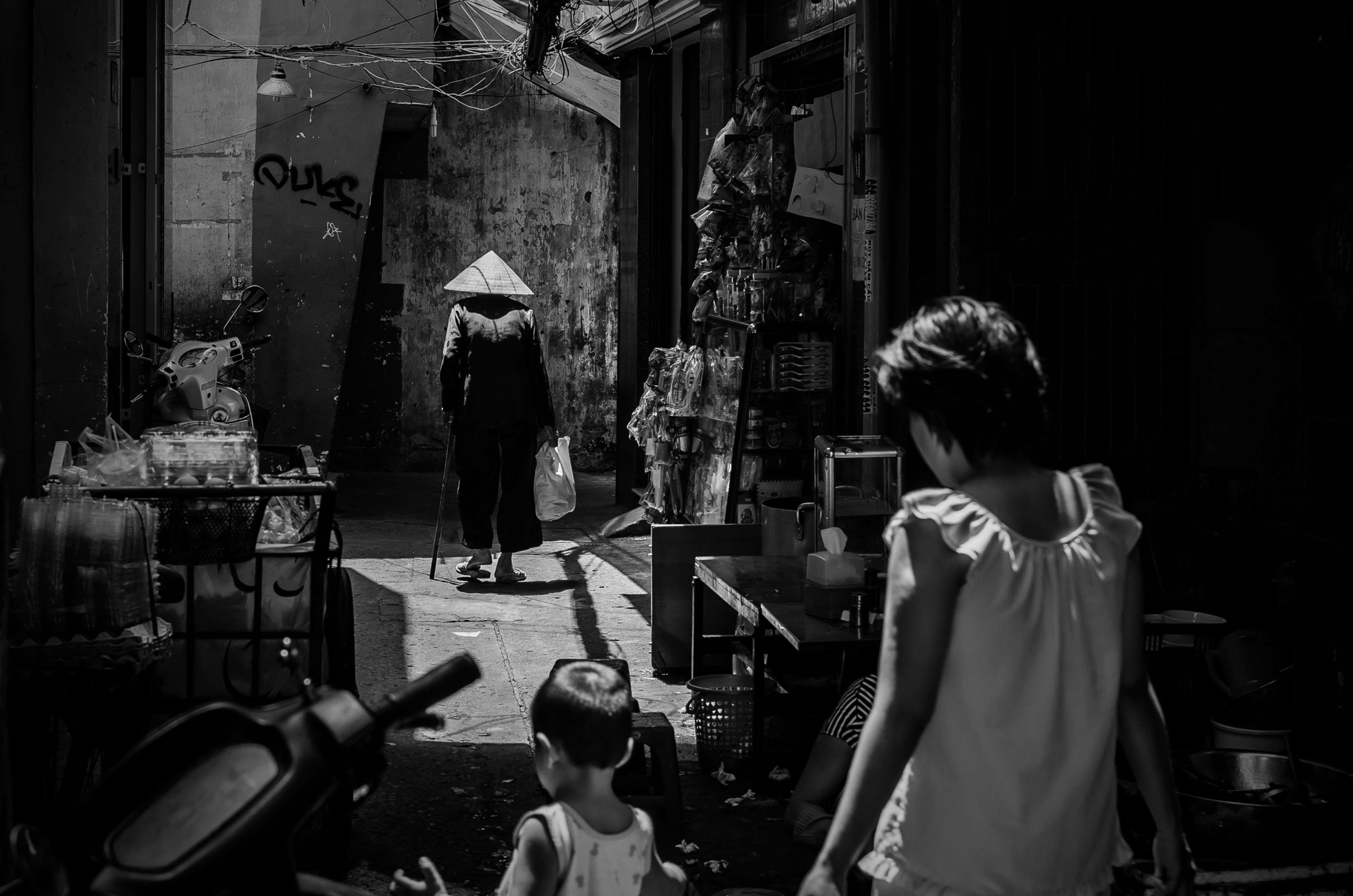
Returning to the dark heron, back alley, Ho Chi Minh city, Vietnam

  Gone is the fully fitted car from Botswana, the glamorous estancia in Argentina, posh wine regions of South Africa and the support crew of cycling in China; the Vietnam edition is just two boys, two bikes and UN relief team quantities of sunscreen. Our bikes to be have indeed seen better days, parts replaced so many times that no trace of an original bike remains; they wobble, stall, struggle to start again and all the while fart and splutter a constant objection to being forced from a retirement well overdue. With vague maps and GPS that works only sometimes we’re planning to set off into the world of Vietnam in the most blind way we can; think Top Gear meets Bear Grylls but without the support crew; or licences. Charlie’s bike has a warranty that lasts for one day while mine has none at all. What could possibly go wrong?

 We hand over the cash and we’re away, the nightmare that is Ho Chi Minh traffic is our first hurdle; well it will be as soon as we turn back and get my bike fixed. We did get a wobbly 15 minutes which I’m declaring as a resounding victory. Take two, and at this stage it’s time to placate mums at home; we have proper helmets and our yet to be named nags have the speed of a ride on lawnmower. Laughing at logic with throttle in hand we take the cautious few steps into our new life, till death do us part. I wonder again, what could possibly go wrong?  

Charlie Winn

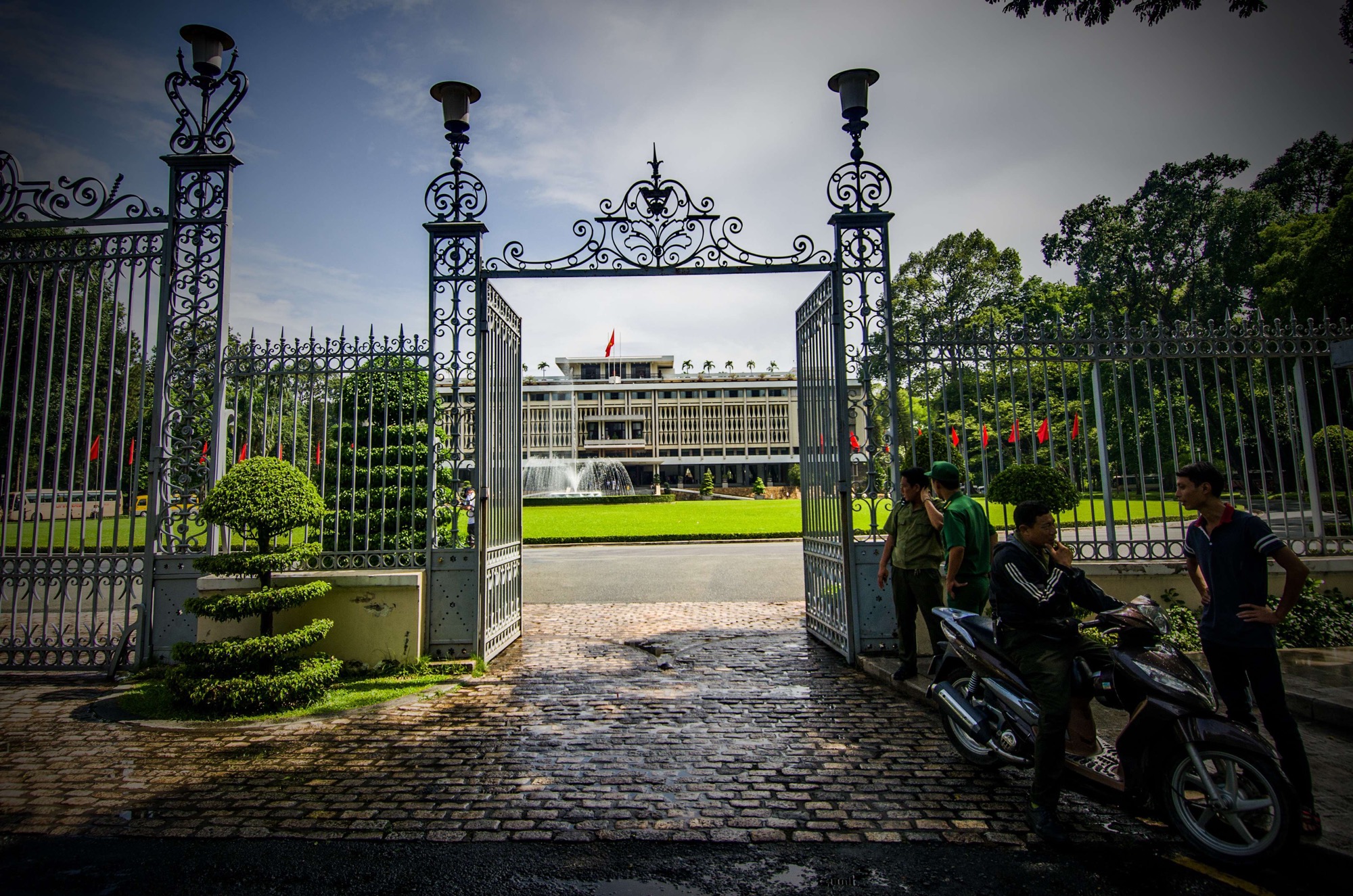
Reunification Palace, previously South Vietnam’s presidential palace, Ho Chi Minh city, Vietnam

  Somehow we make it back to the hostel through the traffic blender that is Ho Chi Minh City filled with the emancipation of twelve year olds with a bedroom of our own for the very first time. Full of freedom we immediately take on the other task of chaining ourselves further to the mast of a trap we can’t free ourselves from. The best baguettes in Saigon are dished up by a mysterious character hidden behind a mask and nestled in a discrete dark alley, the Dark Heron. Like junkies we walk entranced the couple of blocks back to get our fix that we say will be the last time but we know that as long as it’s close we’ll never be free from it. 

 I queue up in the orderly fashion like the rest of the dependants feigning patience, imitating restraint and resisting the nervous shaking. For now the almost child-like freedom of being able to hit the open road seems to have inverted itself into a conflict, we’ll only be taking ourselves away from the Dark Heron and her poison we crave. Again the customary accusing look at me in this place that a white face doesn’t belong; this time I hold up two fingers instead of one. In a flash the bounty is mine, I scurry back to Charlie and in the shattering of a bread crust the world is right again, the cloud of withdrawal parts to clear skies. We can leave this behind, the open road beckons and we will own it; in sickness and in health we say to our bikes, ‘we do’. Filled with the optimism of a narcotic hit we’re ready to launch into the country and seek out the inferior versions of the Dark Herons poison: what could possibly go wrong?

 By the second we pull ourselves free of this city that has felt uncannily comfortable far too quickly, a final walk down what we’re calling ‘cafe street’ seems a fitting farewell. Lined with countless Viet cafe’s it’s a bustling street but it’s not for coffee that we go, we’ve spied a street stall at the mouth of an odd lane full of dilapidated buildings alongside trendy bars crammed with too many scooters. The quintessential Ho Chi Minh location to farewell the city before we fly away. Beer tastes better when it’s in a place you’ve found, Anna the owner of the bar is chatty and for just a minute, five days in, we nearly feel like we belong in this city, white faces and all. The noodle soup outside is rich, warm and typically delicious even if we get the disoriented locals welcome for tourists that dare stray from the corral, either we’re lost, stupid or a bit weird she thinks. 

Charlie Winn

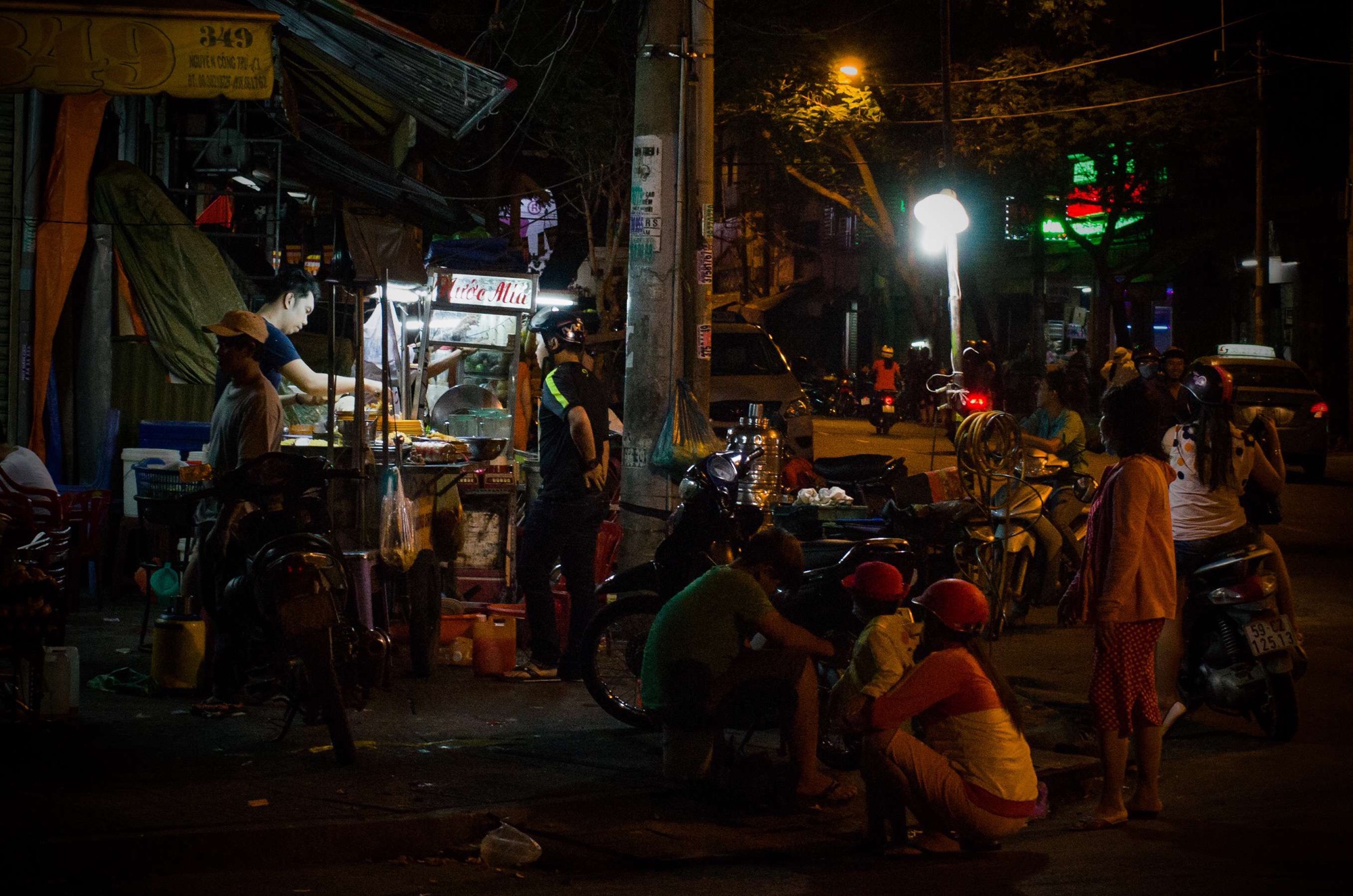
Typical street corner in Ho Chi Minh city, full of food stalls, Vietnam

  We pack bags with excitement and trepidation, we are launching into a great unknown in a year defined by launching into unknowns. If Ho Chi Minh is Vietnams version of a big shiny city and the traffic is more like a migration of wildebeest I wonder silently what the rest of the country is like. Our two new husbands in this polygamous mess are about to leave this world at any minute and yet tomorrow we will mount them to set off into the sunset of new lives together, the new Modern Family. Like the eve of a devout christian honeymoon we’re nervous, excited and entirely with no idea what to expect or do but we plunge with blond bravado into commitment far too grand for our inexperience. What could possibly go wrong?

While you were working – Coffee Buzz, Ho Chi Minh, Vietnam

 What’s this whole business about a ‘coffee buzz’ I hear? Can’t get to sleep, makes me shaky, I’m buzzing; all common catch cries for the caffeine light weight. I want a buzz too, where’s my buzz? Maybe we’re a just tougher or possibly we’re simply pre-enlightened addicts, but for whatever reason coffee remains for us little more than a delicious drink posing as an excuse to relax, catch up with friends or indulge in some good old fashioned snobbery. It seems only typical that Vietnam has its own coffee, an invention that’s purely Viet; it’s coffee, but not as we know it. With a dash of condensed milk at the bottom of the cup, topped with the dense nutty, almost chocolatey coffee a quick stir delivers a hot liquid mix somewhere between a chocolate fondue, meringue pie, peanuts and silken coffee to shame a Roman barista. 

 It’s a weird tasty punch in the face on flavour alone until we get to the special ingredient, the punch in the face leaves me a little dazed and confused. Is this the holy grail coffee buzz thing that I hear so much about? Coffee buzz or a buzz of some sort at least, possibly I’ve had some street hustler slip something into the cup leaving me wondering if I’m taking party drugs at the wrong time and about to get a free ride in the shame-bulance or just finally joining the masses. I’m genuinely feeling a little woozy, my belly is roiling and I’m drawing deliberate long breaths like the pre-vomit wave of motion sickness on a bus with no toilet. I need a little lie down.  

Charlie Winn

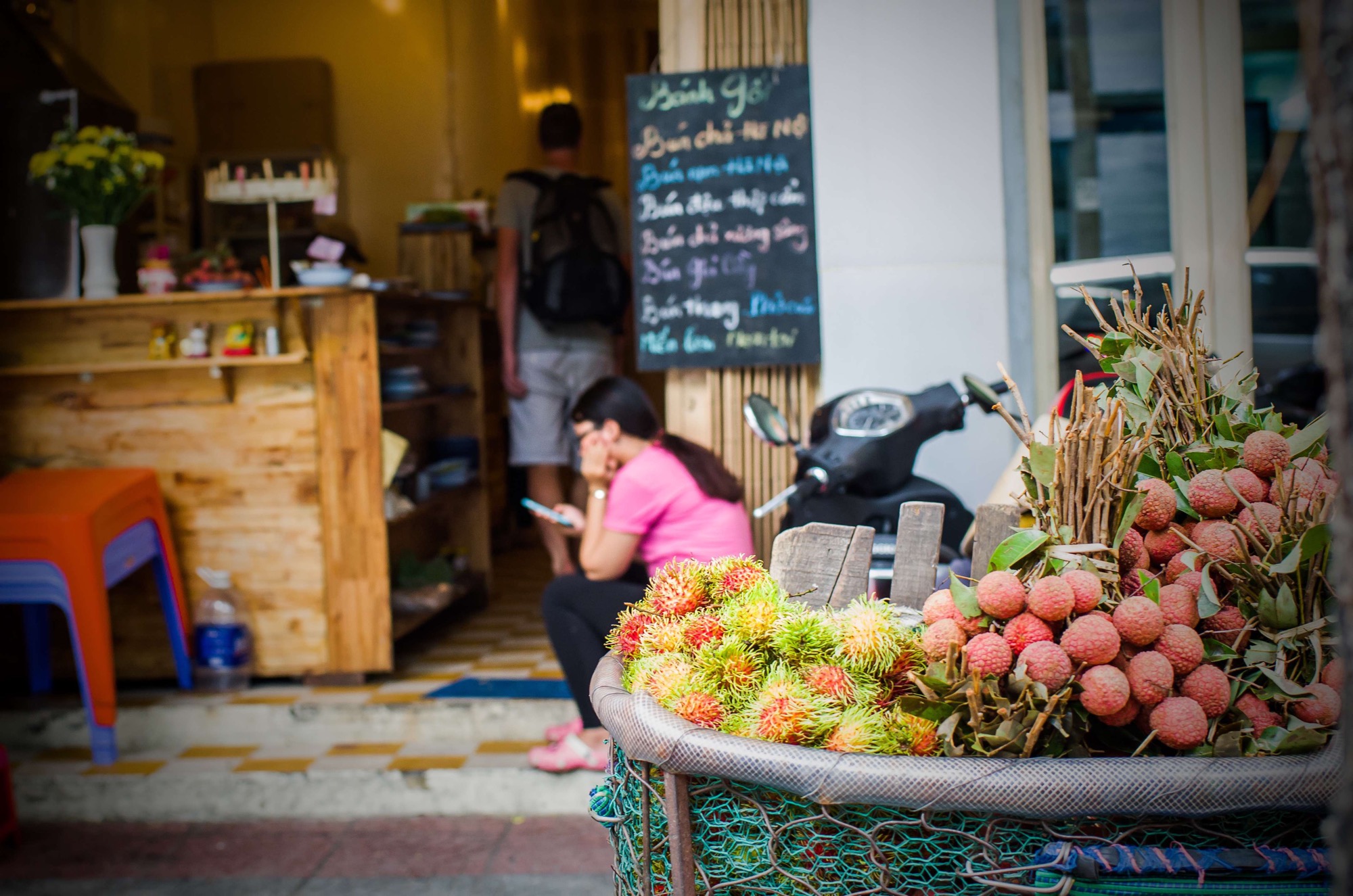
Fruit for sale on the street outside a great local restaurant, Ho Chi Minh City, Vietnam

  After the universal panacea of a nap it’s time to get back into the day, navigating the narrow alleyways feels more like we’re half intruding onto peoples lives and half just getting around. The world cooks, eats, socialises and plays in these tight channels making for very blurred lines between public and private space. And we think having a living area that opens onto an outdoor space is a modern design triumph invented by flighty men in fashionable clothing on reality TV shows. Surrounded by food we realise it’s been minutes without it; time for baguettes in preparation for the two hour food fasting trip to Cu Chi. Nearby to Ho Chi Minh, Cu Chi has one of the more extensive networks of the famous Viet Cong tunnels, a key reason that the outnumbered and outgunned Vietnamese were able to fight off such a formidable foe. 

 Dug by hand over decades, the tunnel network of Vietnam is a labyrinth extending for 250km allowing for military manoeuvring, weapons workshops, sniper attacks and evacuations all so close but yet so far from the US army. The Vietnamese harried and pestered the US into defeat and these tunnels were a large part of the success. It’s so odd to hear about Vietnamese heroes, but heroes they are when seen through the eyes of jaded war-time perspective. This war education will no doubt continue but at this point in time it’s hard to spin a story other than we invaded illegally and brutally and the Vietnamese simply defended their nation, and won. For us America has always been an ally, to hear proclamations of heroism noting tallies of American deaths is a little jarring. Jarring because they’re our ally, jarring also because we find ourselves cheering for their success. 

Charlie Win

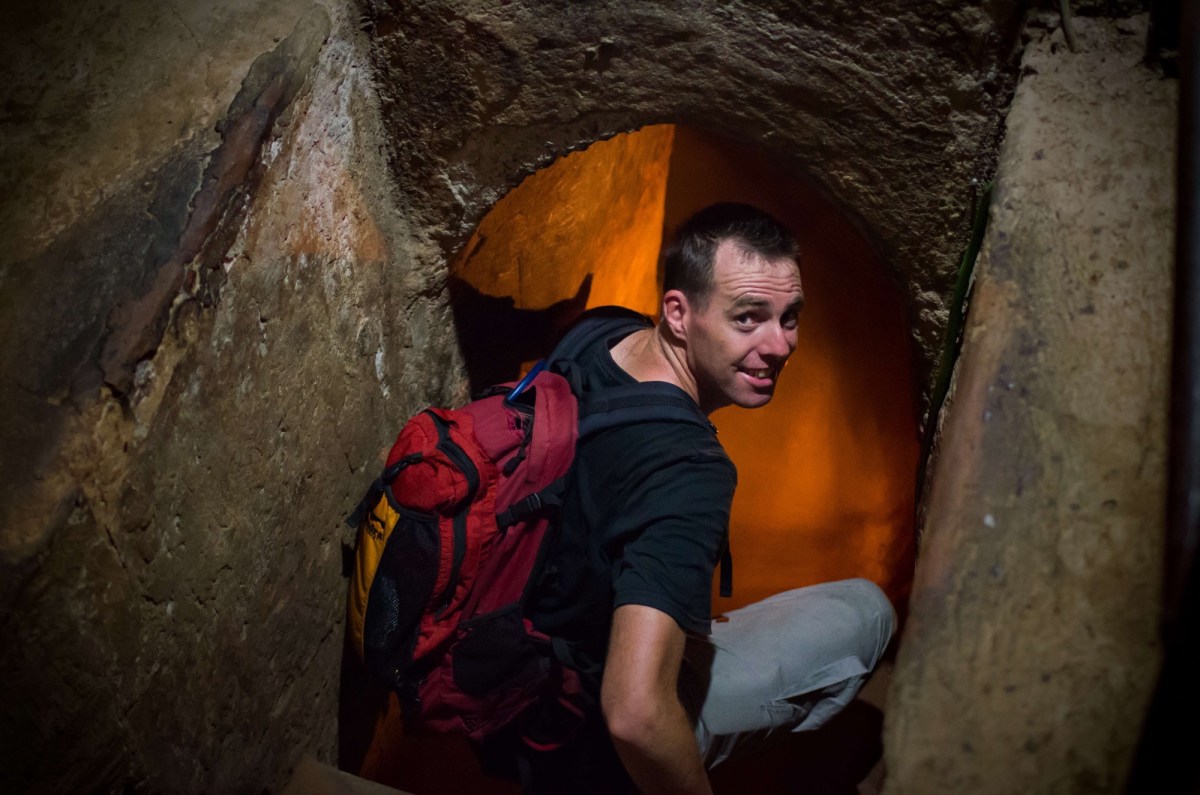
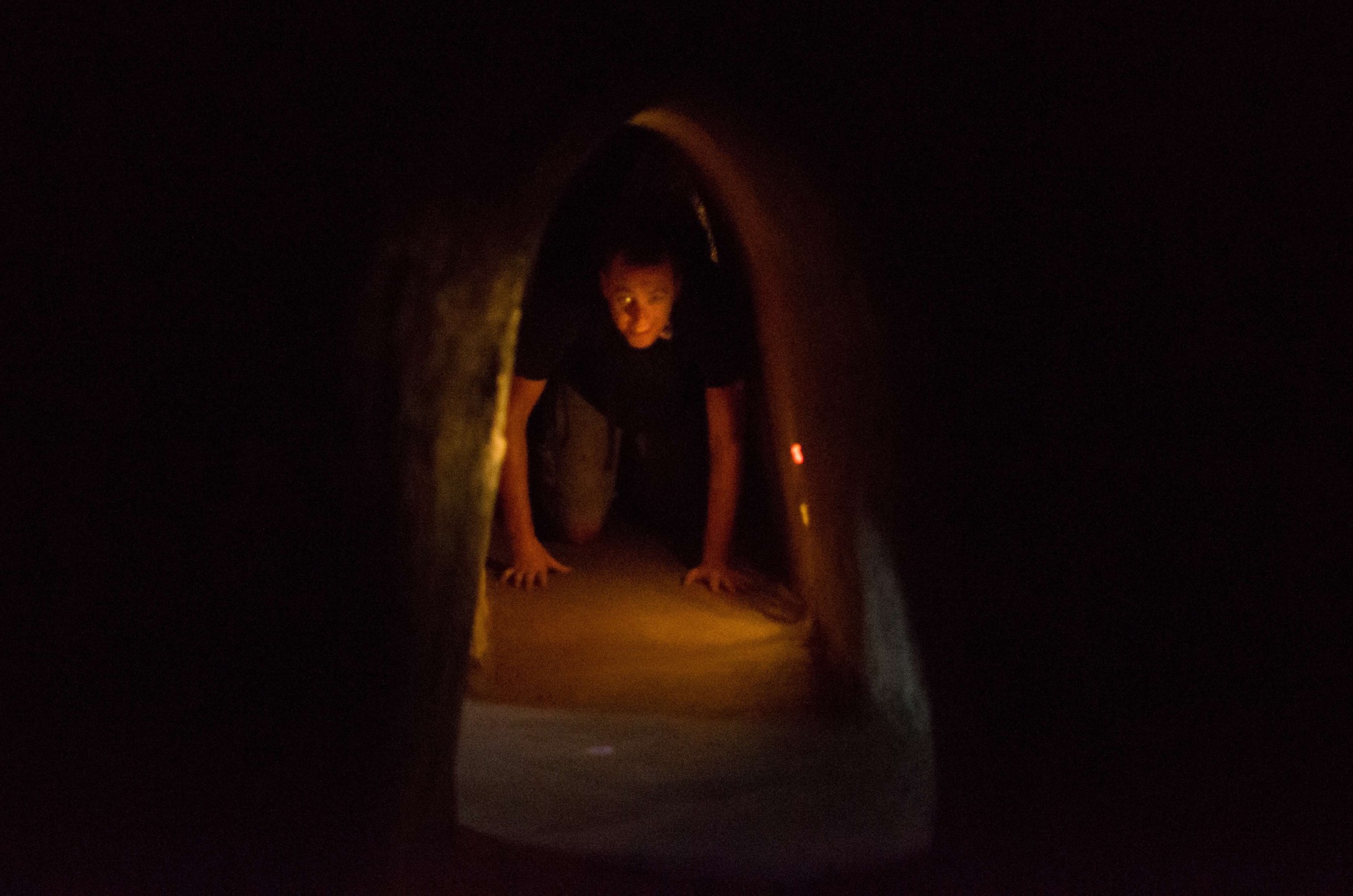
Steve not able to stand in the Cu Chi tunnels near Ho Chi Minh City, Vietnam

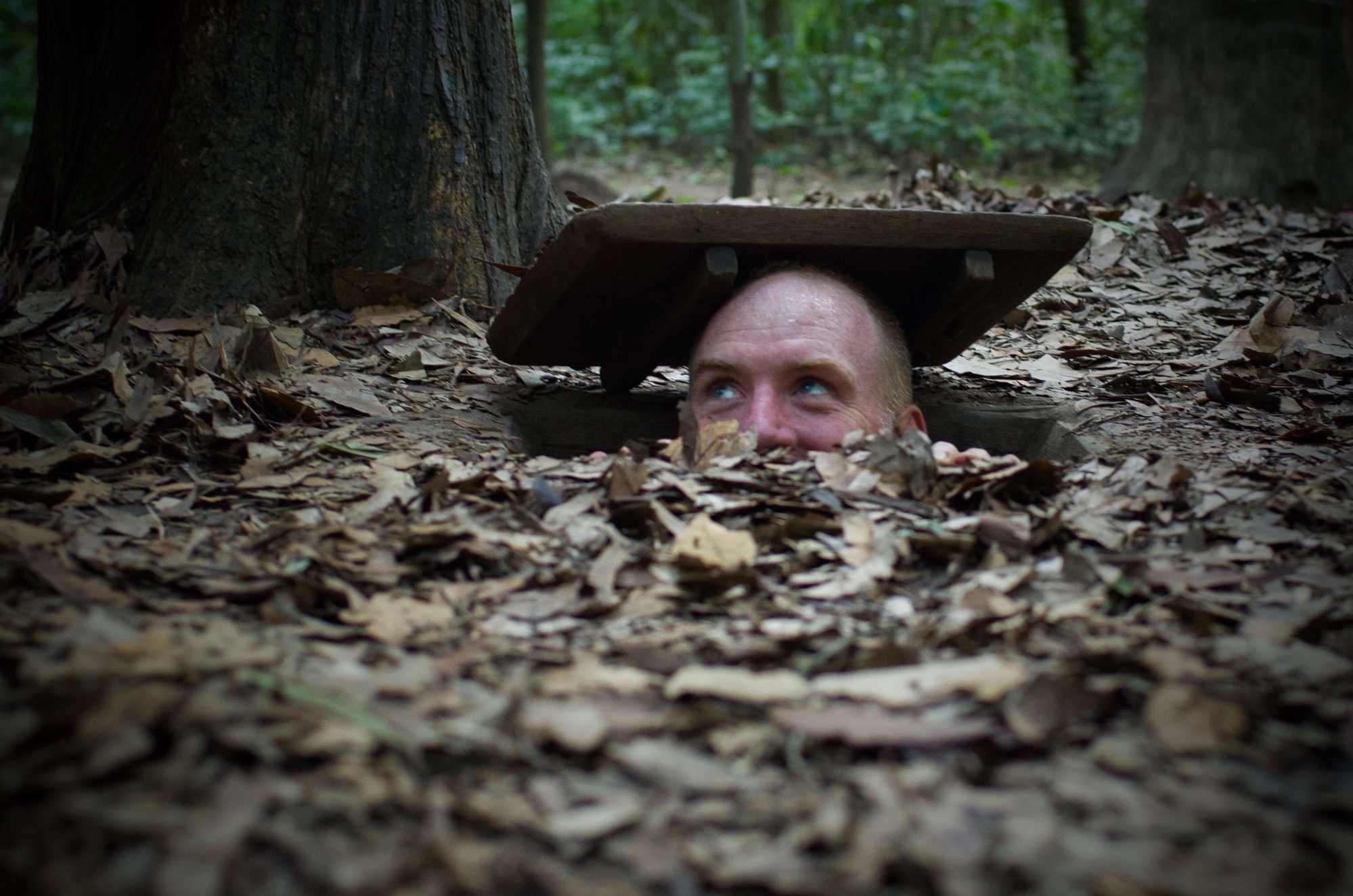
  Too low to stand, to narrow to turn, the tunnels are our world now as we descend into darkness; for a moment we’re two of the famous Cu Chi tunnel rats scurrying beneath the feet of the American soldiers. We shuffle slowly as sweat immediately pours from us in this claustrophobic world just a few metres underground, we have about fifty painstaking metres to go. Napalm craters dot the landscape but this small piece of history survives, the first few metres are fun before long breath gets harder to draw, suffocating every awkward shuffle. Down another small hole deeper into the earth and further away from light, breath and the ability to move. We’re not claustrophobic at all but there’s no mistaking it, this place is not comfortable. 

 Somewhere in the small space offered to us deep in the earth it becomes easier to feel for a fleeting second a shade of what life was like down here. Running from and fighting the enemy at the same time, for most Viet Cong that same enemy had invariably killed friends, family, colleagues and children. The earth would have shaken, the clatter of gunfire would have echoed through this maze and trapped in this tiny space with only a few exits out it must have felt hopeless, desperate. How the Viet Cong not only survived using these tunnels but utilised them to great effect is beyond me; with surrender not an option the pressure on human resolve is more than I can fathom as I, in perfect safety, just want to get out.  

Charlie Winn

Charlie testing out a sniper hole, Cu Chi tunnels, near Ho Chi Minh City, Vietnam

  In a quirk of history, after the better part of two decades the US reportedly had the Viet Cong close to breaking, the famous resolve was nearly spent. Then the juggernaut fell, America withdrew marking one of histories greatest impossible victories. The Vietnamese were the boxer with no strength left throwing one last punch to send their enemy to the canvas. Emerging from the tunnels we’re overheating, sweating, a little shaken and ebullient; oddly I feel like the coffee buzz has returned. No great statues, no commemorative plaques and little propagandist pageantry adorn Cu Chi. Fittingly, just like the nation that would not be beaten it’s simple, rudimentary and nothing more than what’s needed to get the job done. Heroes of unfathomable bravery are now set to tasks other than killing and surviving, possibly making coffee.

While you were working – The PR Machine, Ho Chi Minh, Vietnam

 We want you! In the 50’s we hadn’t all seen those words before, emblazoned over the image of the man in a top hat looking half applaudingly and half accusingly with a finger pointing off the poster right at you. Apparently he wants you. Red white and blue adorns the iconic backdrop as he calls you in and points you out, they want you but who are they and what do they want you for? Millions saw that poster and how many millions answered the call; how many knew what they were wanted for, how many just wanted to be wanted? Such a universally evocative image at the time and now still so for some; for others it ranges from simply conflicting to outright shameful. 

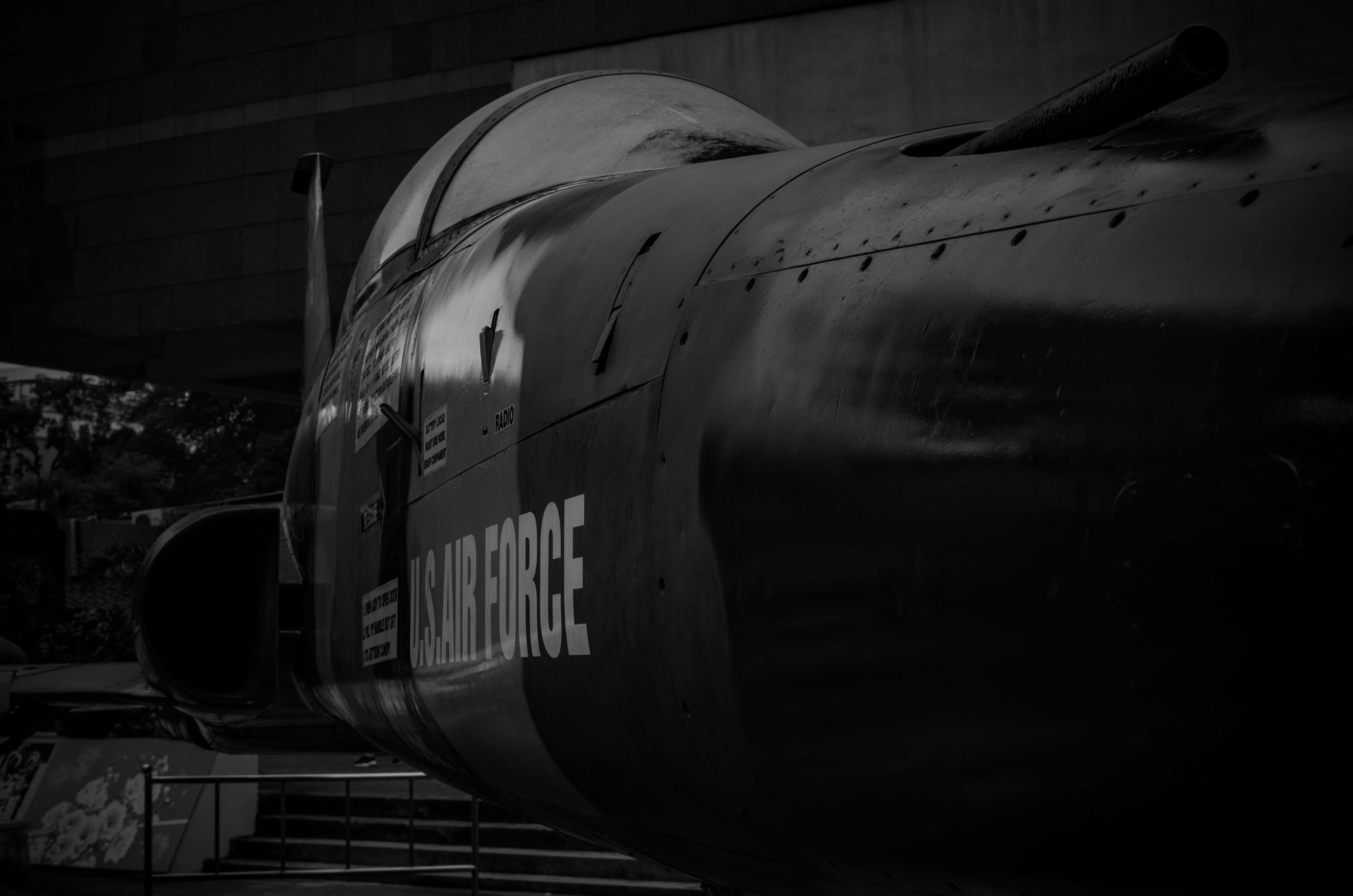
 The Vietnam war remains not only a potent historical marker for Vietnam but so much of the world, and although we’ve had eyes for little other than food, the war has pointed out at us just like that poster and demanded attention. War doesn’t want us and we don’t want the war but some topics are too culturally defining and potent to stay silent. Through the gates of the war remnants museum we are called in, as if the top hatted man’s accusing finger has singled us out: ignore me if your conscience can bare it. Helicopters, planes, tanks and guns litter the open paved area to greet us like junk for sale at a used car yard but with graver stories to tell than a regular Toyota Corolla that just keeps going.    The metal that once had such a purpose sits outside in the process of slow decay, their stories fading with time; inside the stories continue of people who’s bodies have faded into time even if their legacies linger, still so bold. Walls of photos adorn the lower level of a people who’s simple ways conquered the greatest military might the world had ever seen. Women and men all drawn to the task with hoe and wicker basket to repel the hoards drawn to a war of tanks and guns they didn’t understand by a poster they couldn’t resist. The used car lot outside seems such a mockery now, such technology poured into mountains of steel and menace undercut and left outside to rot by a population with few guns, many rudimentary tools and limitless resolve. 

 Resolve, bravery and willpower the Vietnamese had, they’d lived centuries fighting off occupation and invasion; but America had money and apathy to law and humanity, opposition beyond a political ideology. Vietnam is famous for being the war that was first published to the world; reporters and photographers into the fray en masse for the first time in modern history, Americas great strategic error that even their wealth and power couldn’t overcome. The world rose up, protests from people and governments alike built gradually as the juggernaut that now sits outside rotting met its second most deadly foe behind the Vietnamese: the PR machine of its own making. The Vietnam war was getting desperate and the world saw, for the first time, agent orange. 

 Possibly the only wartime act more insidious than land-mines and more horrific than an atomic bomb is chemical warfare. Dioxin, the key ingredient in agent orange, remains the most deadly material known to man, reportedly 80mg is enough to kill an entire city with a population of 8 million. Think about that for a second. America dropped 12 million gallons of agent orange onto Vietnam to eradicate the concealing foliage of the dense jungle that sheltered the Vietnamese. Chemical warfare, how we decry it and rightly so; dioxin was not even required as an ingredient for deforestation, its inclusion just made it destructive to people as well, making the choice to use it all the more unfaceable. Atrocity, genocide, crime; they all seem more appropriate words than war, war invokes at the very least a sense of fairness in battle. Did all those young men who flocked to a poster consider themselves criminals? Did they care?  

Charlie Winn

US airforce jet left over from the Vietnam war, War Remnants Museum, Ho Chi Minh City, Vietnam

  To so many the Vietnam war is exemplified by the massively popular movie, Good Morning Vietnam; so witty, so funny. So insultingly wrong. Agent orange contaminated millions of hectares of farming land, polluted water supplies and lives on through genetic distortion from generation to generation; not a wartime tool, social engineering to make Hitler envious of its comprehensive reach. The horror is endless, photo upon photo of stoic yet malformed children look down up on us, but there’s no more powerful image than a still-born foetus suspended in formaldehyde. Powerful in part due to our inability to see clearly if the life that wasn’t was attempting to be born with just two heads or three, such was the genetic corruption. Before the light fluffy ending to Good Morning Vietnam, Robin Williams screamed the famous line in the face of the ‘betrayal’ of the Vietnamese boy he befriended for lying to him: “This does not look good on a resume”. With all respect to the late Robin Williams, his character exemplifies the apathy required for atrocity, the PR machine was up and running again.

 Was the PR beast the silver haired white men in power? Surely, but the boys called to that poster have blood on their hands too. An accusation is inscribed onto a plaque in the museum, it’s accuracy was later confessed to by the perpetrator after reading US military ‘after action’ reports in court:

 Lieutenant Robert Kerrey reached for hamlet 5, Thranh Phong village and cut 66yo Bui Van Vat and 62yo Luu Thi Canh’s throats and pulled their three grandchildren out from their hiding place in a drain and killed two, disemboweled one. Then the rangers moved to dug-outs of other families, shot dead 15 civilians including three pregnant women, disemboweled one girl. The only survivor was a twelve year old girl Bui Thi Luom who suffered a foot injury.

 It was not until April 2001 that this accusation was validated by confession. In 1988 he was not a war criminal, he was elected as an American Senator. His Wikipedia profile’s paragraph of his bronze star medal of honour notes specifically the raid on Thrang Phong. The official military citation reads: ‘conspicuous gallantry and intrepidity and the risk of his life above and beyond the call of duty…’. Those pregnant women and children cowering in a dug out surely posed the greatest homeland security threat of the modern era hey Bob? Bob Kerrey was still running for his seat in 2012. 

 We in Australia can’t cry outrage either, nor can Canada, Taiwan, Thailand, Philippines, New Zealand or South Korea; America was far and away the main protagonist but we were all involved. On searching Google for facts on the Vietnam war my third ranked search was a CNN ‘five things you didn’t know about the Vietnam war’, just what I was after; data. Did you know that US soldiers were forced to sit in 48 degree swamps? Horrific for its deluded apathy; vomit inducing chemical war garners commentary about the poor boys who weren’t close enough to air-conditioning. Pin drops can be so deafening. The layers of desperation and horror in this museum match the shaking fit that threatens to consume me just like at the Killing Fields in Cambodia. Robin Williams character got it dead right; America, this does not look good on a resume.  
Charlie Winn

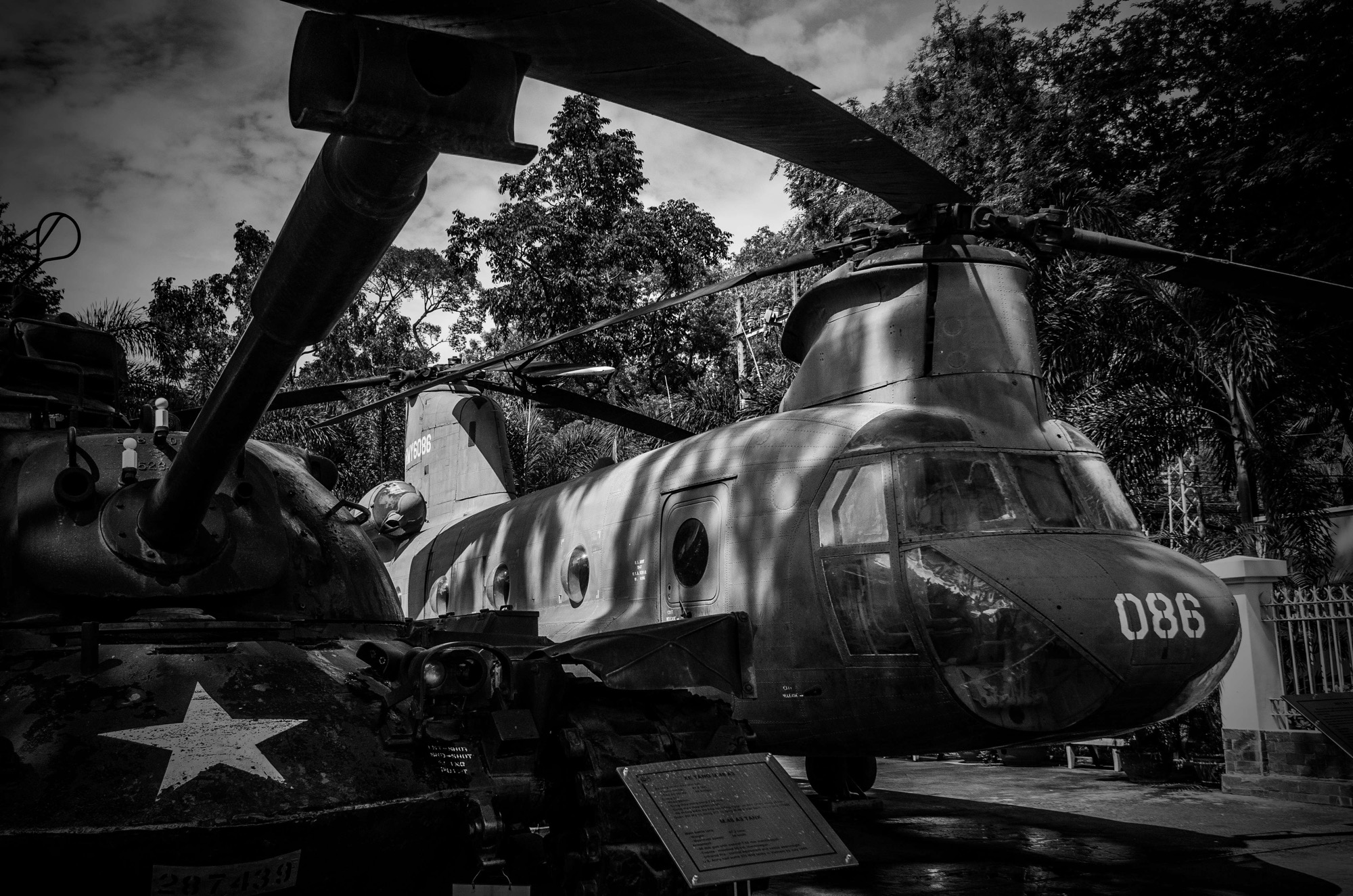
Chinook helicopter and tank on display outside the War Remnants Museum, Ho Chi Minh City, Vietnam

  So the PR machine turned on the government that created it, America’s own media broadcasted back to the USA horrific picture after shameful story after unbelievable breach of humanity. The greatest military power the world had ever seen was defeated by shovels, hoes, sharpened bamboo sticks along with a scant few guns. But the real victory was earned on the irrepressible resolve of a people that have fought off powers for centuries and, on the cusp of claiming true autonomous unity, were not to be denied. The war is now over but the wartime resolve persists; vitality and ingenuity is no longer wasted on killing and surviving, it’s turned to making better lives, simple tasks like keeping an alleyway clean, making fantastic food and working an honest job aren’t taken for granted. 

 The story is a balanced debate in one respect, is the greatest discussion about Vietnamese resolve or American belligerence to law and life? Of course the muddy waters of war are complicated and seeking a neat conclusion seems delusionally naive. Interestingly for me the mistake of allowing the press into a war-zone has never been repeated. How many ‘Vietnams’ have come since that we know little about? How many are going on right now?
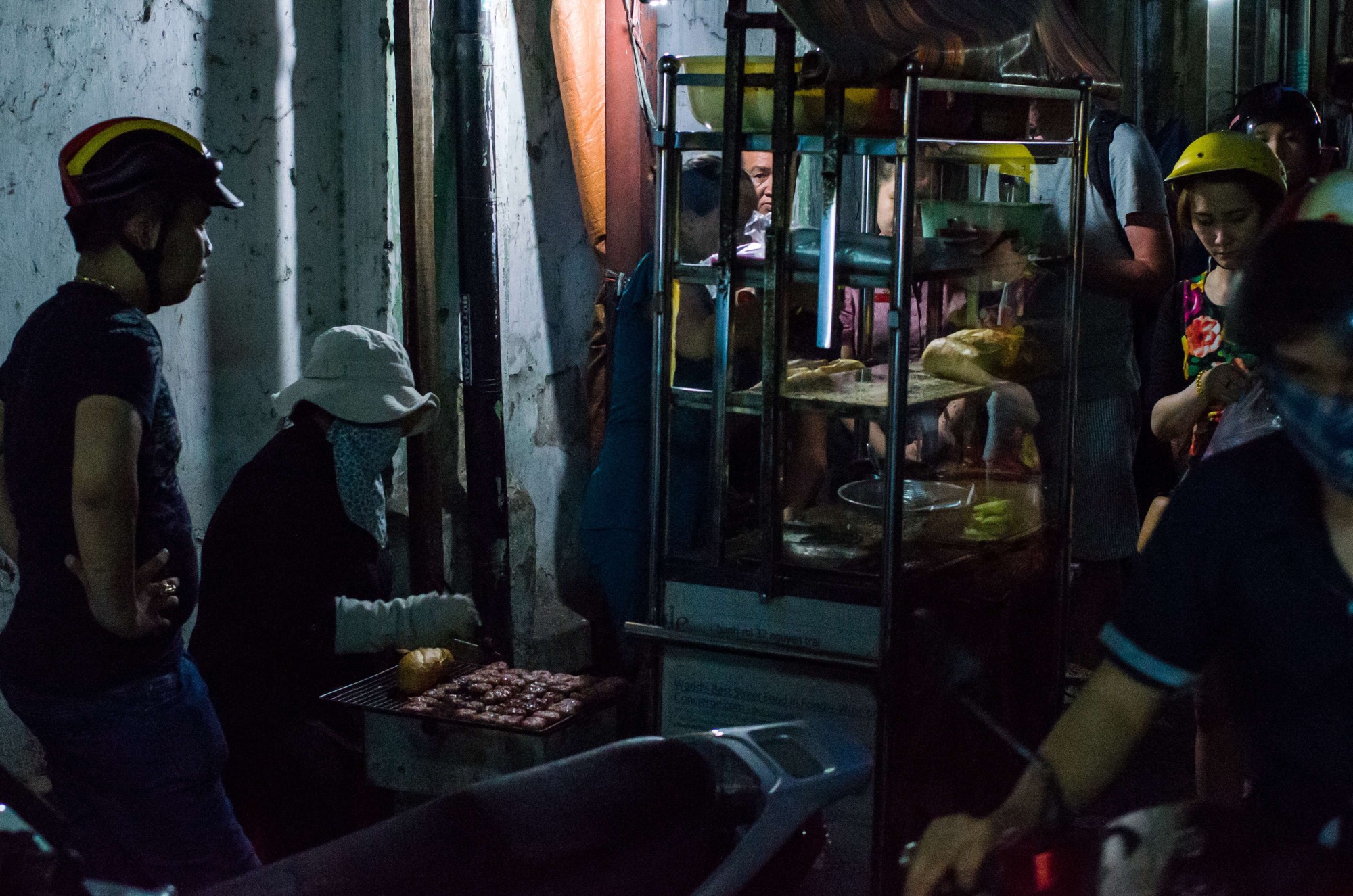
Gluttony Expedition – The Dark Heron, Ho Chi Minh, Vietnam

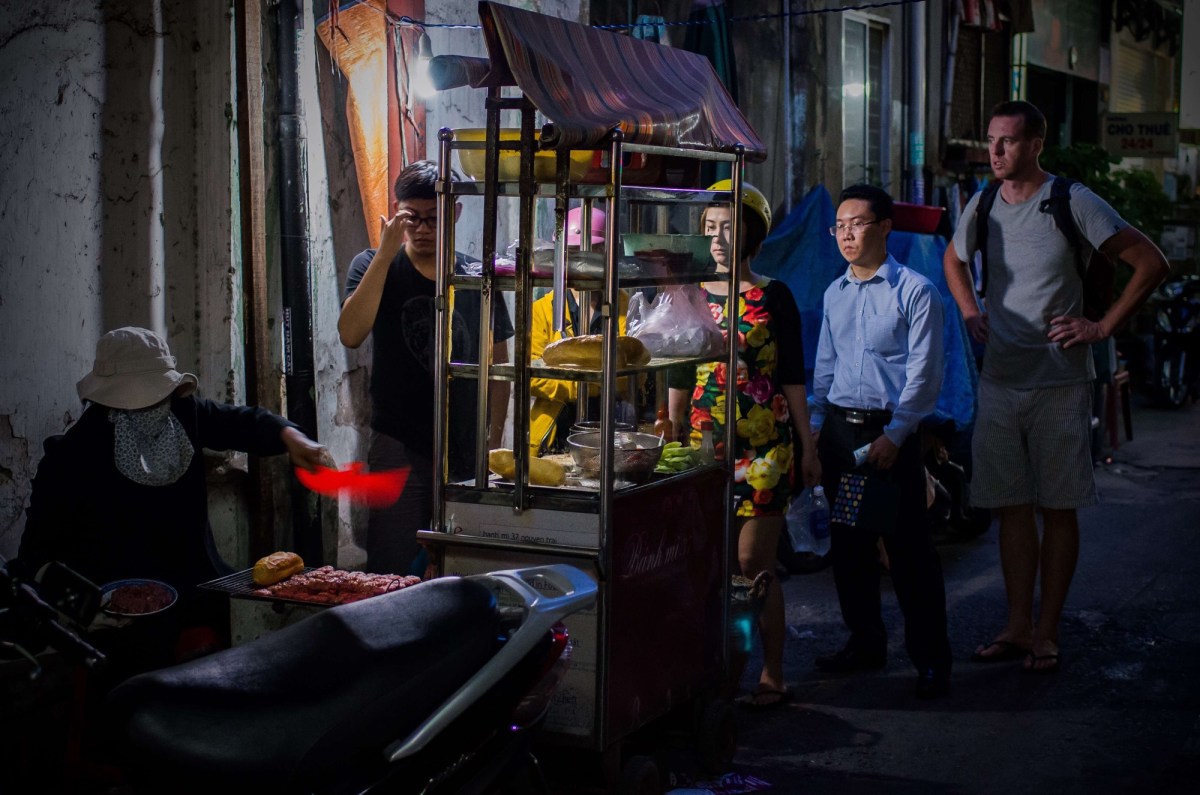
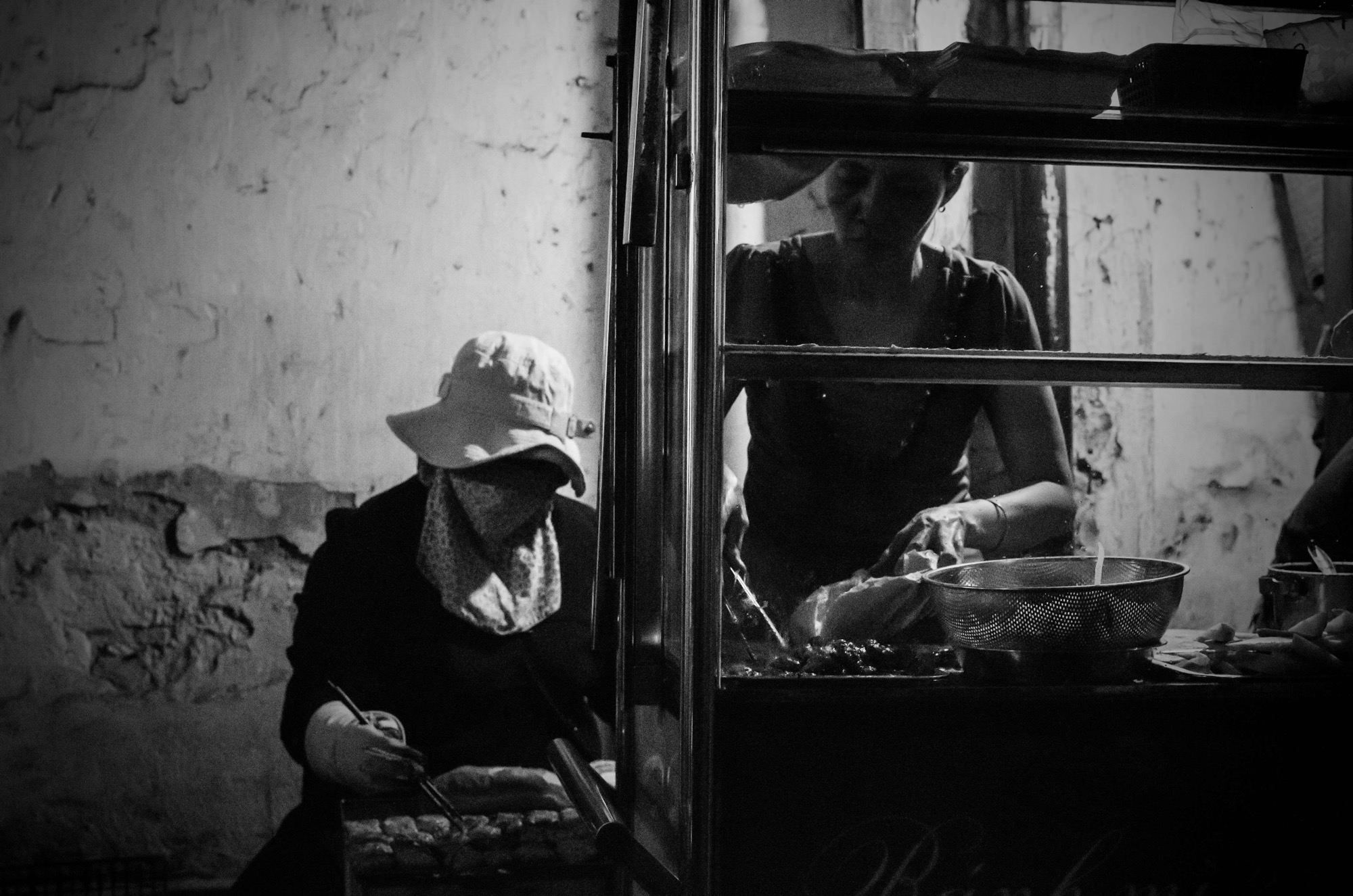
We follow our scratchy paper map weaving through the hectic rampage of Ho Chi Minh to the street corner we seek, the next alley on our right is where we get our fix, the lady with the stuff; it can’t be far. Sure enough the alleyway is there, swept concrete of no more than a couple of metres wide and flanked by windowless cliffs of urbanity reduces the former complexity of our map to a single thread. There’s a small box on the ground with some burning embers topped by a fine mesh griddle to greet us. Darting like a heron, chopsticks fly to snap up and turn tiny meat patties sizzling and protesting like witches burnt at the stake, eyes obscured under the broad brim of a hat. There’s a young boy here too, he looks at us quizzically, your faces don’t belong here his says with eyes alone. 

 A quick glance up and down the alley: gradual descent into darkness fills an unknown on one side while soft afternoon light flickers with the fluttering urgency of a heaving city from the way we came. The boy is still looking, we know too well that we don’t belong here but we need this, we’ve come too far to turn back as our urges overcome timid objections, need is all we know. I hold up one finger before glancing to Charlie, eyes filled with eager desperation waiting for him to urge me to more than just one. I need more but the young boys eyes of warning are now joined by the heron like lady crouching so comfortably on this concrete, and no acquiescence to desire is coming from Charlie. I hold up one finger again.  

Charlie Winn

The dark heron at work, back alley food stalls, Ho Chi Minh City, Vietnam

  The dark heron snaps and five victims are plucked form the burning embered pond, we’ve waited too long for this. For a moment I stop scratching my forearm and Charlie’s eyes seem to be looking at something rather than an indescript longing, lost somewhere too far away. The heron has hunted and resumes her foraging, the young boy says ‘seventeen’ in surprisingly good english as he hands us our baguette to send us on our way toward the bustling end of the alley rather than the shadows of an unknown alternative. Pre endorphins rush to precede the hit, the wrapping is off before we’ve made it the few steps back into a bright world; for the first time in my life I feel empathy towards junkies. Sadness threatens to swallow me though, they say you can never replicate the first hit but right now the first hit is all I have. 

 The junkie well, into which we so willingly jump pulls us ever further down, the mere concept of food takes on religious proportions to us but when it’s street food it becomes spiritual. We have definitely saved the best for last with three of our favourite cuisines bringing this trip home, Thailand, Vietnam and Japan all rate highly on our list along with most of the world I imagine; let the great asian title fight begin. The baguette crunches into light nothingness and inside it a collection of the sweet meat patties alongside crispy vegetables and that little special something that, just like all good drug dealers, the dark heron has laced her poison with. We say we won’t be back but we know it as much as the dark heron knows it. Laughable; as if we say we won’t be back, we’re making plans to return before we reach the next corner. 

Charlie Winn

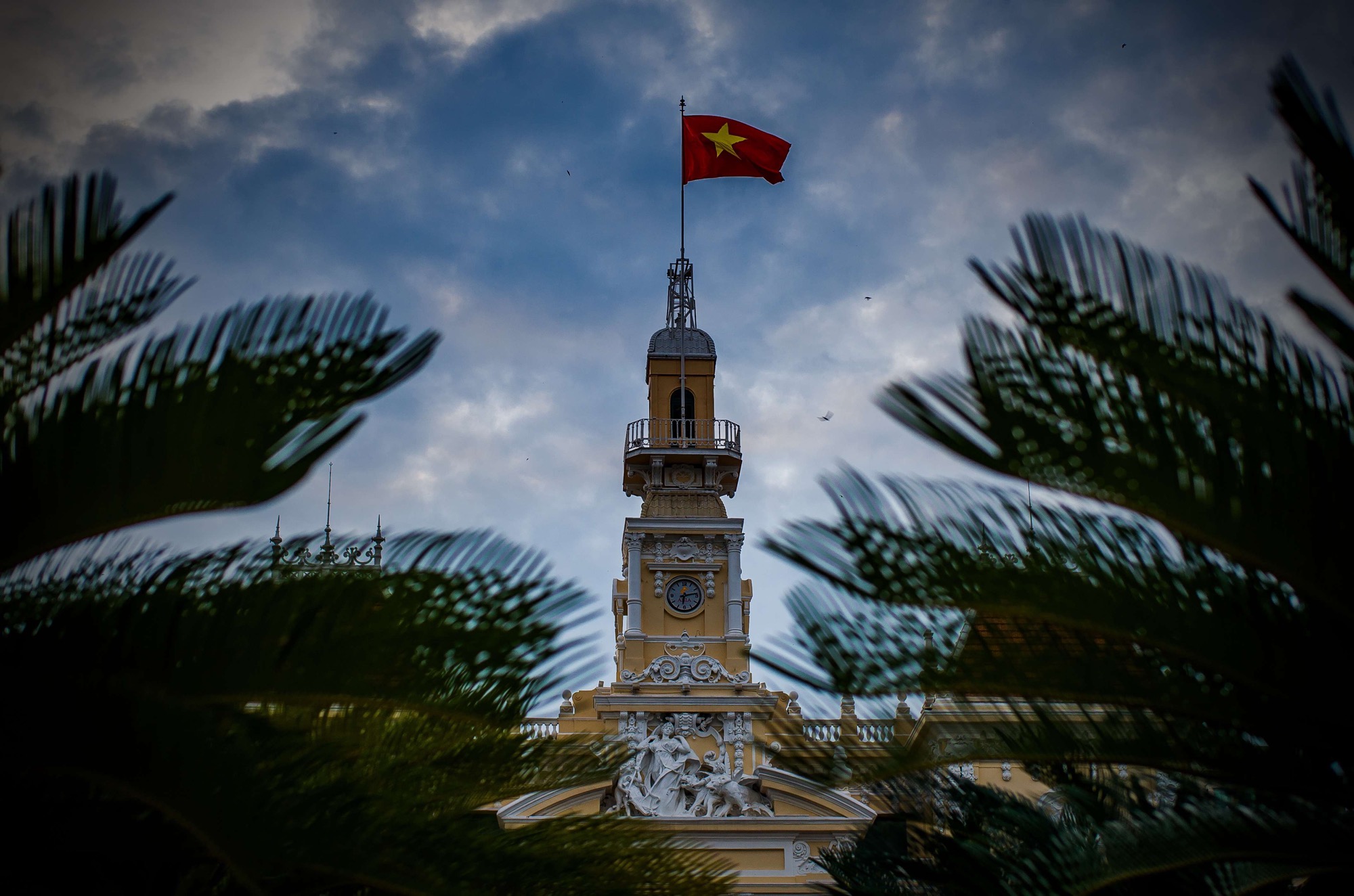
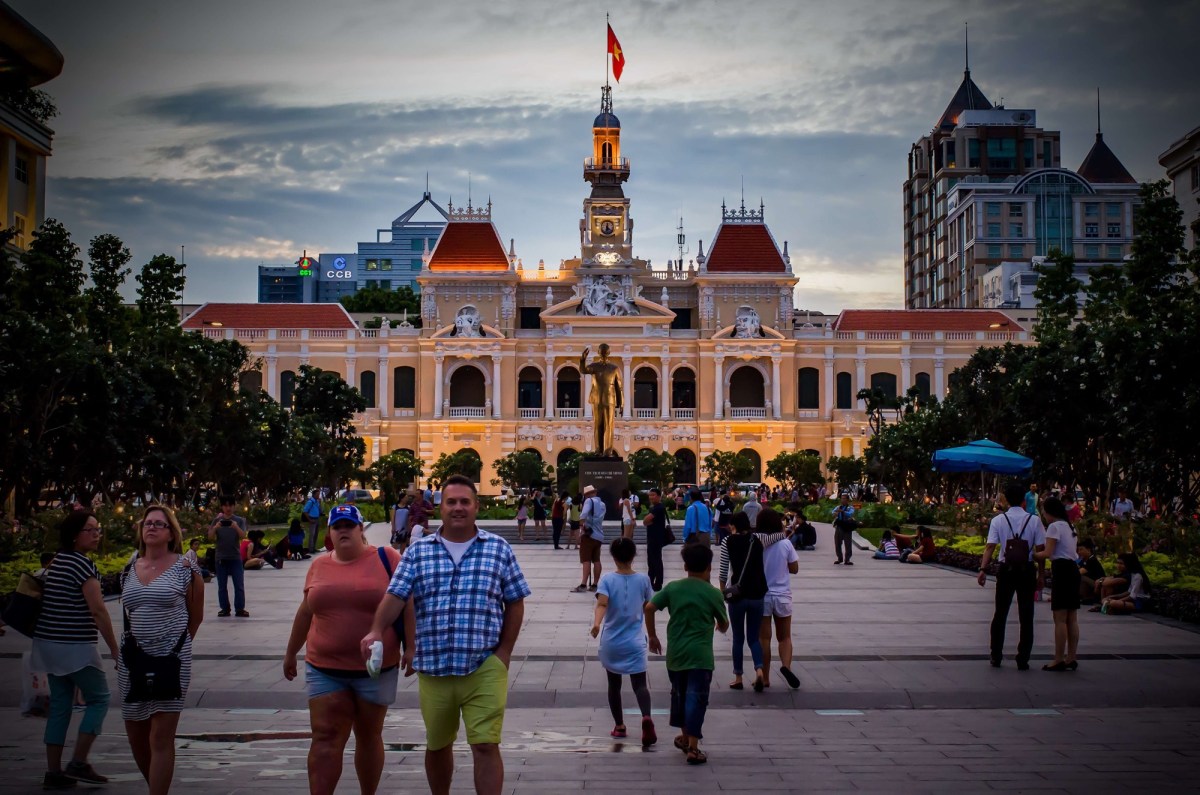
Vietnamese flag flying over Ho Chi Minh City hall, Vietnam

  It’s our first afternoon in Vietnam, Ho Chi Minh city is a food junkies paradise and we walk the streets to affix ourselves to our habit as firmly as possible. Surprisingly clean streets and alleys surround us and the million bikes that flow through the streets like water in the canals of Venice guide our way to the market and another fix. This time we have no reputable dealer but we sit down to spring rolls and barbecued pork grilled on it’s sugar cane skewer. Already there’s no turning back from the firm commitment to eat nothing outside of local eateries shunning the easy comfort of more western style offerings. Of course it all tastes delicious, it’s healthy, but the macro critique of the food itself seems trivial in the face of the concept of street food: like junkies getting a fix, saying it’s delicious just entertains the possibility that it could be otherwise.  

 Black sticky rice with coconut sends us on our way and into the raging waters of streets that flow like water rather than a collection of metal objects so inflexible. Cars follow the signs and lights but bikes do not, major streets are hundreds and hundreds of bikes pouring down upon us like dams that have burst, a leap of faith is required to cross the torrent. And so we walk, into the gnashing jaws of the tsunami as the roar flows around us; Jesus apparently walked on water, a trifling parlour trick compared to a tsunami bowing to part way for us.  

Charlie Winn

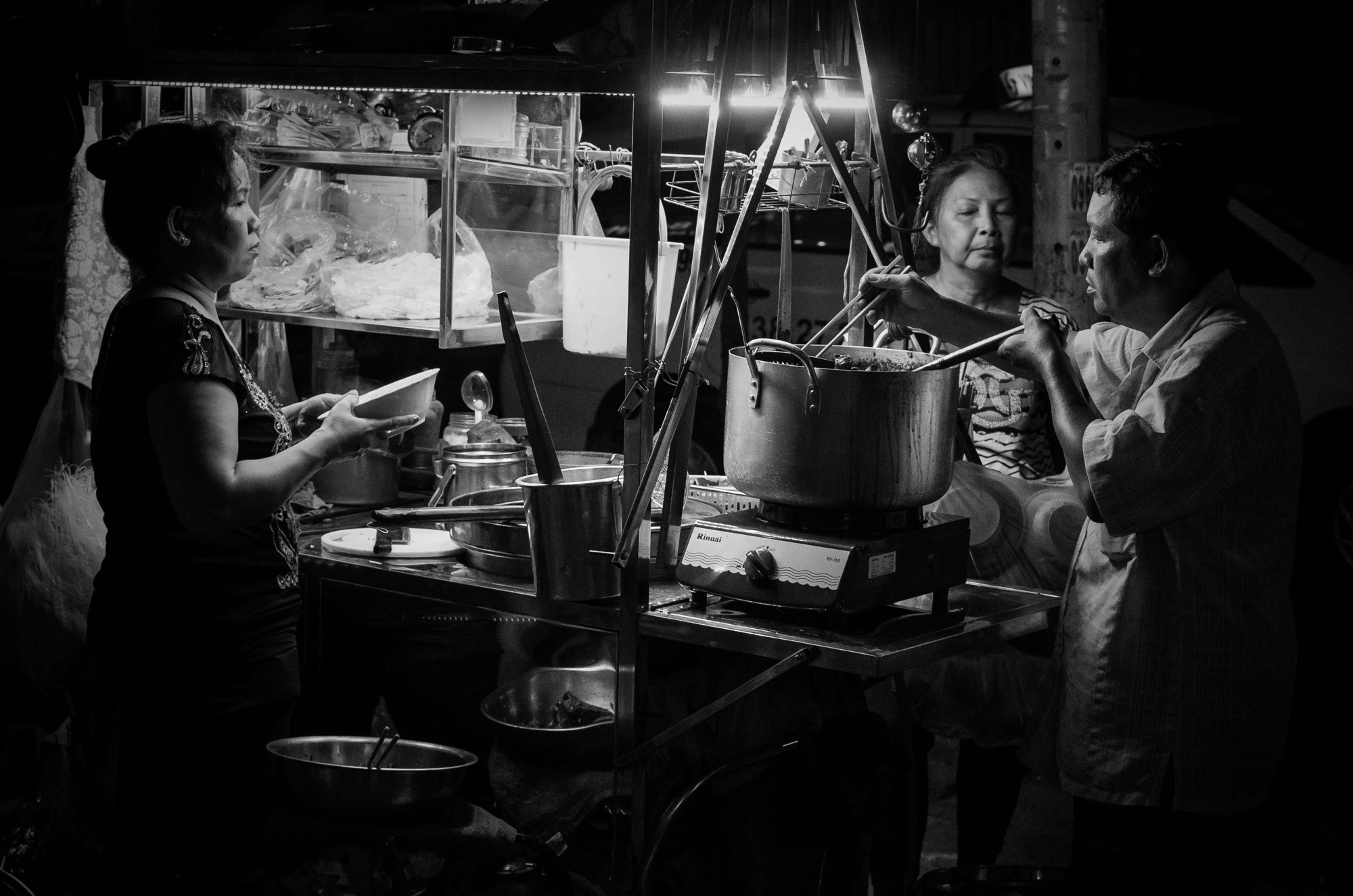
Noodles with beef soup stall, back alleys of Ho Chi Minh City, Vietnam

  The ramshackle simplicity of street food anywhere is its charm and nowhere hits that nail on the head better than Vietnam, on first glance at least. A cutaway tin can, a piece of iron roofing or a beaten pot that had seen better days decades ago yet still goes strong are the tools of the trade; nothing that we would call a cooking implement seems appropriate. From this discarded world the greatest bounty comes; again saying that the food is delicious seems rude and ignorant, of course it is, it’s the setting and lifestyle that truly hooks into our flesh and pulls us in. The idea of ‘behind closed doors’ seems a distant notion, the world here shares the world, it laughs together, cries together and all the while it eats together. 

 In our culture we laud the romance of a family dinner table, a place to connect, share and often do what we define as being family. What if you needed no sanctuary of space behind closed doors, no big table, no confinement to a Sunday afternoon time-slot? What if we could take all that is held dear and cherished about the family dinner table and not only make it every meal but share it beyond our nearest clan, with the world? Love and companionship is extended to a broader society on an open invitation to come and share with the universal accessibility of a fruit box or upturned paint can chair; it’s not as idealistic as you might think. 
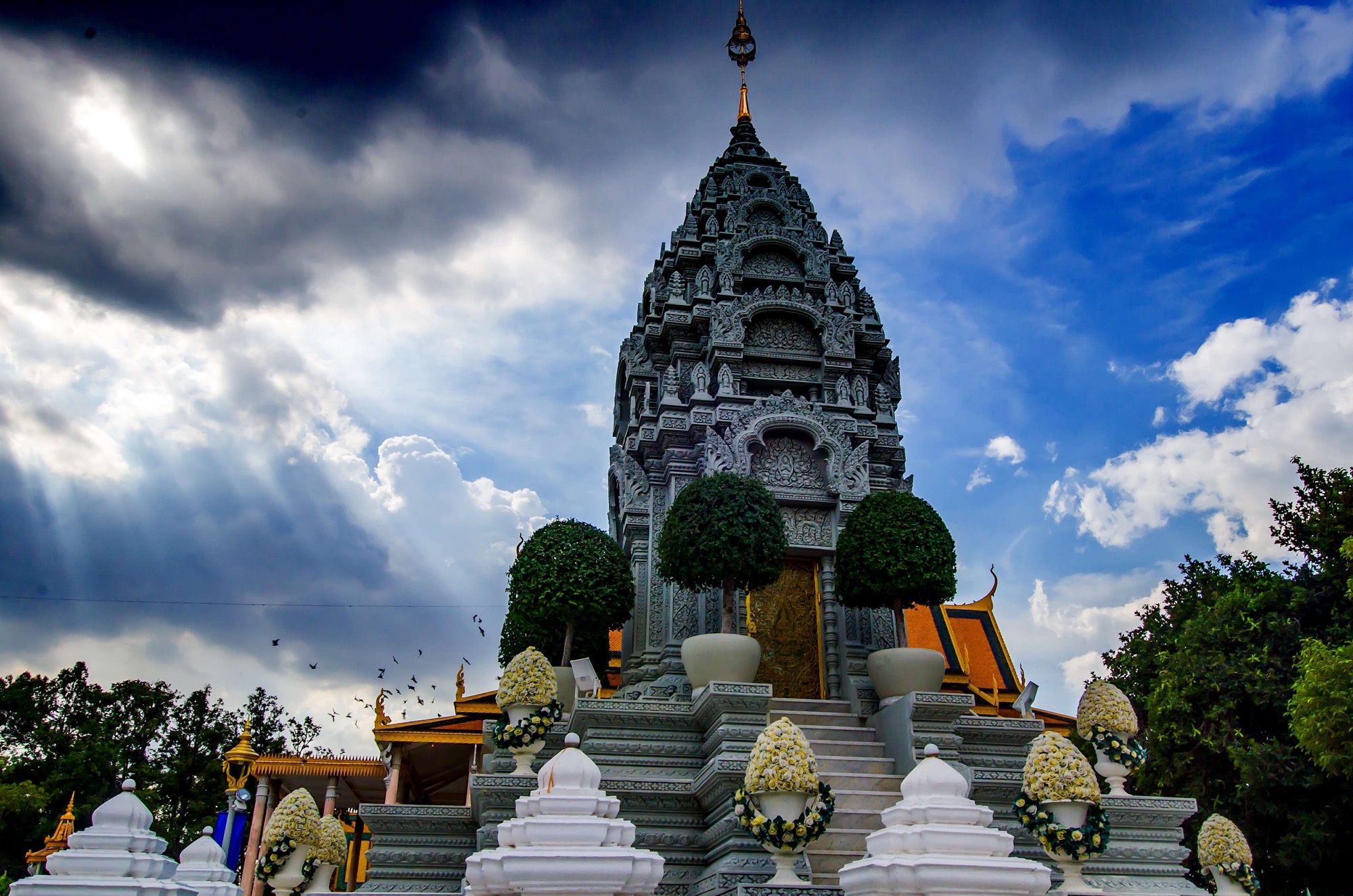
Gluttony Expedition – Walking tall, Ho Chi Minh, Vietnam

 Spat out into the world once again; a new city to explore, a new culture to taste, a new language we can’t speak. There’s a mountain of history pouring down on us in Ho Chi Minh, the southern capital of Vietnam but for now the long stories of Vietnam and its place in the region are reflecting only in the gleaming facade of a modern asian city. A somewhat out of place cleanliness surrounds a more comforting sense of chaos as this polished commercial edifice makes no attempt to quell the no-nonsense irrepressibility of a nation borne on raw bravery more at home in a rice paddy than a skyscraper. A history that has shaped this nation is however never far away, there’s nothing passive, benign, disconnected or lethargic; this is not a culture on the lazy downslope of a generation born to expectation. 

 Market time again. The walk through the market is nothing short of an adventure itself as we dodge and fend off friendly insistent advances. Where Cambodian culture just makes you want to give it a cuddle, Vietnam is a splashing battle in the pool or the juvenile sleepover pillow fight, smiling yet on guard. Have we been travelling too long that sparring with street sellers is now truly a fun exercise? Victory is declared, victory over the vendors, victory over the lack of language and most importantly, victory over the need for breakfast. In truth the final battle here is a mock victory, I think we could ask the dude fixing motorbikes to whip us up some brekky and it would reduce our vocabulary to positive grunts and groans. From selling to eating, no venture great or small is adopted with lethargy or assumption; Vietnam you are winning already. 

Charlie Winn

Steve enjoying a local eatery, indoor this time. Ho Chi Minh city, Vietnam

  We have admittedly been easy beats so far, Vietnamese food and cooking has no downside with us but the flighty evasive coffee snobs are about to descend, the crowd is hushed. On a tip from a guy in Phnom Penh we seek out Workshop, a cafe tucked on level two of an old French style industrial building that has seen better times. The chic industrial renovation takes us all the way back home, this is looking good but what’s in the cup is what this hike across town is all about. We have had good coffee along the way, Ristr8to in Chiang Mai, Wonderful in Santiago and LatteTe in Buenos Aires join warehouse in the heavy weight ring but none deserve defeat as warehouse stands tall among elite company. Vietnam is the worlds second larges producer of coffee beans but its reputation is all about volume, not quality; reputations can be so fickle. Vietnam, you can’t win all the time. Surely?

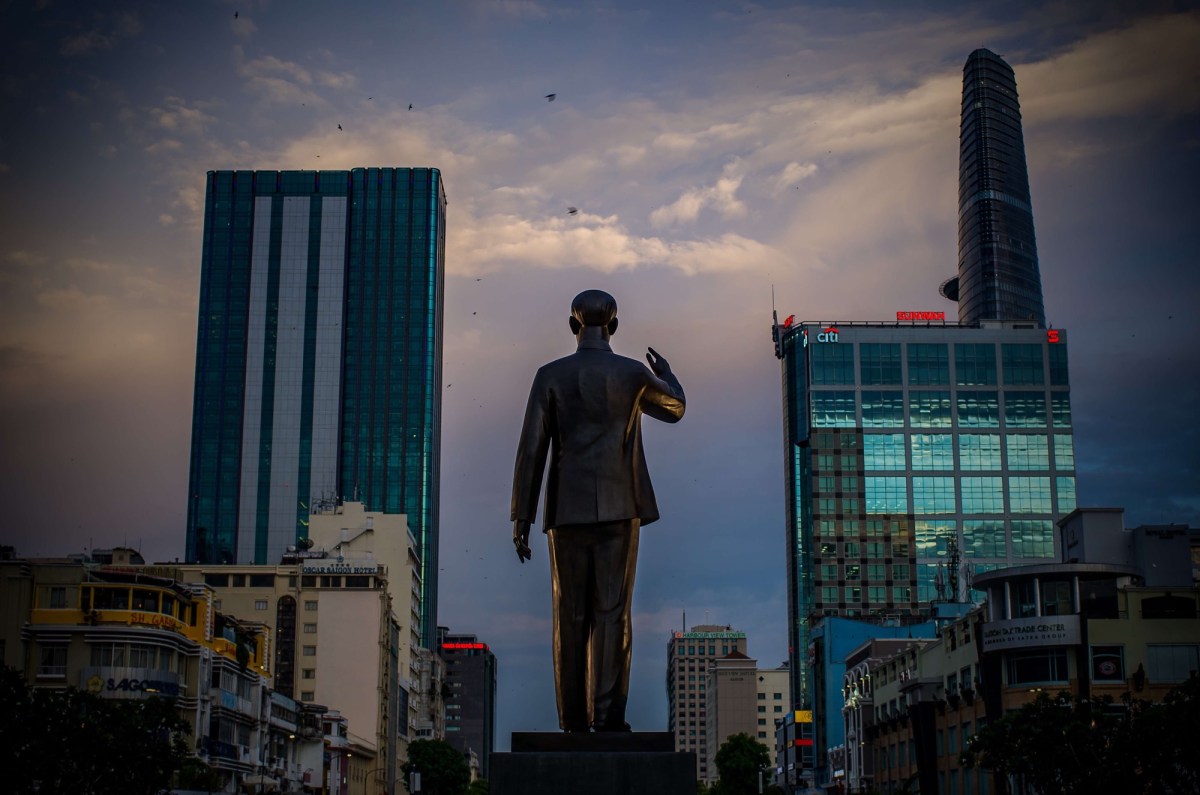
 Lunch comes and goes in a flurry of sounds that would sit aptly on low-brow pornography than a local eatery but we’re coming to expect little else from this big city named after a little man. Ho Chi Minh, or uncle Ho as he’s known here, may have one of the most famous goatees in history but it’s a mere novelty to his impressive history of life achievements. His life spanned sojourns to the USA, France, Britain, Russia and China and after receiving his political education in France he returned home to Vietnam after a near 30 year absence to lead the liberation of his country. Ho remains the figurehead of modern Vietnam and largely skirts the stain of atrocity that seems to cling to communist leaders of his generation. Is his famous rift with China that solidified his positive story or was it his irrepressible story that forced the rift with China? 

Charlie Winn

Back alleyways of Ho Chi Minh city, Vietnam

  The swirl of influences that is Ho Chi Minh city flies at us from all directions like the traffic tsunami that is a more of a mass migration of scooters, this first day is too much for one day, this city too much for one city. The world not only refines to a point, that world not only fits itself into one day, in Ho Chi Minh city it does it all better than the places in which it borrows inspiration from. Somewhere along the line of Chinese dynasties, French colonialism, Japanese occupation and American atrocity Vietnam not only kept its stride but now stands alone in the ring as an undisputed victor on so many fronts. The weight of the world has been burdened to the shoulders of the Vietnamese for centuries who don’t only bare that weight but stand tall with it rather than succumbing to its crushing burden. 

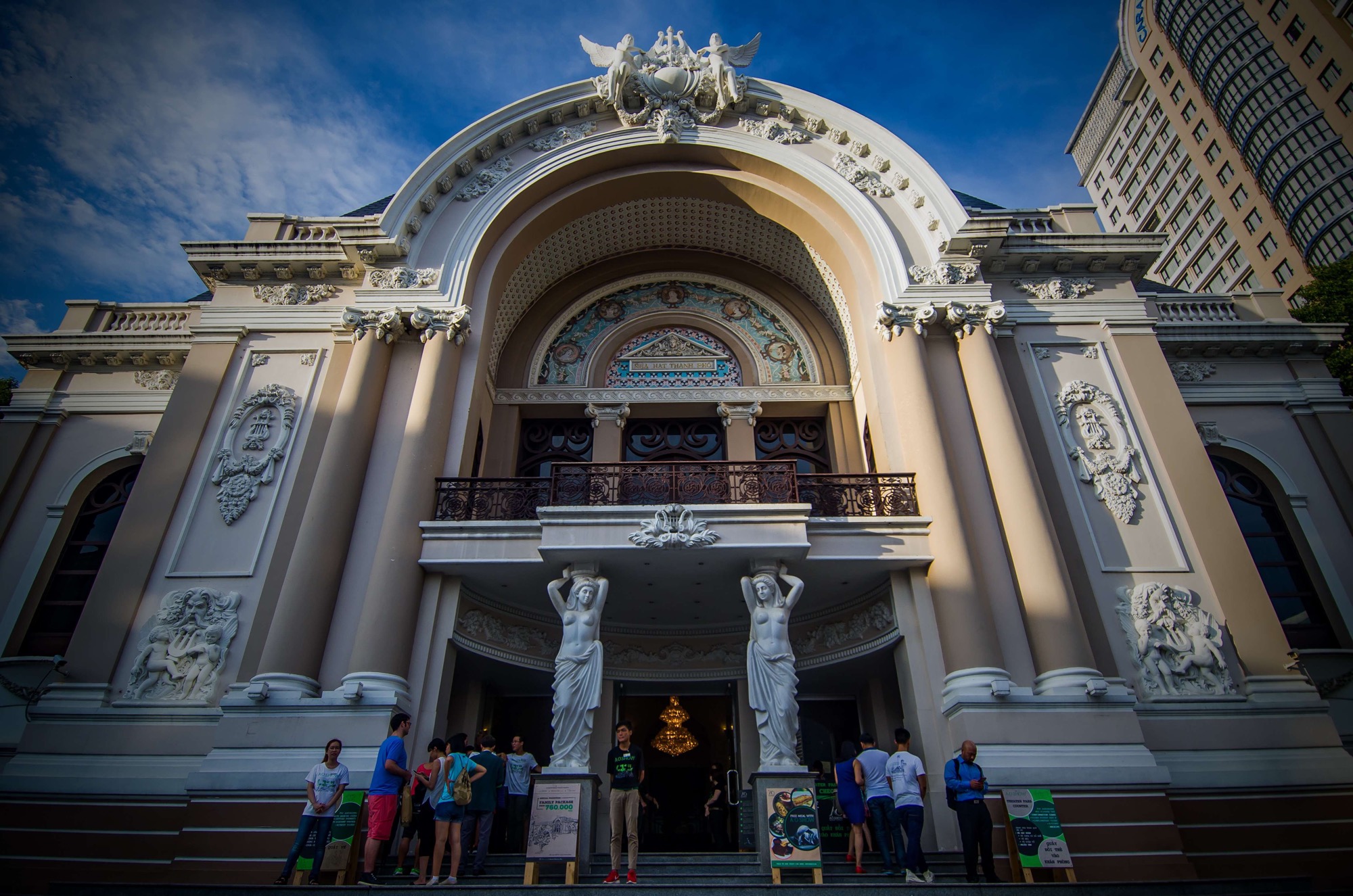
 Fittingly we aren’t pegged into a one trick pony of a place, not content to graft just a gritty local style, it’s off to the theatre in the glorious Ho Chi Minh opera house. The glamorous bit will start soon, for now we’re tripled on the back of a scooter and whizzing through the streets in the only manner scarier than walking them. We’re far too big for these bikes, I’m literally holding my legs off the ground with my fingers hooked into my jeans in a scene as absurd as it is funny. No one seems to even look at us. Arriving in style, a style at least, our world of patina so rapidly becomes ornate ceilings, plush chairs and demure silence. Just like the layered history of this nation the performance is a slice of dance, acrobatics, circus, lyric theatre, traditional storytelling and comedy. Of course it’s the best of everything in a town that seems to make the concept an afterthought, visually stunning with little more that a bunch of big pieces of bamboo.  

Charlie Winn

Ho Chi Minh City Opera House, Vietnam

  It’s a first impression, a giddily exciting travellers introduction but walking into a world that has had to fight for centuries just to call their lives their own fills us with a vim too unrelenting to discredit as a whim. It’s possible to say that laziness is the privilege of the comfortable, the comfort of the privileged; but neither of those elements exist here. Ho Chi Minh never lived to see the final unification of the nation he liberated but it’s southern capital Saigon now bears not only his name but his diverse world reach. Uncle Ho is the figurehead but Vietnam has fought off the worlds powers for centuries with a resolve and fortitude that is on show at every corner stall and whizzes past on every scooter. 

 The French cock, American eagle, British lion, Russian bear and Chinese sickle all take a back seat under the single star flag of Vietnam; influences true but nothing more. Few national personalities have shouted louder to us on this trip than Vietnamese resolve. In an overflowing day the world is on show in Vietnam and like the most recent slice of its tumultuous history, no other country has space to exist in a world already too full of a culture that won’t lie down or sit still. It’s too quick we say to ourselves, too early to declare such a bold and comprehensive critique, but as the world hustles by it’s equally undeniable. They’re friendly, polite and small of stature these people that have no knowledge of apathy and laziness; heaven help anyone that gets in the way of this nation that walks so proudly in no direction but forward. 
  

Top 10 – Cambodia

 The ancient city of Angkor could have a top ten all of its own such is its scale and grandeur. But that would be selling Cambodia short. Throughout this trip Cambodia has continued to surprise and refuse to be pegged into a preconception. So much of our adventure was teleported away to a different time, when Cambodia was a different country and we went along for the ride. So come with us, not only to where but when we enjoyed this great big little country. 

10 – Beach dinner: Sihanoukville, present day

 Papasan chairs on the sand, candles encased in former plastic water bottles a little melted at the top. Beating kids selling bracelets at paper-scissors-rock, fireworks and downing delicious khmer barbecue with a few beers and new mates. It feels a little like tourist ravaged Bali, just not putrid.

9 – Bokor Mountain: Bokor, 1920’s

 On a pristine hilltop overlooking the town of Kampot, Vietnam and the open ocean, Bokor mountain remains trapped in the 1920’s where many of it’s derelict buildings hail from. Initially a French escape from the heat, 900 people died in the construction of a grand resort which, along with a host of other ghost buildings, leaves the whole mountain trapped in time with ghosts to greet the visitors that scream up the hill on rented scooters. 

8 – The Foreign Correspondents Club: Phnom Penh, 1980’s and 90’s

 Heavy drinking, chain smoking, risk taking and fast talking were the order of the day; the characters that were foreign correspondents are sadly an endangered species nowadays. Overlooking the river this grand colonial building is the place for GnT to accompany your journey back to the time when brave intrepid reporters, risked their lives, slammed fists on the table, had fabulous hair and found the news rather than waited for it. No time better encompassed this maverick world than the heady danger of the Khmer Rouge from 1976-79, what stories were told at the FCC in those wild years? 

 7 – Street Stalls: Everywhere, present day

Charlie Winn

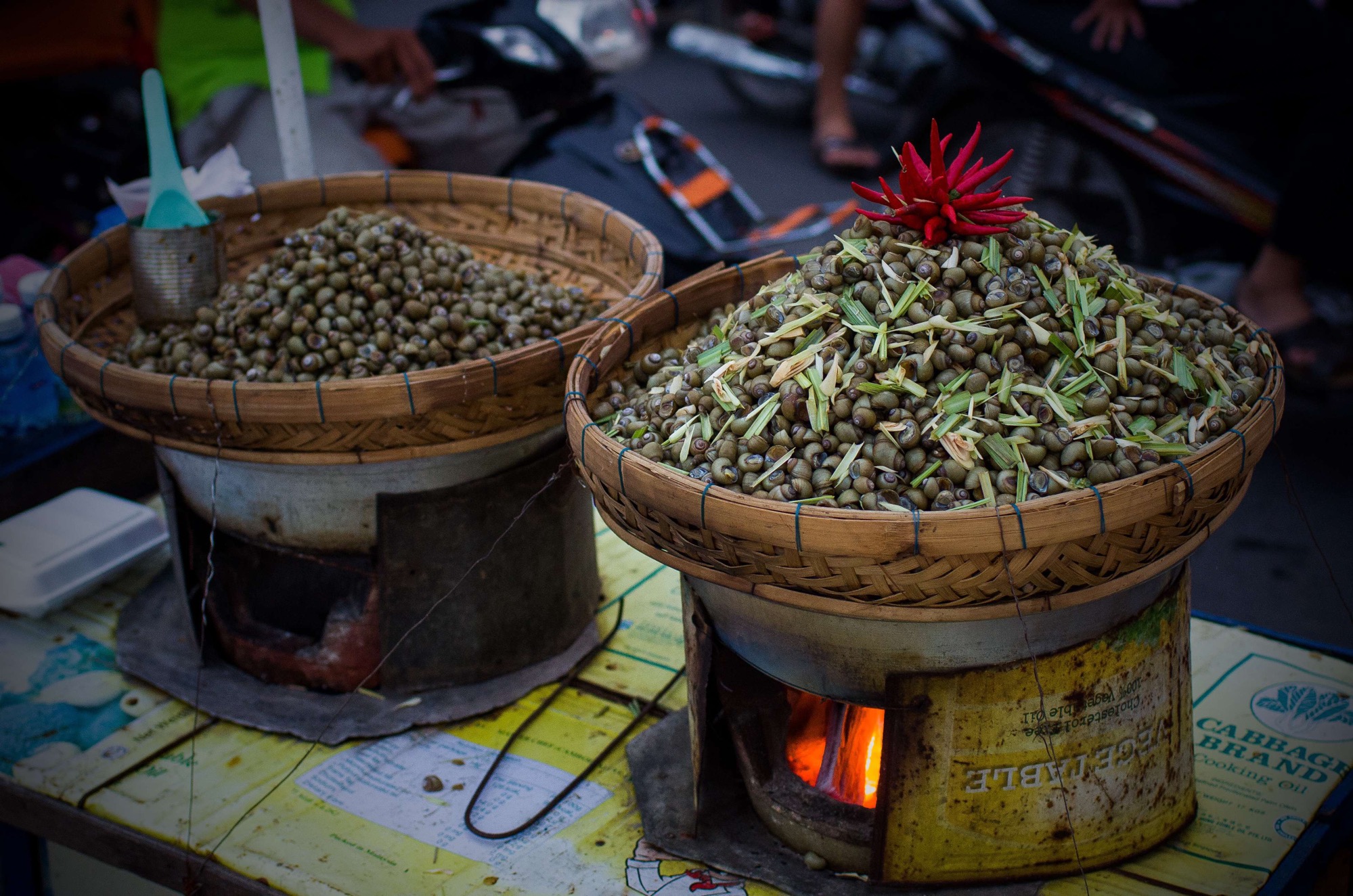
Braised snails for sale from a street stall, Phnom Penh, Cambodia

 Food stalls have been around forever and they’re not going anywhere anytime soon. Nothing so elegantly transforms a cracked pavement footpath, a street gutter with a little too much litter in it or even a beach quite like street food. Routinely better than cafe or restaurant food for a fraction of the price it’s more than food, it’s an emblem of life on the streets, a society being social. Noodles, soups, meat on a stick are all great but little can touch the juggernaut that is a green papaya salad, a borderline national emblem if ever there was one.

 6 – Kampot town: Kampot, Early 20th century 

 Another getaway from the big town of Phnom Penh; Kampot sits snuggled on the coast and bristles with former charm and fading glamour. It’s gritty and rough but like some rare places, this all just seems to be beautiful. Throw in nearby Kep and this small part of the coast is the getaway from the getaway to let your worries slip by on the slow rivers slide to the sea.  

 5 – Koh Rong Sanloem: South West Coast, The Future

Charlie Winn

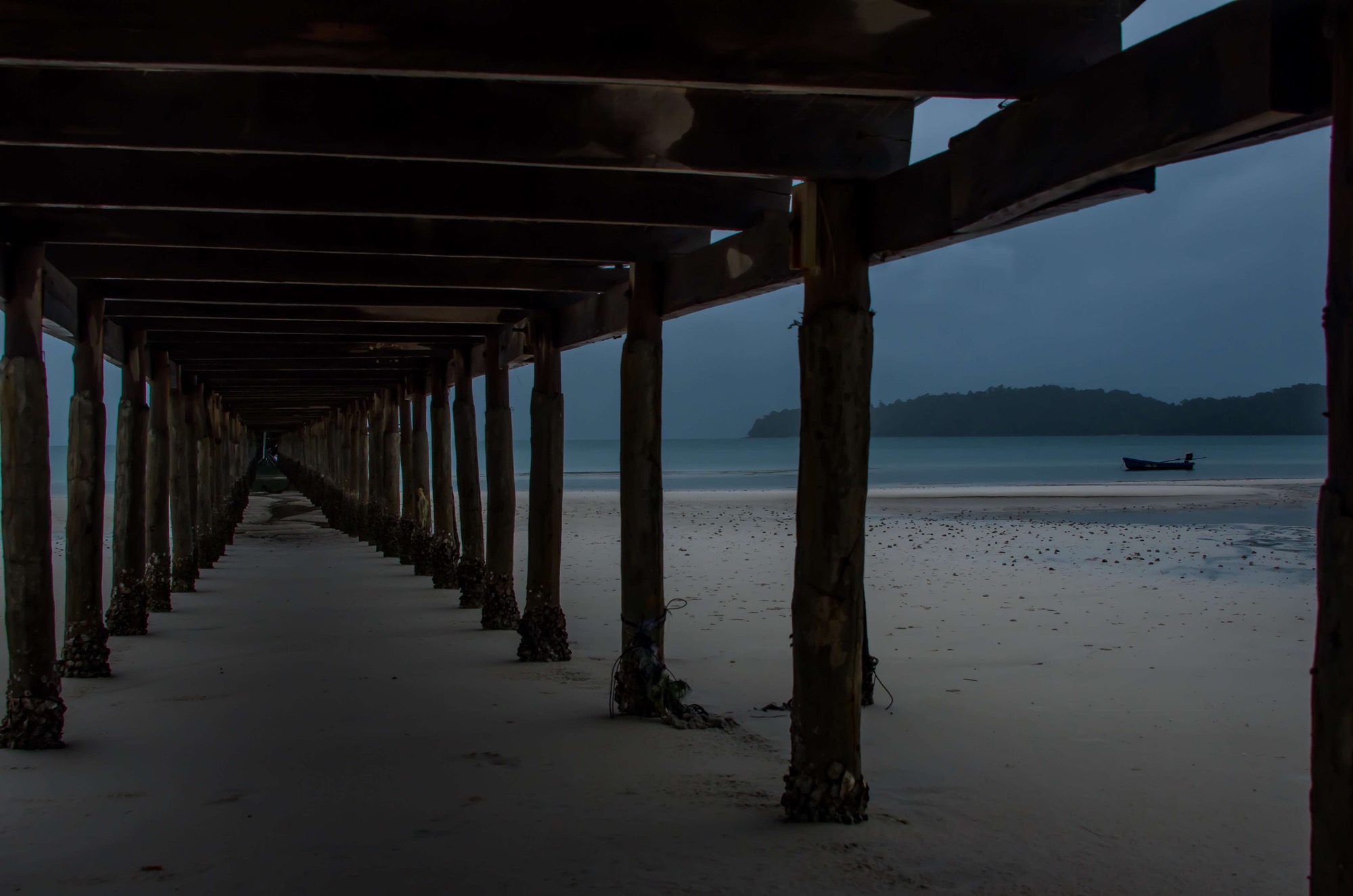
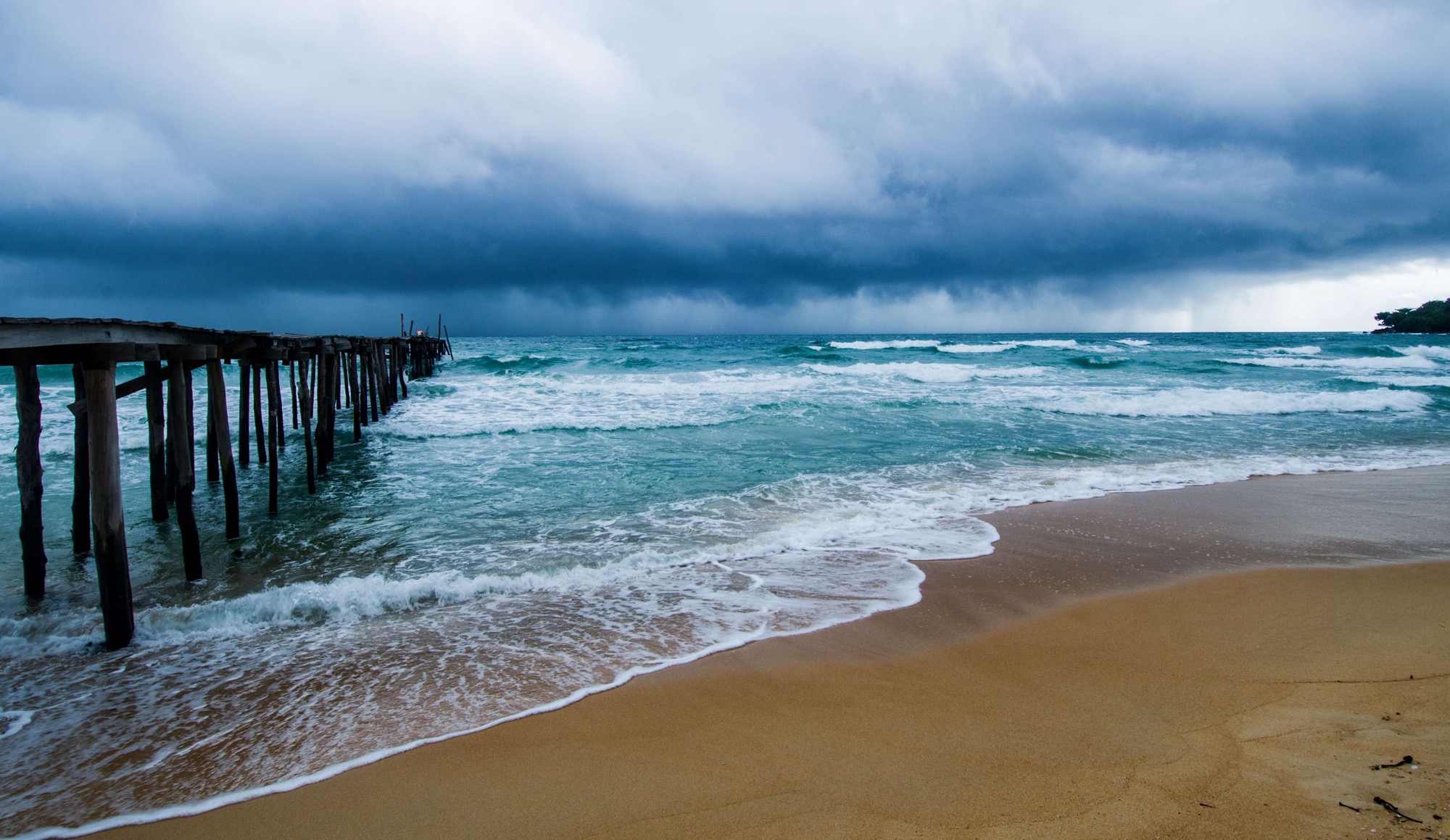
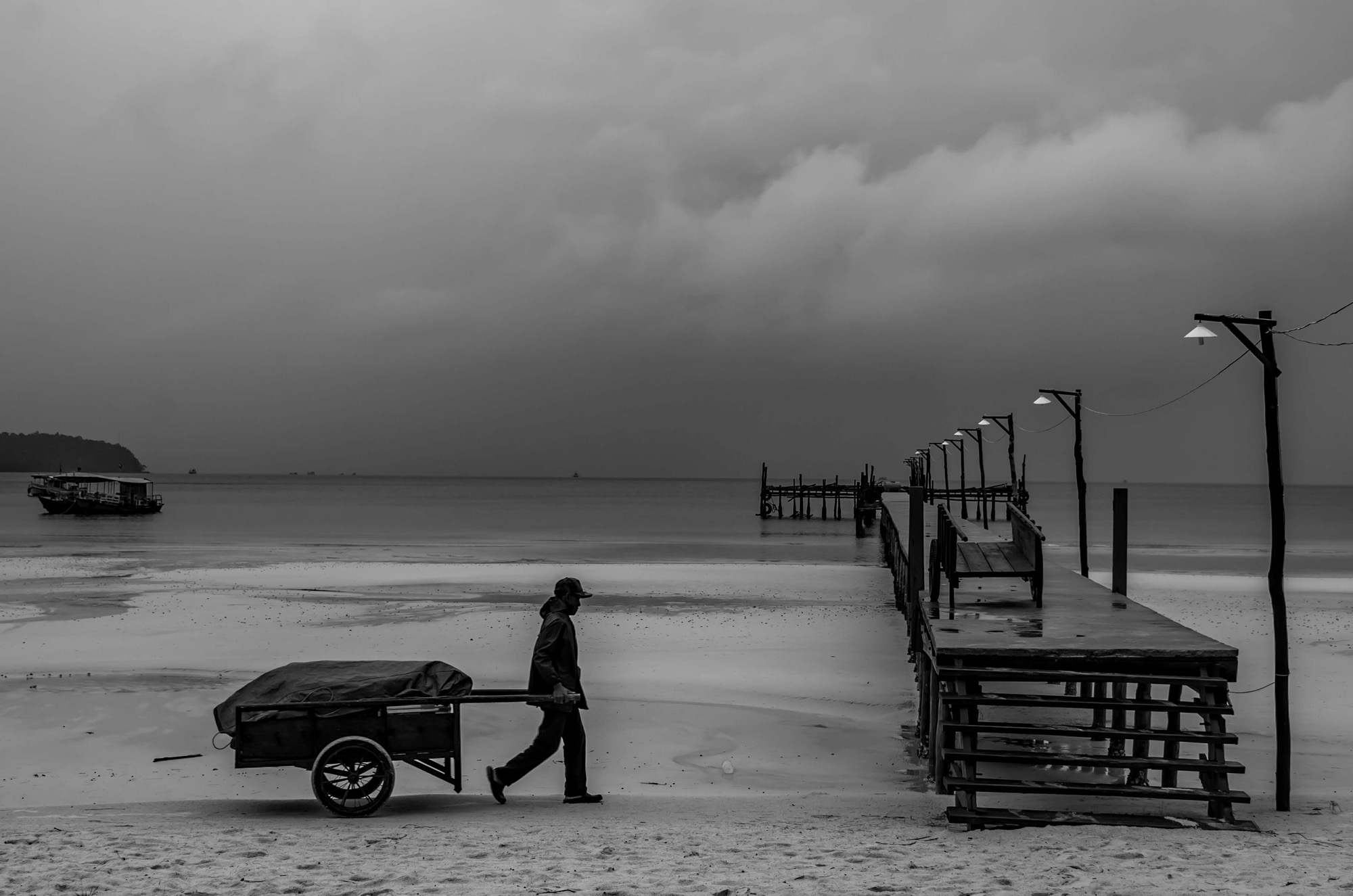
Rainy Koh Rong Sanloem, Cambodia

So much of Cambodia’s attraction lies in its history both ancient and recent, grand and horrific. We can all name a place in the world that we think of when we wishfully air the term ‘tropical beach’ but few would immediately say Cambodia. We should, its white sand, turquoise waters and coconut palms have ben plucked straight from postcards and so far it remains that way yet to be overly trashed by tourists.

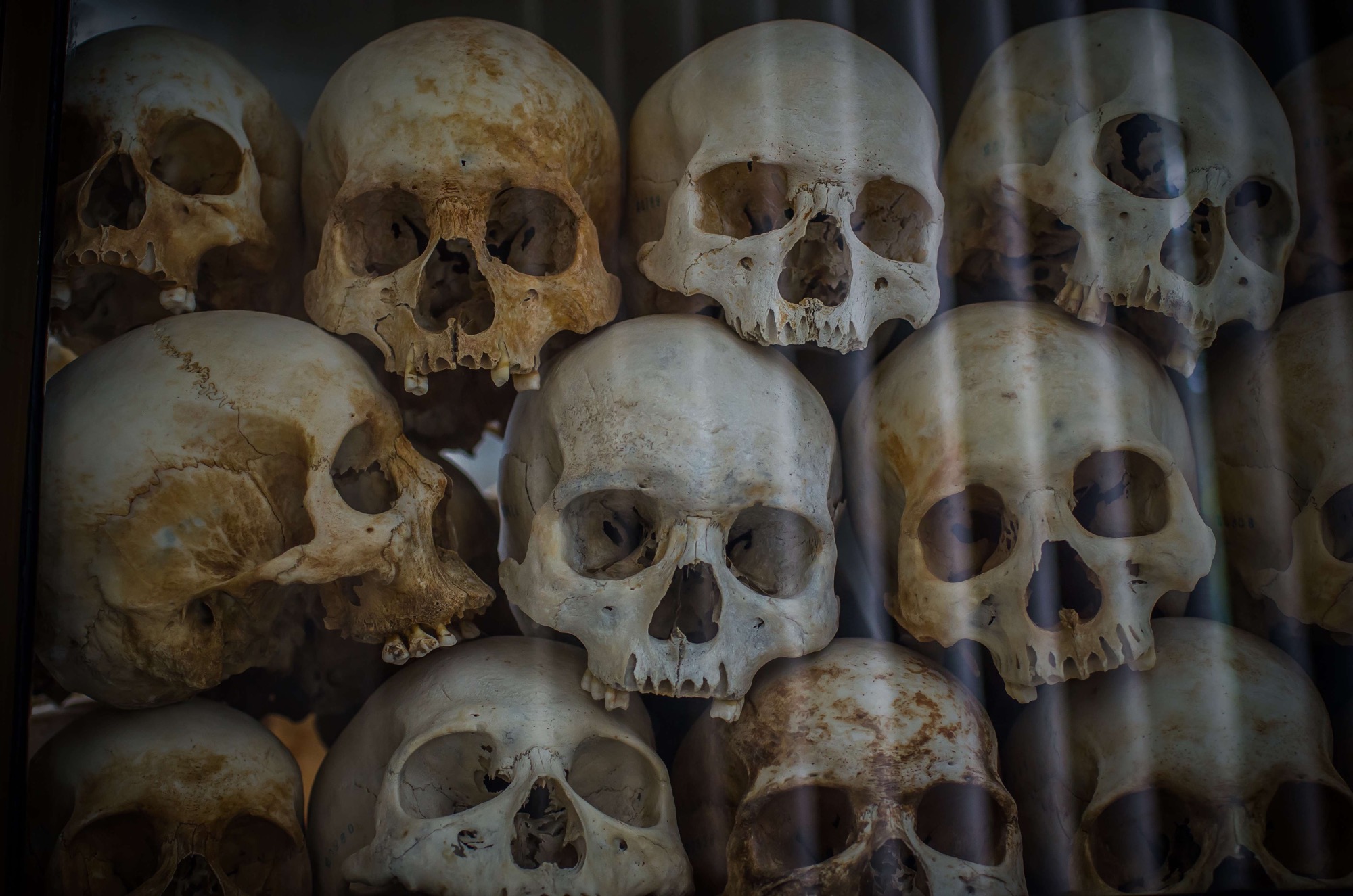
 4 – Choeng Ek (aka The Killing Fields): Phnom Penh, 1976-79

 A human abattoir is the only way to describe Choeng Ek, where the Khmer Rouge sent people to be butchered and lumped into mass graves. It’s an important part of Cambodian history, such was it’s impact. Locking yourself into the world of the audio set to be talked around the horrific place is a journey to the killing fields that every person to visit is happy to get away from; traumatising and captivating.  

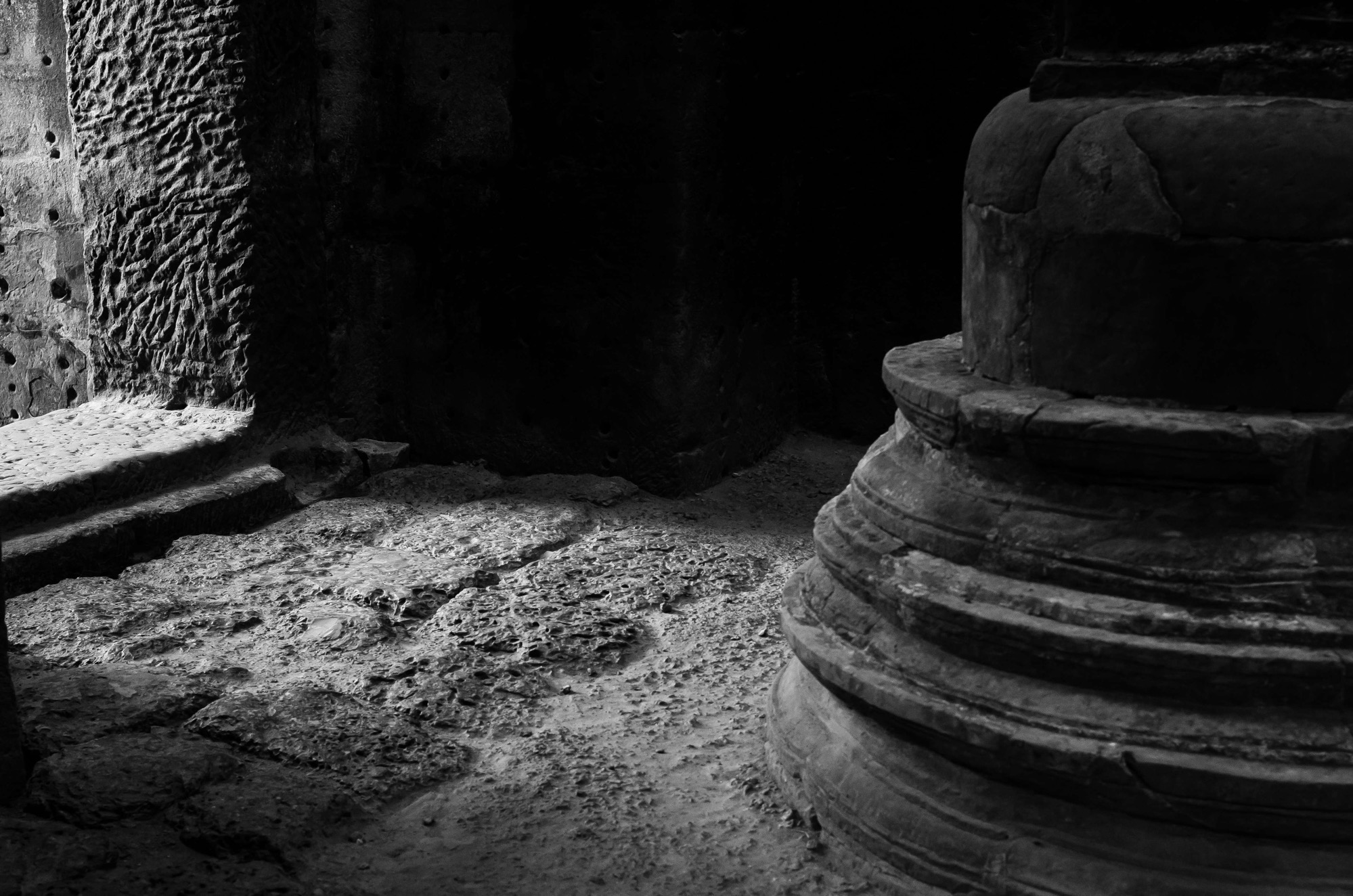
3 – Ta Prohm: Siem Reap, 13th century

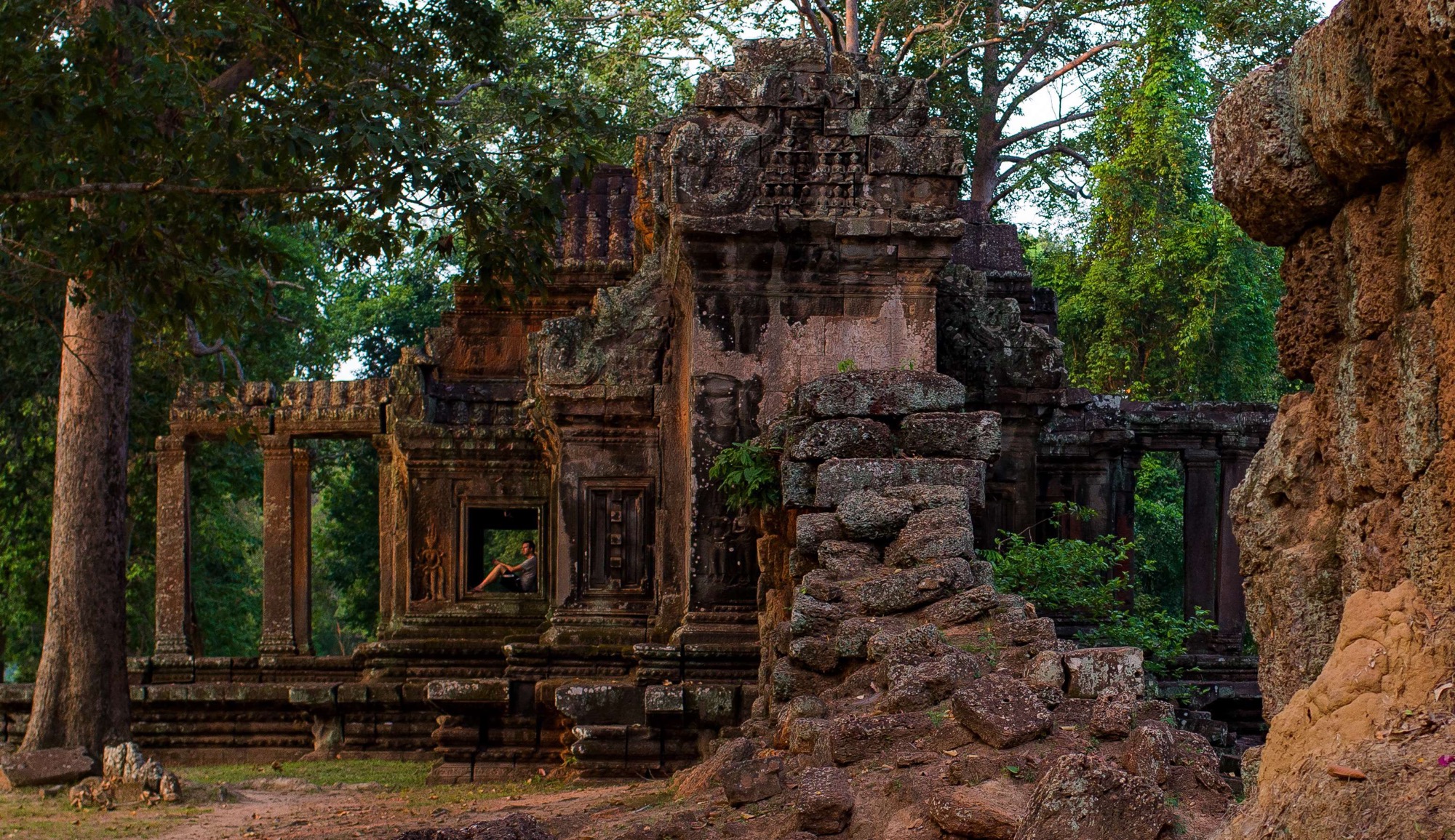
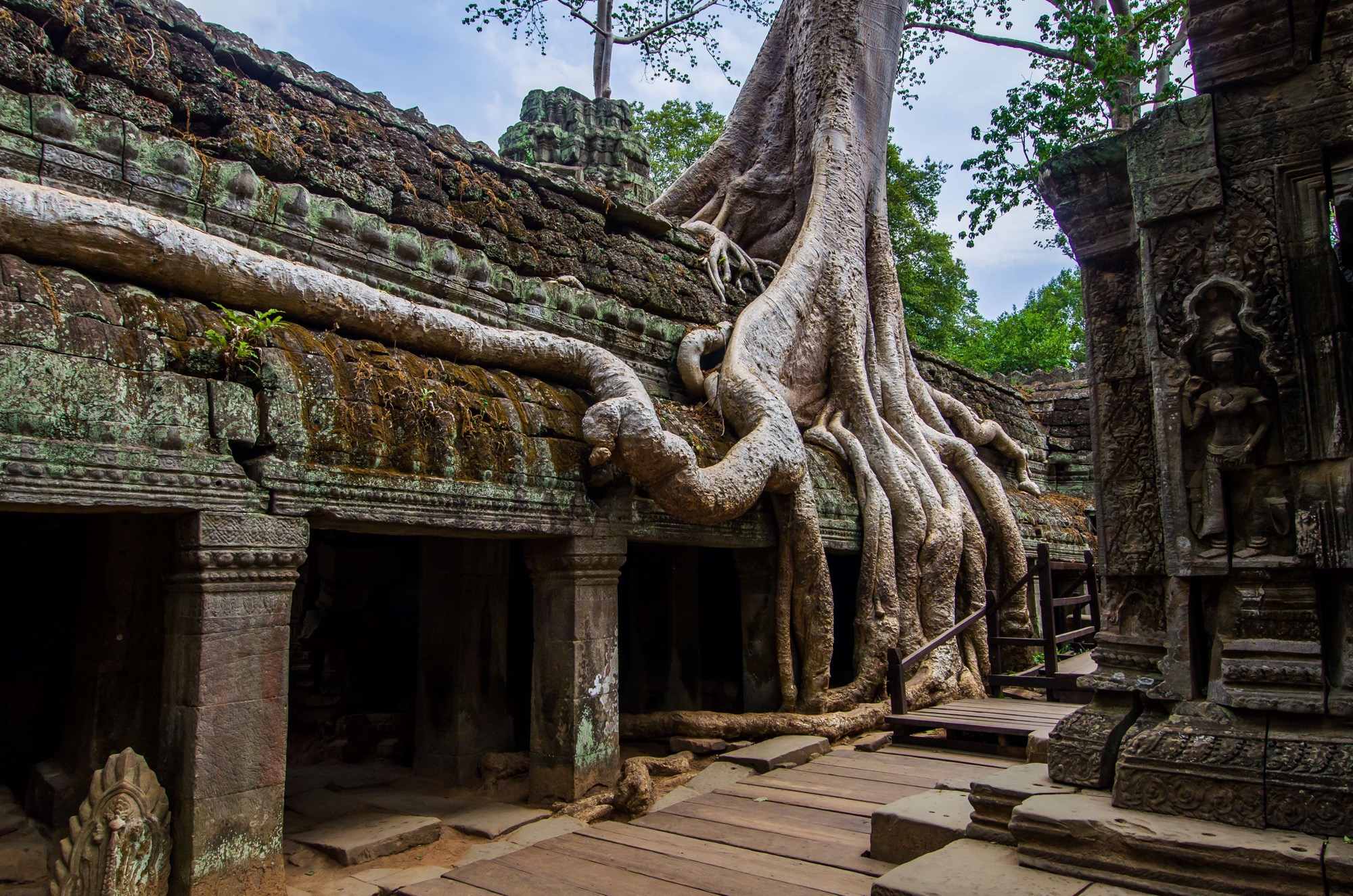
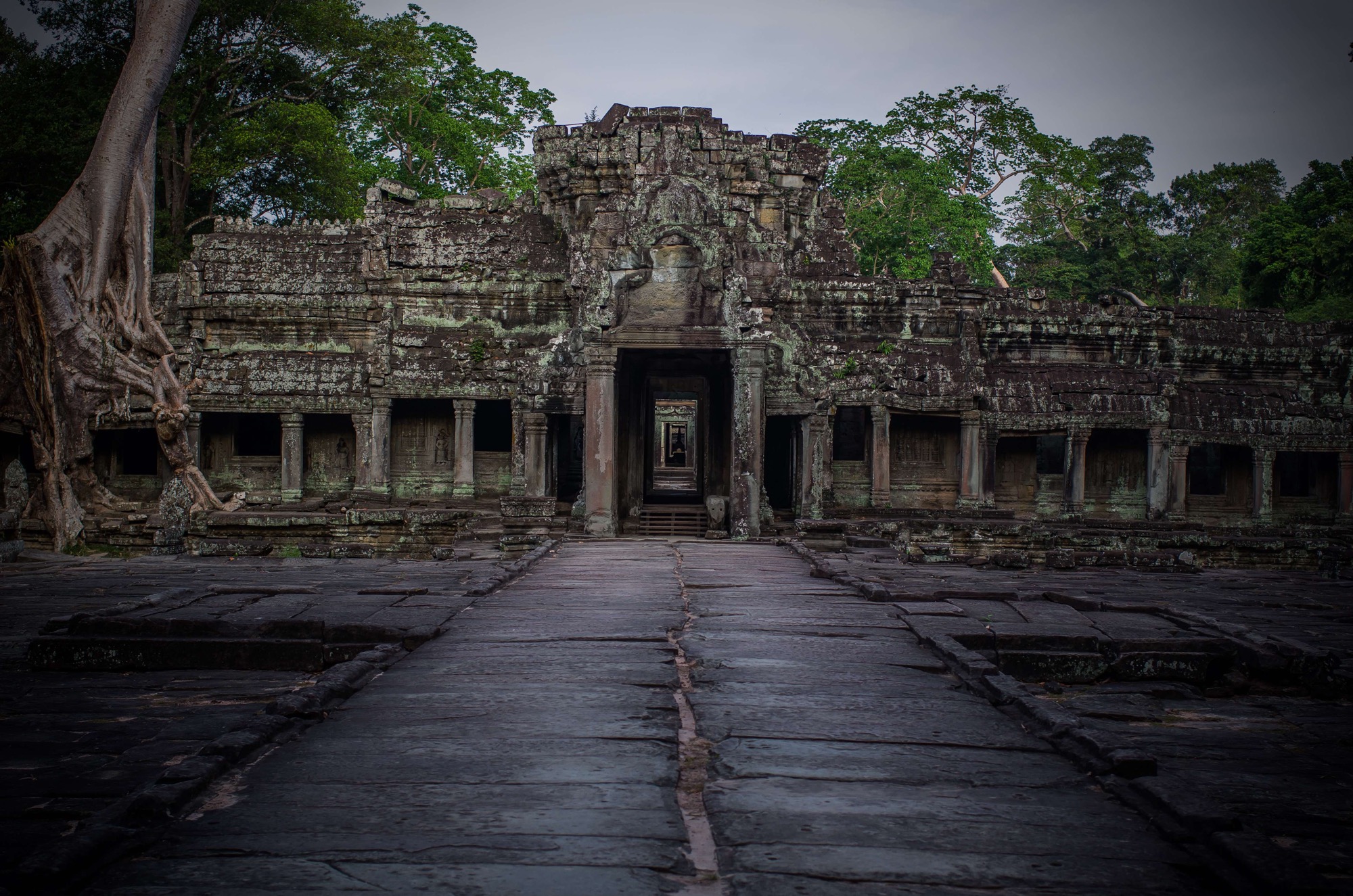
 The centuries have built up Ta Prohm, displayed it in glory, watched its decline and shrouded it in jungle. So evident is the passing of time as you look upon grand trees clambering over this temple to make an eerie place somewhere between natural wonder and human triumph. Whichever side you view it from it’s a story of ages played out before your eyes. Hollywood may have shot the move Tomb Raider here but really, no amount of skill can match artistry that takes centuries to create.

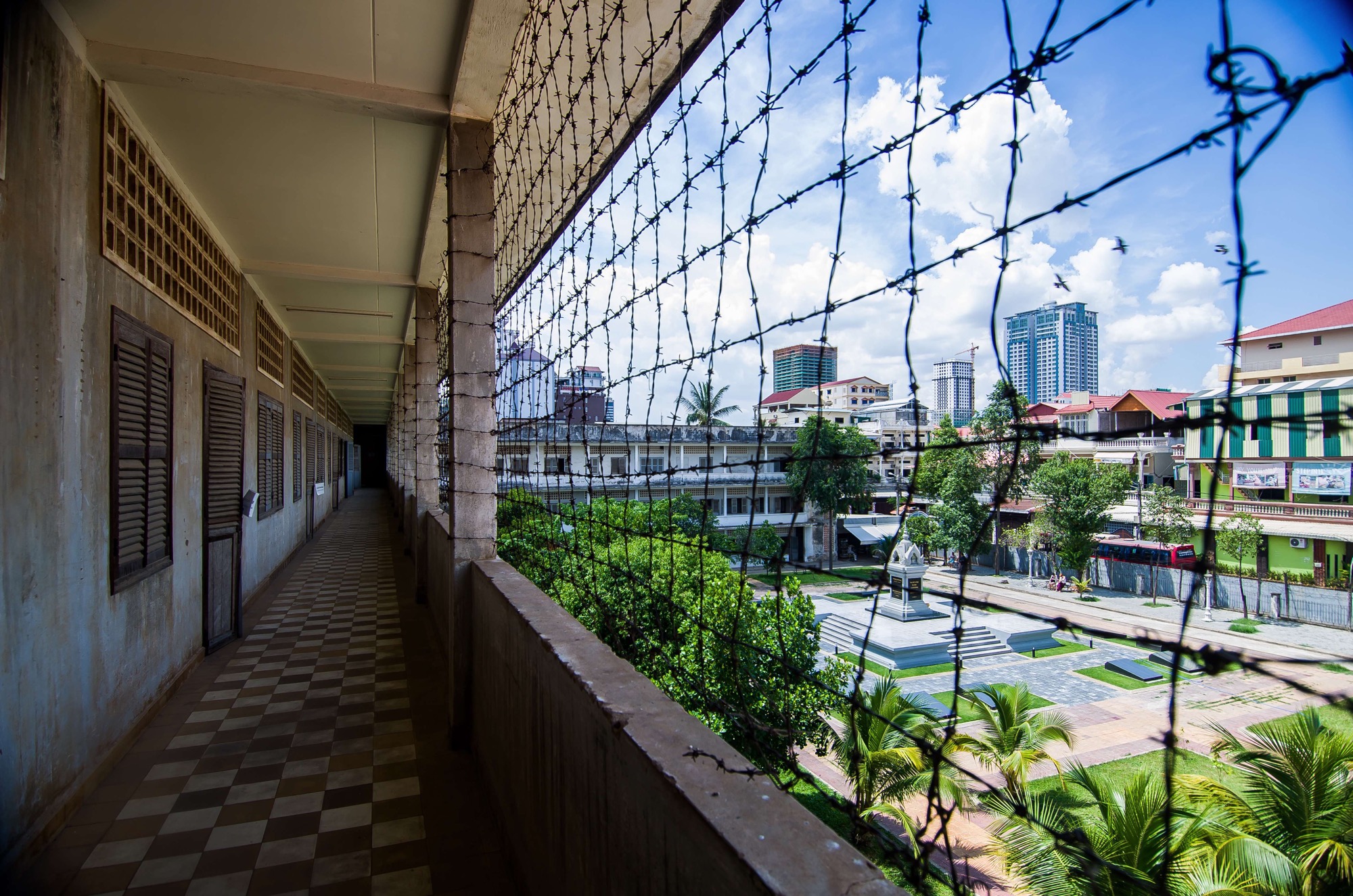
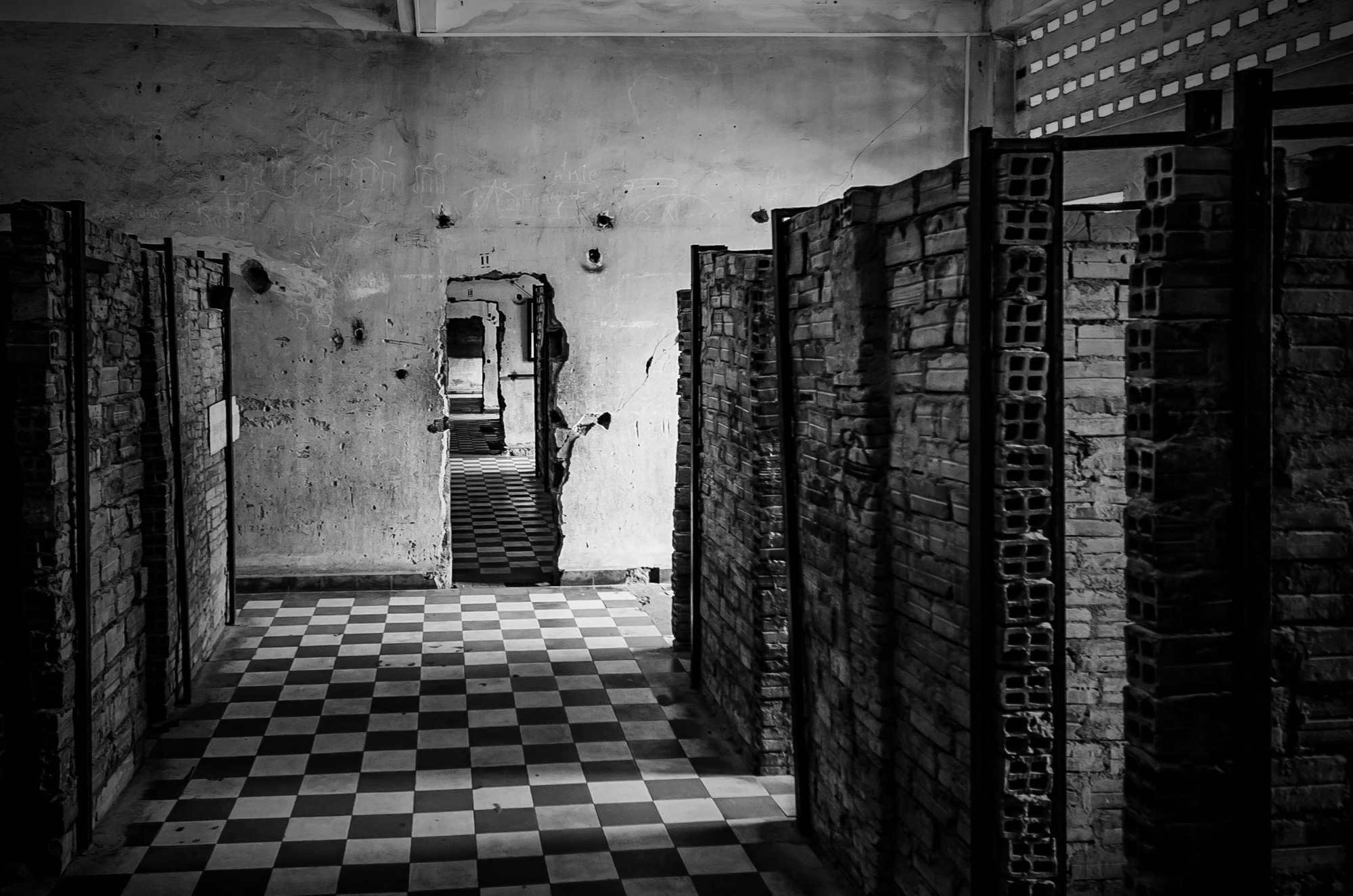
2 – S21: Phnom Penh, 1976-79

Charlie Winn

Classrooms converted into prison cells, S21, Phnom Penh, Cambodia

 14,000 people entered and few left with their lives since all made the trip to Choeng Ek. S21 was a school of hopeful children before being turned into a torture facility for political prisoners beforeq sending them to the killing fields. Probably more traumatising than the killing fields themselves, cells sit alongside torture rooms, survivor testimonials and room upon room of photos staring down at you from eyes that were looking at the last few days of their lives. Few left with their lives then, no one leaves without tears now.

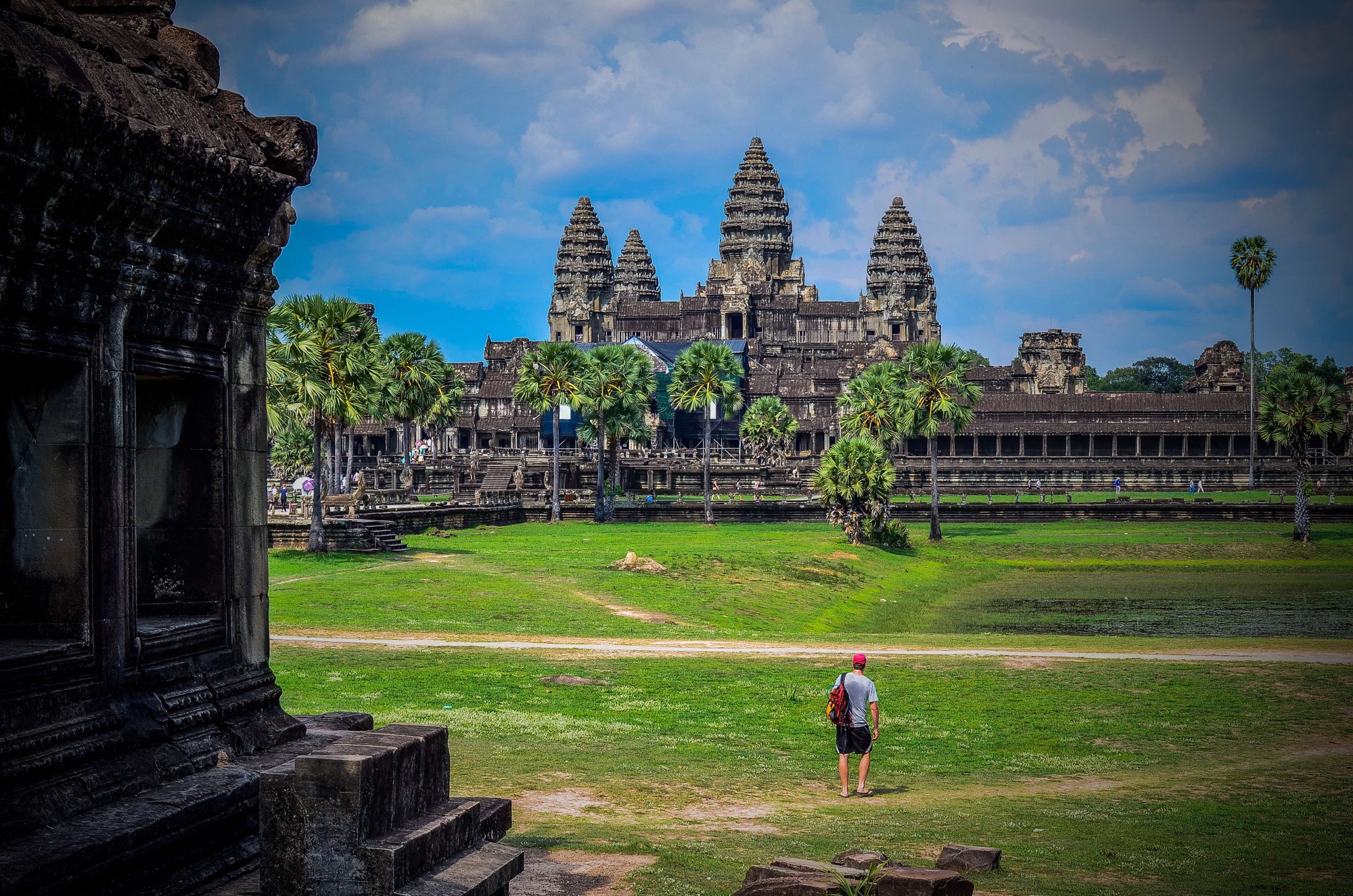
1 – Angkor Wat: Siem Reap, 12th Century. 

Charlie Winn

Steve approaching Angkor Wat, Cambodia

  It’s the obvious one really, and so rarely do those obvious ones live up to their hype; Angkor Wat doesn’t so much live up to the hype but crush it. Angkor remains the worlds largest city of the pre-industrial era, the true centrepiece of the worlds power. And the centrepiece of that power was Angkor Wat. Get carried away for a day and be king Jayaravarman II and shout from the heights of the main spire: “I’m king of the world”; you’ll feel like it’s an obvious statement.

What you’d rather be seeing – Cambodia

Just another country? Not at all, yes a smaller country geographically but it has so much of past glory and present challenges. The past and present are immense weights but the future looks, to us, very positive.

PAST (The former greatest civilisation in the world): 

Charlie Winn

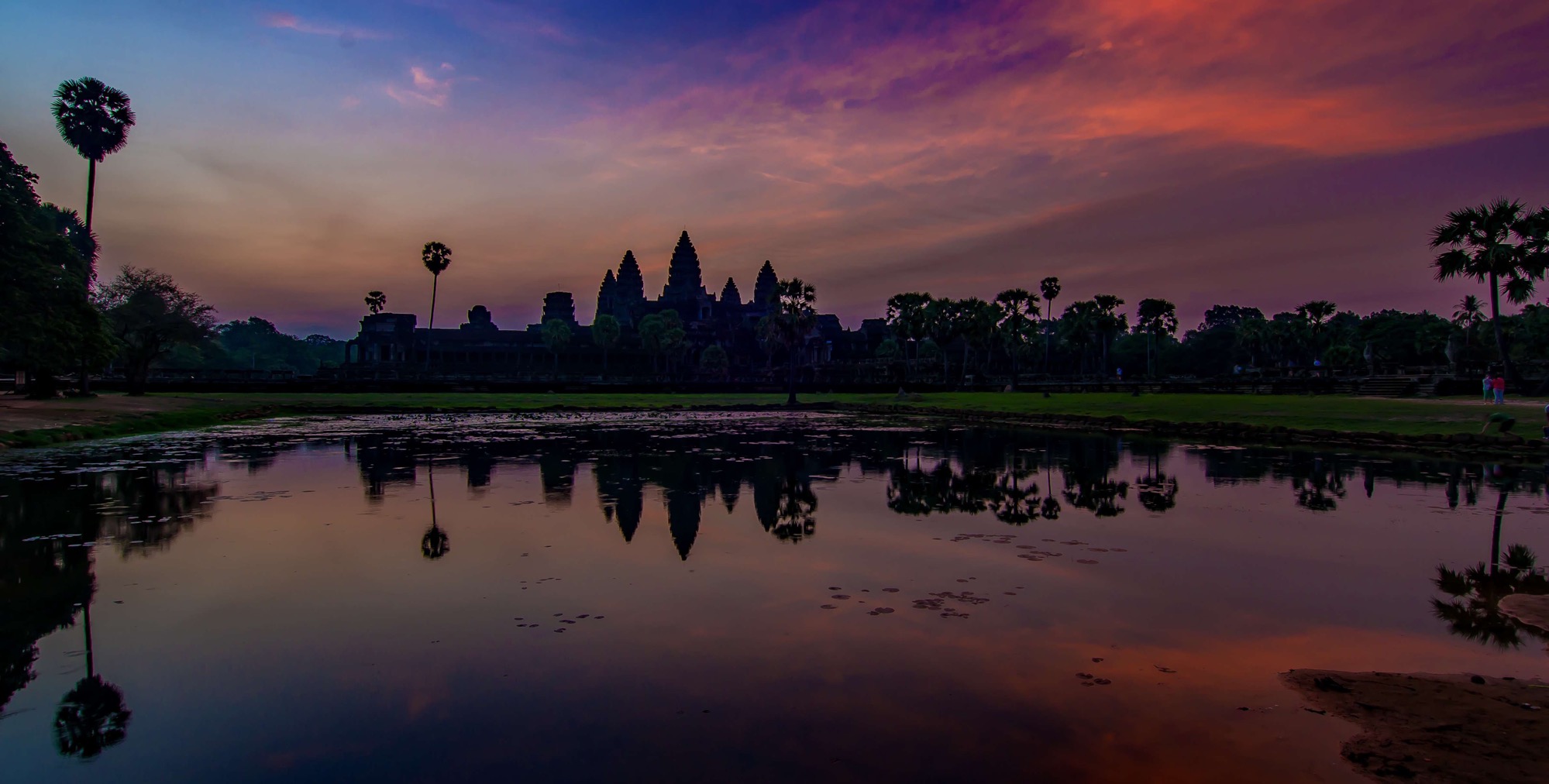
How many sunrises has Angkor Wat seen? This was ours, Siem Reap


Charlie Winn

The seldom visited eastern gate of Angkor Wat, A new day all to ourselves, Siem Reap

  
Charlie Winn

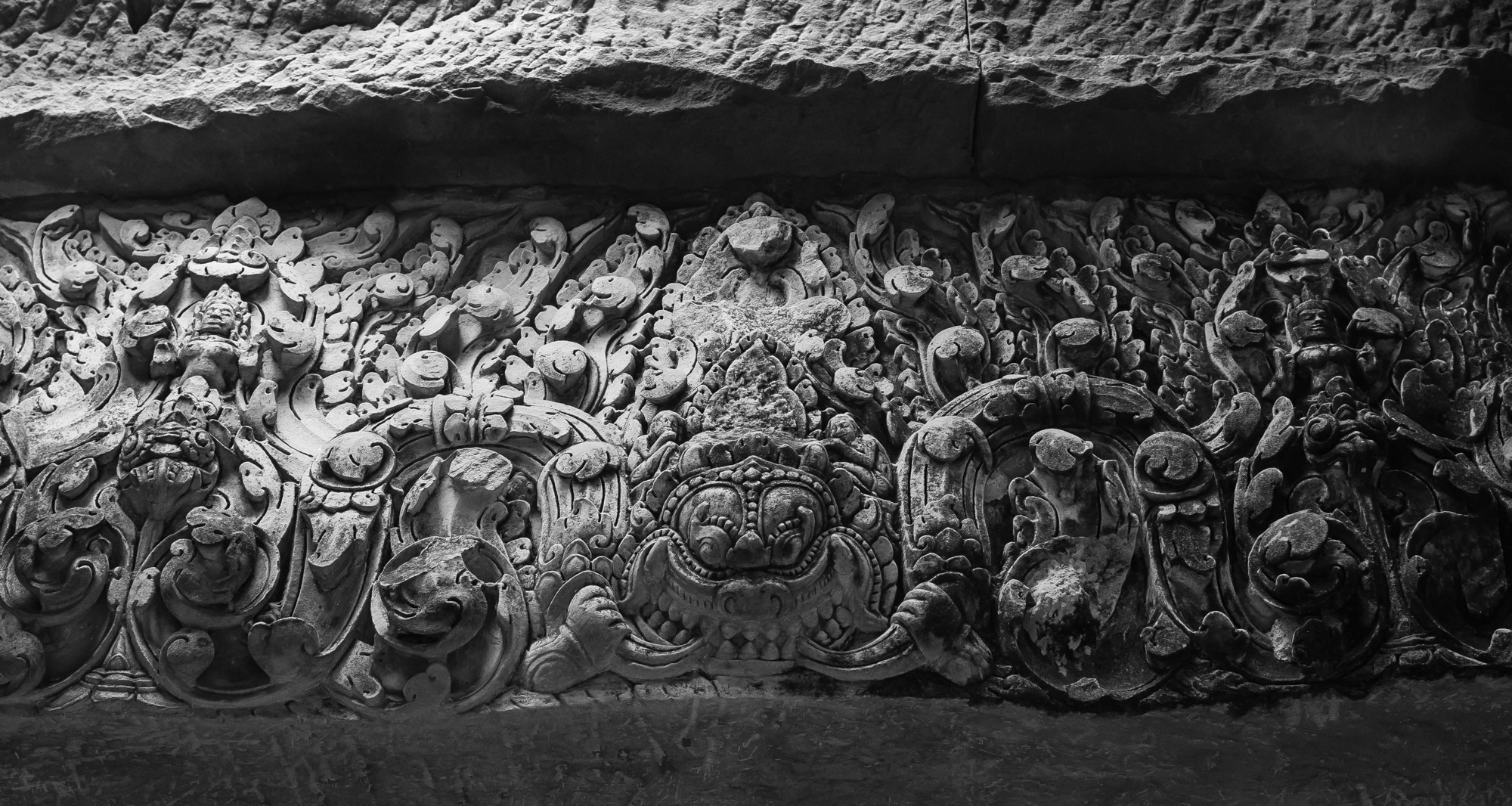
Such detail for such scale in the great city of Angkor, Siem Reap

  
Charlie Winn

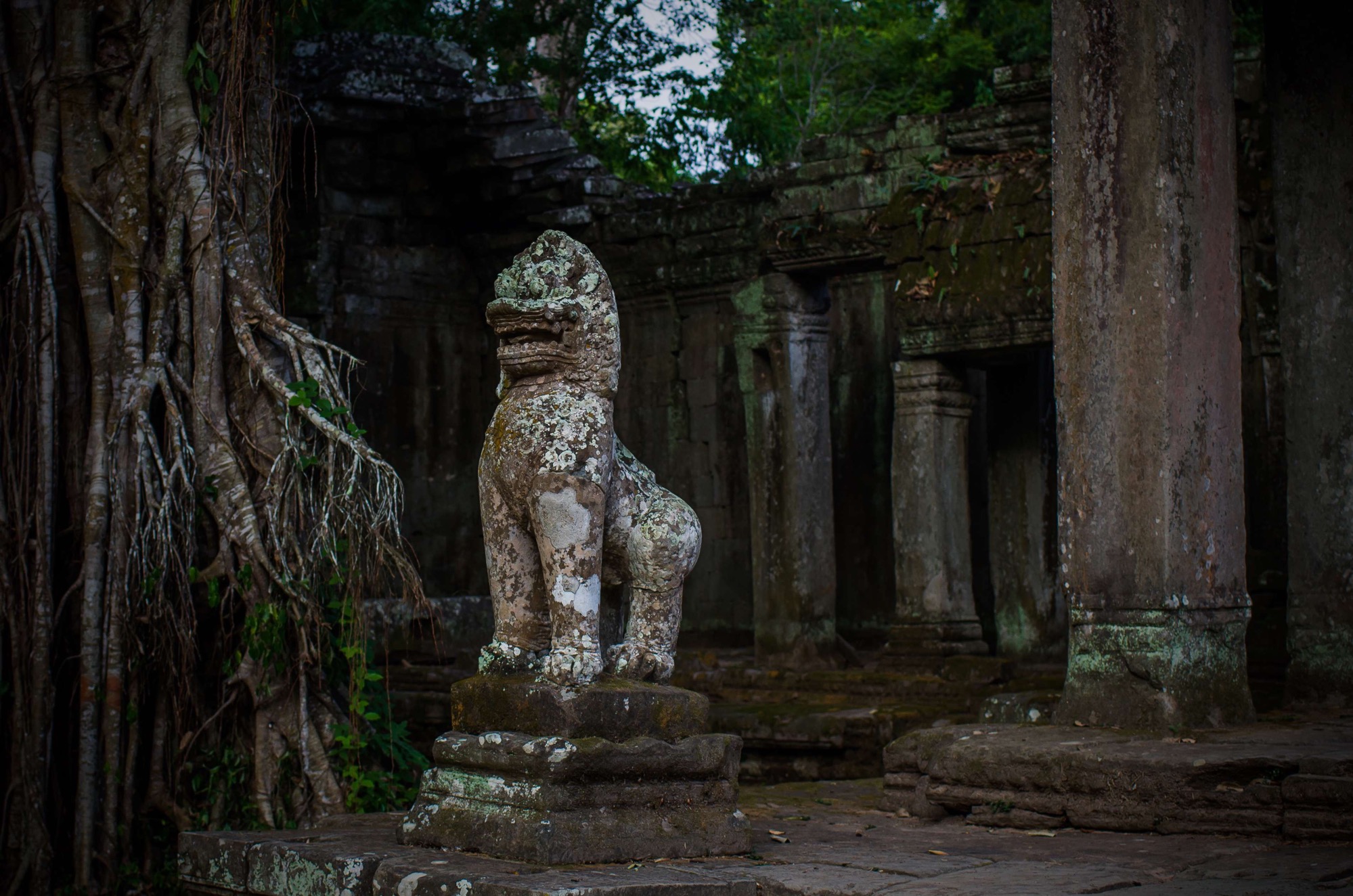
The Angkor temple of Preah Khan, still guarded by lions , Siem Reap

  
Charlie Winn

Great power wrestles with great power at Ta Prohm in the city of Angkor Thom, Siem Reap

  
Charlie Winn

Steve feeling a 12th century sunrise at Angkor Wat, Siem Reap

  
Charlie Winn

Stone erodes but life continues as it has for centuries at Angkor Wat, Siem Reap

  
Charlie Winn

Who needs artworks? Preah Khan temple is alive with colour in Angkor after 900 years, Siem Reap

  
Charlie Winn

Kilometres of corridoors more like artworks give passage through Angkor Wat, Siem Reap


Charlie Winn

Not just forts, Angkor city is a study in design, light and aesthetics , Siem Reap

PRESENT (A nation rising from significant challenges):

Charlie Winn

Victims of recent tragedy at the hands of the Khmer Rouge in Choeng Ek (the killing fields), Phnom Penh

  
Charlie Winn

No escape for victims or the minds of visitors at the S21 prison, Phnom Penh

  
Charlie Winn

Modern Cambodia is not just the gritty poor country you think, Phnom Penh

  
Charlie Winn

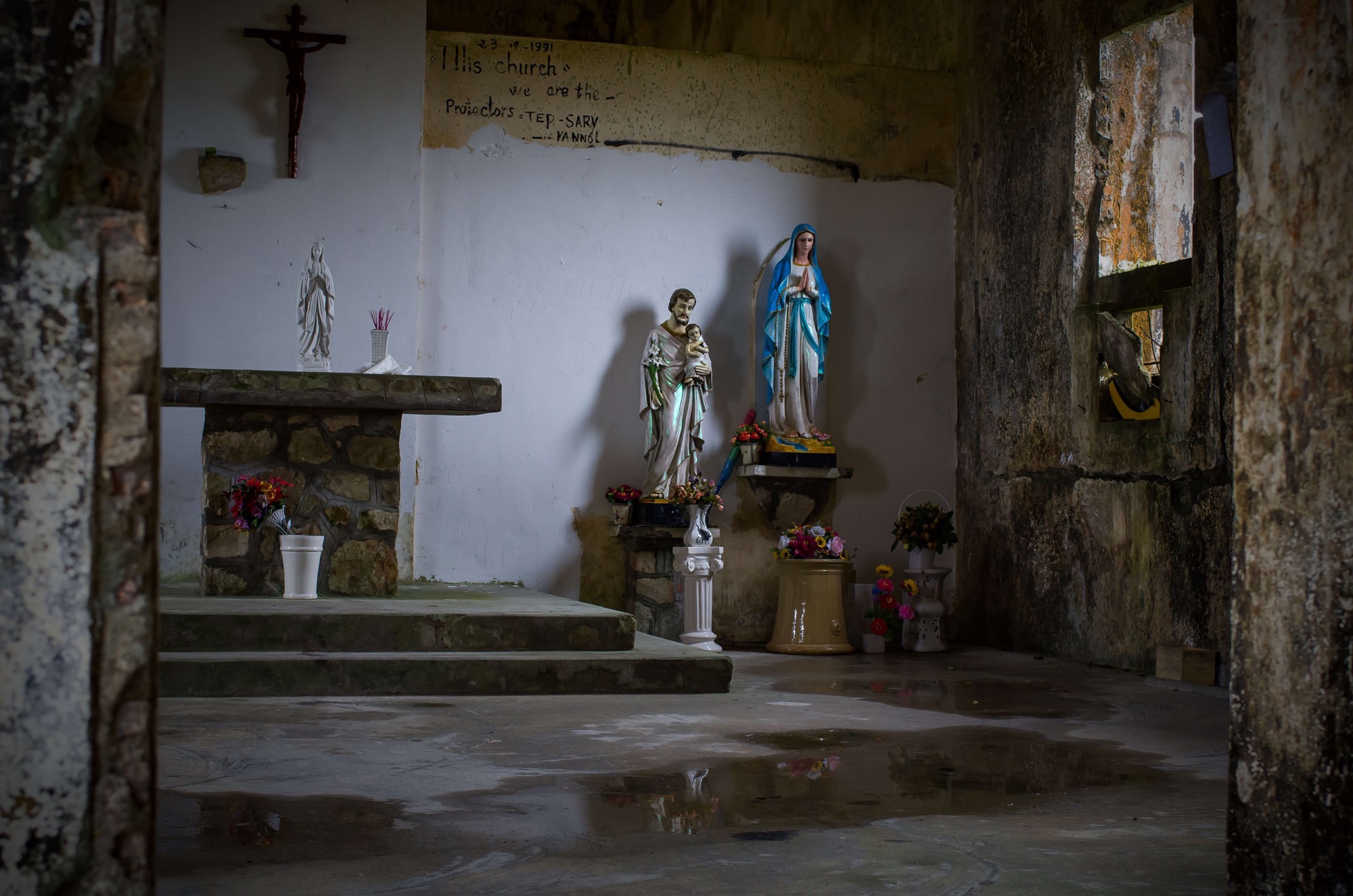
An abandoned church still serves a purpose on the eerie Bokor mountain, Kampot


FUTURE (Past grandeur and recent tragedy gives way to a bright future):

Charlie Winn

The future leaders in the present appreciating the past, Siem Reap

  
Charlie Winn

Sea breeze call us to from home in a paradise so far from what you think of Cambodia, Koh Rong Sanloem

  
Charlie Winn

The caribbean, Thailand, Fiji, Greek islands. Add Cambodia to that list, Koh Rong Sanloem


Charlie Winn

Tropical storms rage and pass but paradise remains eternal, Koh Rong Sanloem

  
Charlie Winn

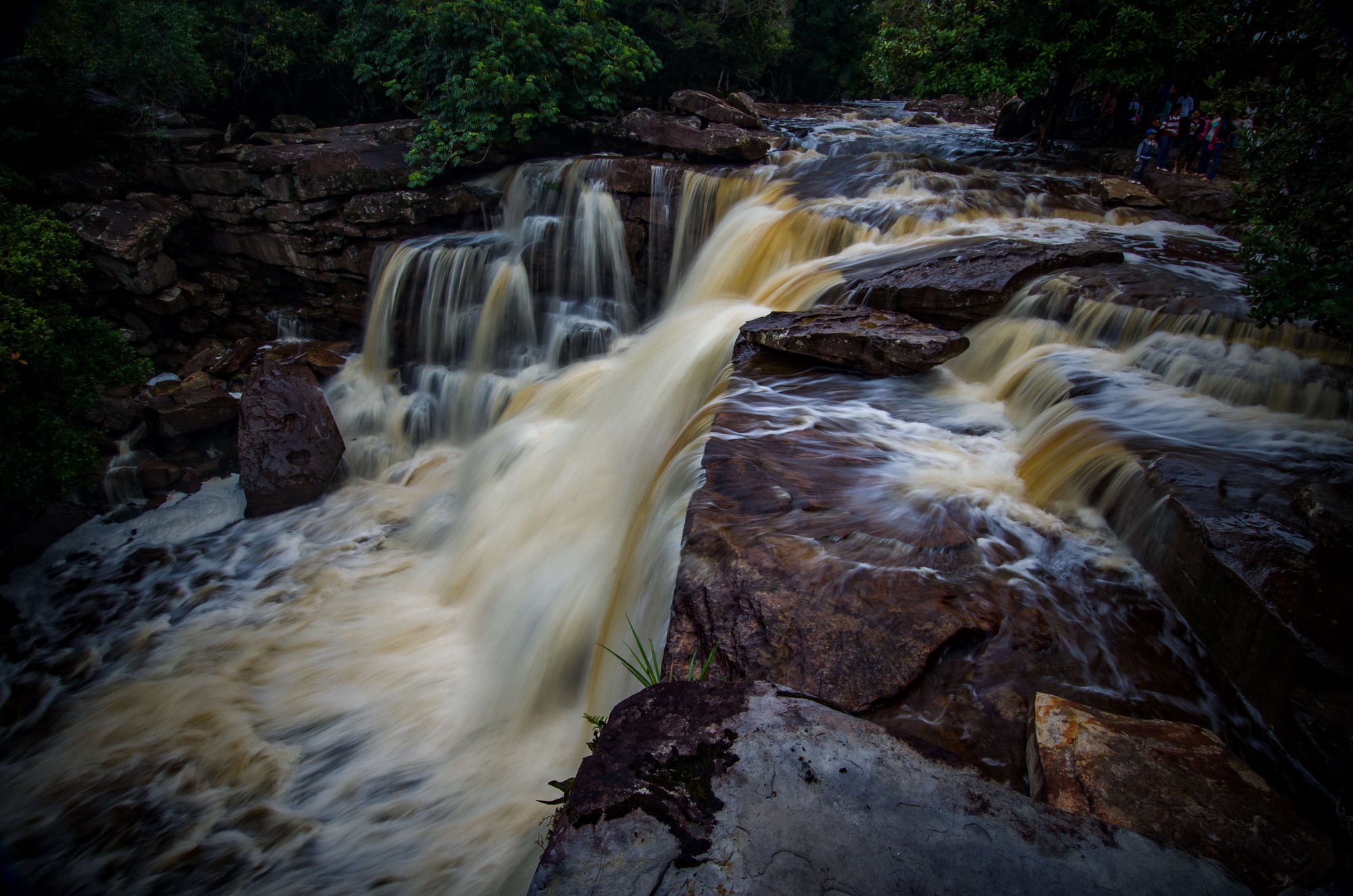
Rich earth colours the raging waters of Bokor Mountain, Kampot

  
Charlie Winn

Leaving past grandeur and recent tragedy behind as the sun sets on another hopeful day, Koh Rong Sanloem

  
Charlie Winn

Life doesn’t always need to bow to convenience as Cambodia shows us all a great lesson, Koh Rong Sanloem


While you were working – Magic Dust, Phnom Penh, Cambodia

 A good place to visit; such a common expression said so flippantly about so many places but what do we really mean when we say that? Maybe it’s when places are all the things we want them to be, the exact environment we chase; maybe it’s when it’s the opposite, a new experience to give us the vacation not only from our home places but from our lives. Maybe it’s easy measurements like architecture, food, history, culture and lifestyle or maybe it’s the welcome invasion of intangible inspirations, the wisps of emotion that stir something inside that’s hard to fashion into words. Possibly edgy adventure to get your pulse racing or the welcome secure comfort of retreat to lower the blood pressure. A good place to visit can complicate your thoughts or make them simple, free you from the burden of pursuits or inspire you to search for more.  

Charlie Winn

Angkor temples, an insight into the largest pre-idustrial city in the world.

  It’s all these things to all different people; and more. Such a complicated soup this definition becomes upon such little pondering, for us though there has emerged a somewhat simple marker to divine the merits of this vague range of criteria. You’re looking at it now. For us the correlation is direct and tangible, some places are easy to write about and take photos of; they inspire. From any of the features I pose inspiration can come; the places that we love have all drawn from us an artistic torrent that we aren’t familiar with to turn two usually pragmatic worker bees into expressions of everything not pragmatic at all. I call it art, art forms; the result is debatable but the unrelenting desire to express it is not. Even if my writing sits appropriately as a third grade homework project and Charlie’s photos belong on a home made flyer for a garage sale the result is a moot point; any place that can shift you to feel, think, elevate and express is a place where dreams are made. 

 Tomorrow we leave one such place, Cambodia. On any measure Cambodia is a clear winner; for us we have been feverish in our endeavours to write and take photos, barely ever able to pour out enough of what we feel about this place to ease the log-jam of inspiration flooding to us relentlessly an unsought. Beyond our simple tell-tale measure though Cambodia has given us what we want in grand architecture, history, food and culture while shifting us to think and be inspired about home, social justice, humanity and more. It’s edgy but cleaner than we thought, punctual yet relaxed, people are cheeky and endearingly polite at the same time, full of adventure and discovery with ample vacuums of modernity.  

Charlie Winn

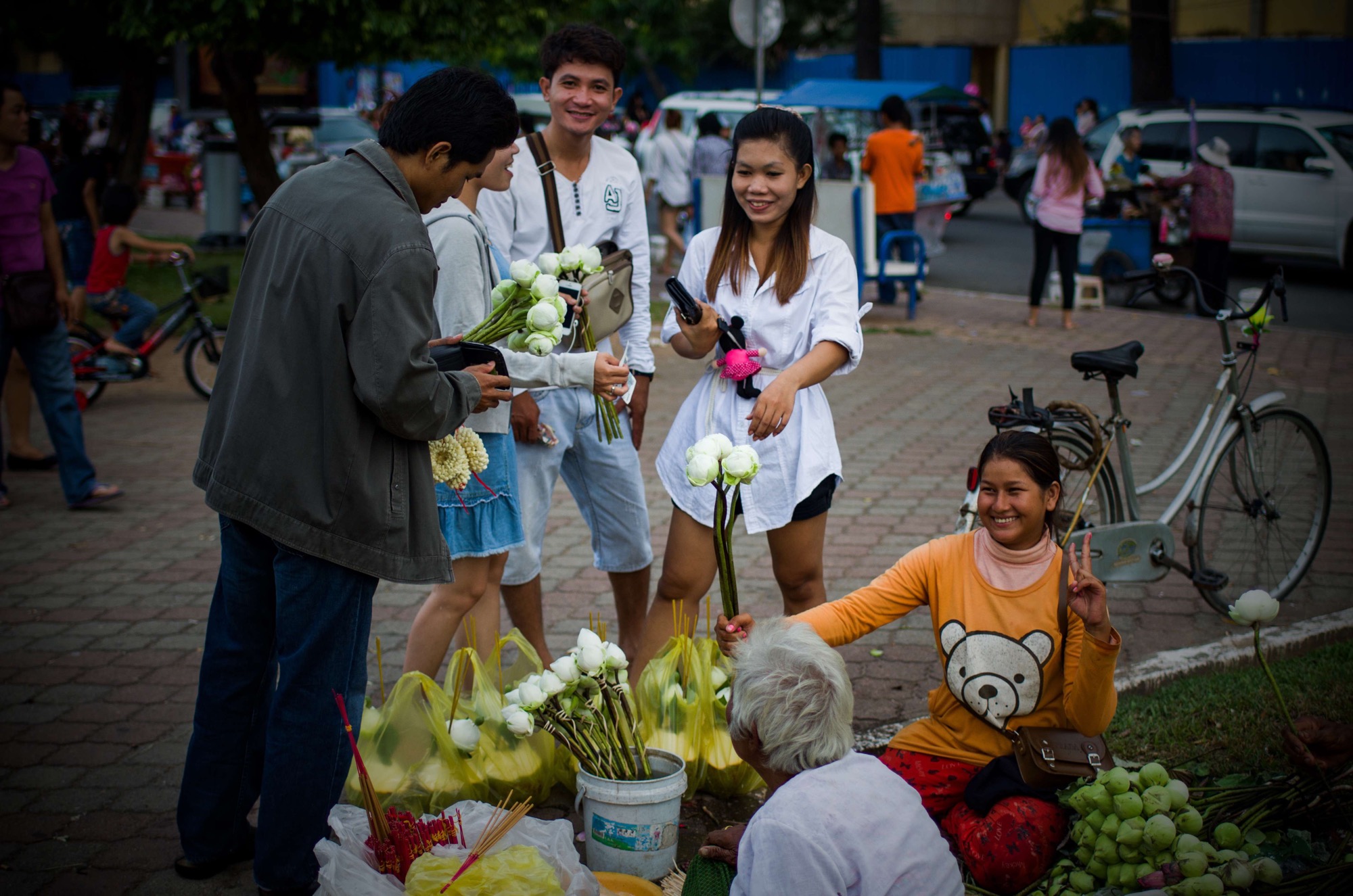
Cambodians are incredibly friendly and happy. Here, lotus flower sellers on the streets of Phnom Penh.

  Such a complete picture this country is and atop it all for me lies a continuity of history like I’ve never seen alongside an honesty in self appraisal that can only be applauded. Cambodia has a history so long, from the pinnacle of the worlds power in ancient Angkor to the depths of human despair through the regime of the Khmer Rouge and none of it seems distant or disconnected, such an unbroken chain feels too long to be so intact. An ancient city built to laud a Hindu god has passed elegantly to a buddhist population without the need to destroy it before it was rebuilt; one of recent histories most horrific atrocities is embraced and taken on board, not shunned or denied. 

 So what’s the magic ingredient we wonder, Cambodia has pulled the trick that little known countries have done to us so far; Ecuador, Botswana and even neighbouring Laos have all shouted louder than we thought they could. Indeed these little gems that glimmer so brightly hold an intangible grace, an appeal, a charisma. Like a lover that stirs you to rash behaviour, a wise friend who always says the right thing or a poet who’s words set you on a path that persists long after you forgot the words, these countries leave with you a result that makes the reason seem so trivial. In slices so far, nearly all countries have given us some sprinkle of this magic dust but probably not a single country has spread it as comprehensively as Cambodia to cast a glamour over every possible criteria. 

Charlie Winn

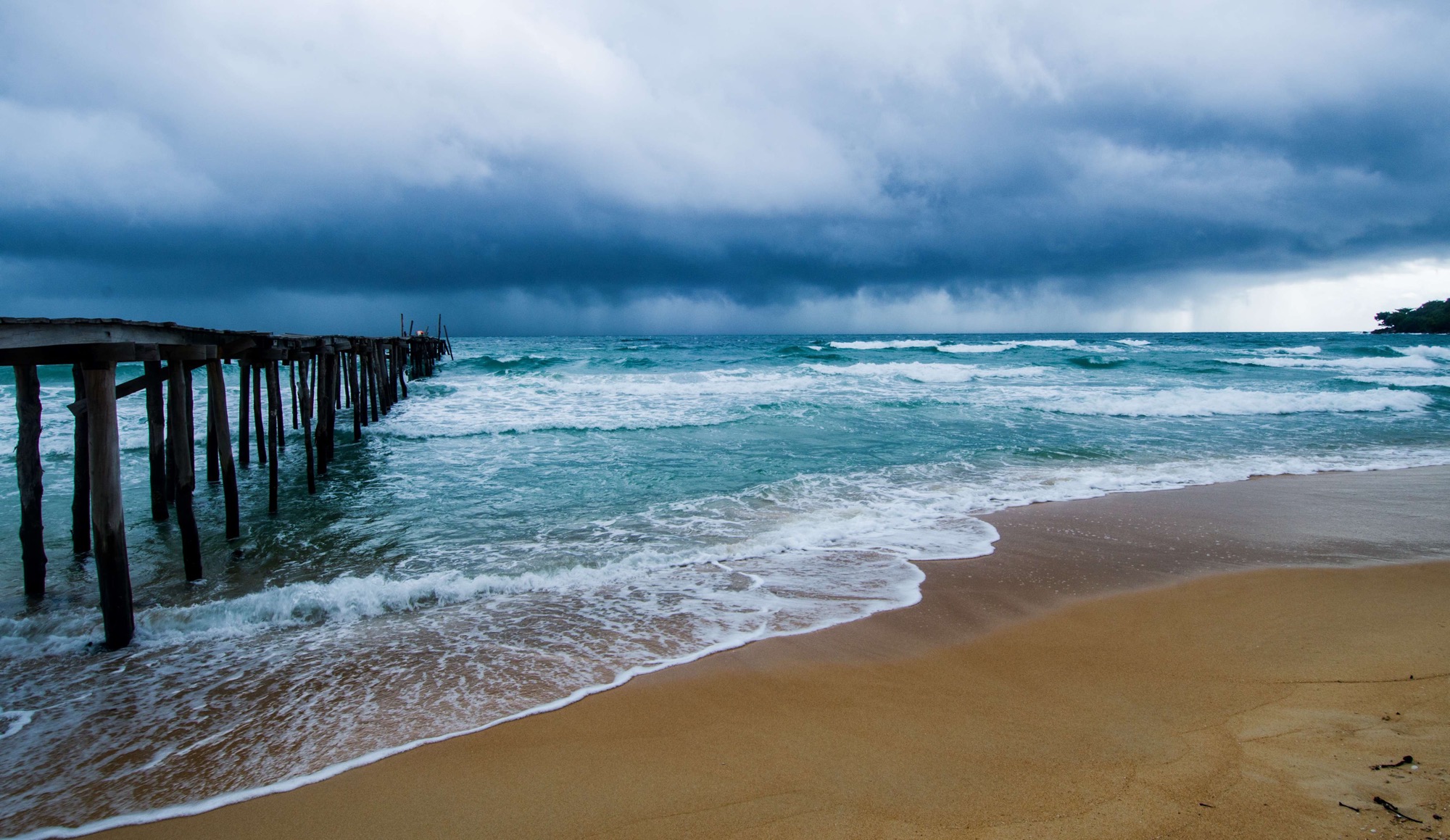
A storm rolling towards Koh Rong Sanloem, Cambodia.

  It’s a big call, the first ever piece of writing I penned for this adventure contained the line ‘we’re on this trip of a lifetime, leaving behind a lifetime after having the time of our lives’, and the time of our lives we’ve had even though it is far from over yet. Few people know much of Cambodia other than it’s got that big temple and they had some really ‘bad shit’ in the 70’s or maybe 80’s but don’t let first impressions fool you. Of the 17 countries we’ve seen so far it’s a raging hot contender for the one that’s been most rewarding to visit, far more than a temple and some musing on recent history. Cambodia is the lover, the wise friend and the poet all in one; the impossible package who’s magic dust will affect us long after its intoxication has faded. The third grade homework and the garage sale flyer has never been so easy to create. 

While you were working – Imagine, Sihanoukville, Cambodia

 Beggars. Every travellers nightmare, the doorway to an awkward world where no response is appropriate and no emotional resolution comfortable, so rarely are our intellects and our hearts torn in such opposing directions. No matter how succinctly we rationalise a give-or-not-give flowchart in our minds, feelings of guilt, unjust opportunity, empathy and even some outrage are a blanket thrown upon us every time we see the rattling can, the cupped hands or the shabbily scrawled message on the torn off cardboard side of what was once an apple box. They’re the easy outs, the ones that offer no engagement, the ones that slide through the flowchart reasoning without the awkward loop that sends you cycling through questions easier dismissed than pondered. Kids are easy too; never give an option out of education. How easily we begin to categorise human beings into grades of dismissibility lest they insult our sensibilities with their visibility. I don’t usually think of myself as a bad person.  

In truth the sad answer is that it’s usually best to do nothing, usually. In many parts of the world begging is an industry, a sizeable one and we’d all prefer to give money to someone offering something, disabled, desperate or otherwise. Even the simplest of services like offering directions, three squares of toilet paper or a rubbish bin in a country that offers few options is enough to garner respect for some initiative and turn begging so elegantly into a service. But of course the lines are routinely blurred, extraordinary circumstance that disrupt your once iron clad rationale. Welcome to Cambodia, a land where dispelling myths that crossed the border in your backpack is a national pastime. Maybe that’s why they smile so much, they’re laughing at our wild misconceptions.  

Charlie Winn

Feeding Cambodia, one street stall at a time. Phnom Penh.

  In this small country with many faces there’s a story that’s never too far away: land mines. More pointedly it’s the victims of the land mines and for us luckily enough not the land mines themselves. Largely through the seventies, where war was a constant in this region, Cambodia was laden with land mines by multiple groups; the infamous Khmer Rouge was one such group to ensure their bloody legacy would not stop with political change. Approximately 40,000 Cambodians are amputees as a consequence of this scourge and with up to 6,000,000 pieces of ordinance left in the ground there’s enough to go close to eradicating the whole population of this country. Of course there are organisations who find and detonate the mines to attempt to clear the disaster; one such organisation loses 5-10 staff a year despite expert precautions, methods and technology. What hope does a farmer and his or her family have?

 Many countries have tragic issues, this is true, but only a few have the combination of these issues alongside a lack of safety net for victims and no resolution in sight; wars can end, land mines endure. 25% of land mine victims in Cambodia are more than six hours from a hospital and 15% are three days away. One third are children. Most of the remaining mines are in rural areas and as a consequence a single victim often throws a whole family into extreme poverty or worse; it’s yet another burden that Cambodia seems to shoulder with stoicism and resolve. While the glimmers of modern commerce are starting just recently to grace the major cities, rural parts of Cambodia are sadly stuck in a time where most peoples imaginings of a struggling poor nation remain stubbornly accurate.  

Charlie Win

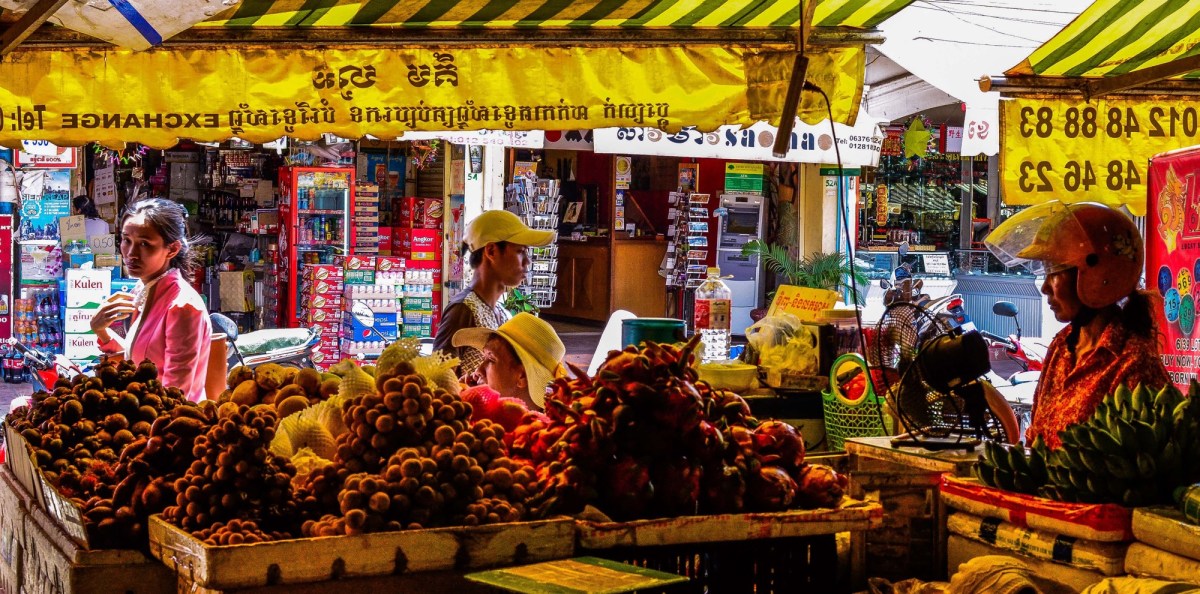
Fruit stall, Siem Reap, Cambodia

  How easily the flowchart gets blown to smithereens. With such generosity and welcome we have been greeted in this country where inactive deference to a governments responsibility is not a common consciousness. There’s no turning a blind eye, no rinsing of hands because it’s ‘not my problem’; here in Cambodia it seems every citizen rolls up their sleeves to help or do their part. So refreshing and wholly disarming to minds formed in a society of such blinded eyes. There’s a grand scale national crisis here, just one of many to be honest, and while times they are a changing, the burden still falls to the population here to plug the gaps; as it has for as long as anyone can remember. 

 So we travel, we see new things, we meet new people and we learn from new ways of life. There’s beggars of the traditional category here, as with any humane place, but there’s a new social category we’ve yet to be introduced to until now. It’s not a beggar but they plead on the street for money. Life has battered them and cut them down, literally, yet they show no signs of defeat. They’re not beggars, they’re land mine victims; victims by definition don’t choose their station and in Cambodia these victims refuse to go submissively to an existing category. I think specifically of the happy dude in Kampot with neither forearm anymore who indeed got our scooters going again after I locked the keyhole and couldn’t get it going again. We didn’t donate to him three sepearte times, a little bit of Cambodian education gave sight to our blind eyes three times. 

 So we give; we give to every band that plays, every person that donates a smile, directions or even offers help starting our scooter, just fifty cents or a dollar is enough. We travel to experience new ways of life, here we learn to break the bonds of our indoctrination. We think of John Lennon’s well known song: Imagine, where the world drops their weapons, dissolves borders, forgets religion and humans just look after and care for each other. The words tumble over:

Imagine no possessions
I wonder if you can
No need for greed or hunger
A brotherhood of man
Imagine all the people
Sharing all the world.

 Imagine seeing a portion of your own people suffering and instead of making a newspaper story of them or winning an election by wedging them in the number crunch of opinion poles; just helping them. Imagine if we just rolled up our sleeves and lent them the hand that they very well might not have anymore, like the happy dude in Kampot, ecstatic to get a grand total of a dollar or so from us. John Lennon’s words were never something I thought I’d come close to seeing, the idealistic hippie maybe more humanist visionary after all. Sadly this humanity hasn’t visited Australia in my lifetime and taking a look at politics in our country today it seems like it’s in the same category as ‘the boats’; turned back or stuck in mandatory detention. Imagine if in our country we were able to stop leaving it to aid organisations, charities or government services and everyone just helped each other out a bit; just imagine; as the lyrics say, it isn’t hard to do.  

If you’re like us you haven’t heard the song in a while, treat yourself: Imagine

While you were working – A Salt Water People, Koh Rong Sanloem, Cambodia

 There’s a story I have, a story of the earlier and formative years of my life, before an adulthood which permitted no romance placed a full stop at the end and closed the book. Charlie has a similar story, albeit shorter, the story embedded in Australian history long before it was called history. It’s the story of a salt water people. It’s origins lie before our fair skinned forebears arrived to the country we call home, passed down through generations from a time when dreams were more than a hasty scribble on a post-it to snatch at the waking instant sliding into discretion. It’s not my history, my forebears did their best to quell that, but it is my country and some stories are more than a collection of contrivances. It’s a story of a country from before it was dreamed by the people who walked upon it. Some stories are inherent and whisper for anyone willing to listen, spoken by one people for all those to come, a persistent story of Australia so succinct it needs no updating or modernising. 

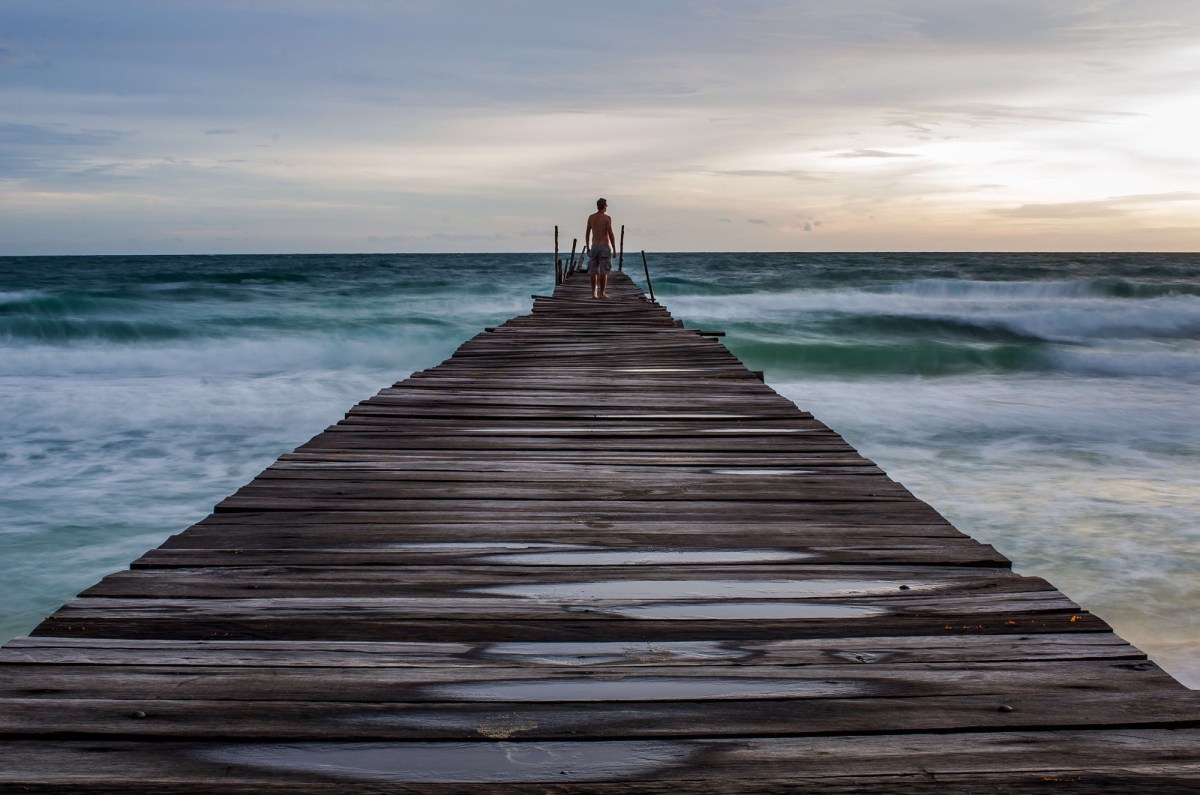
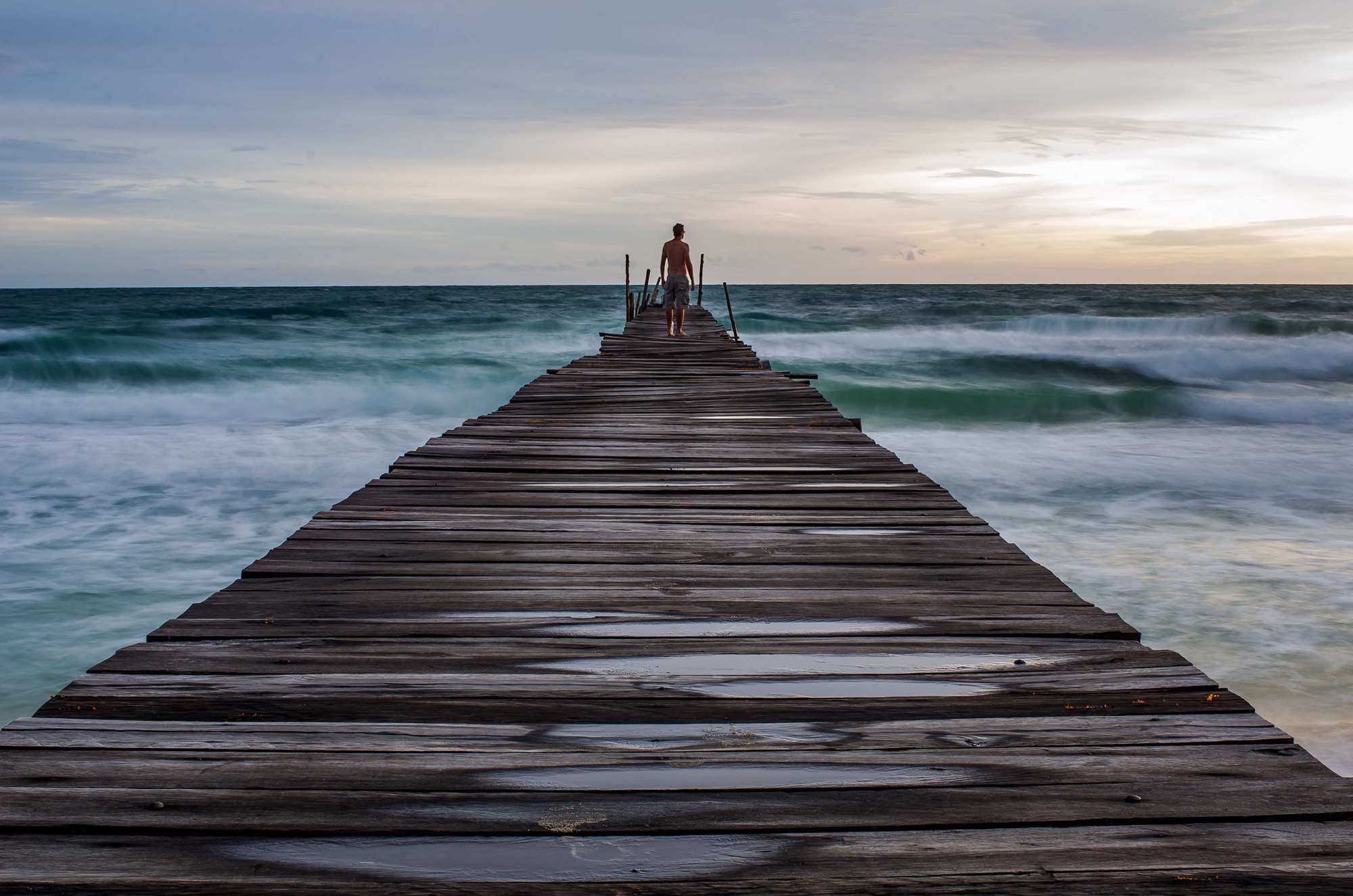
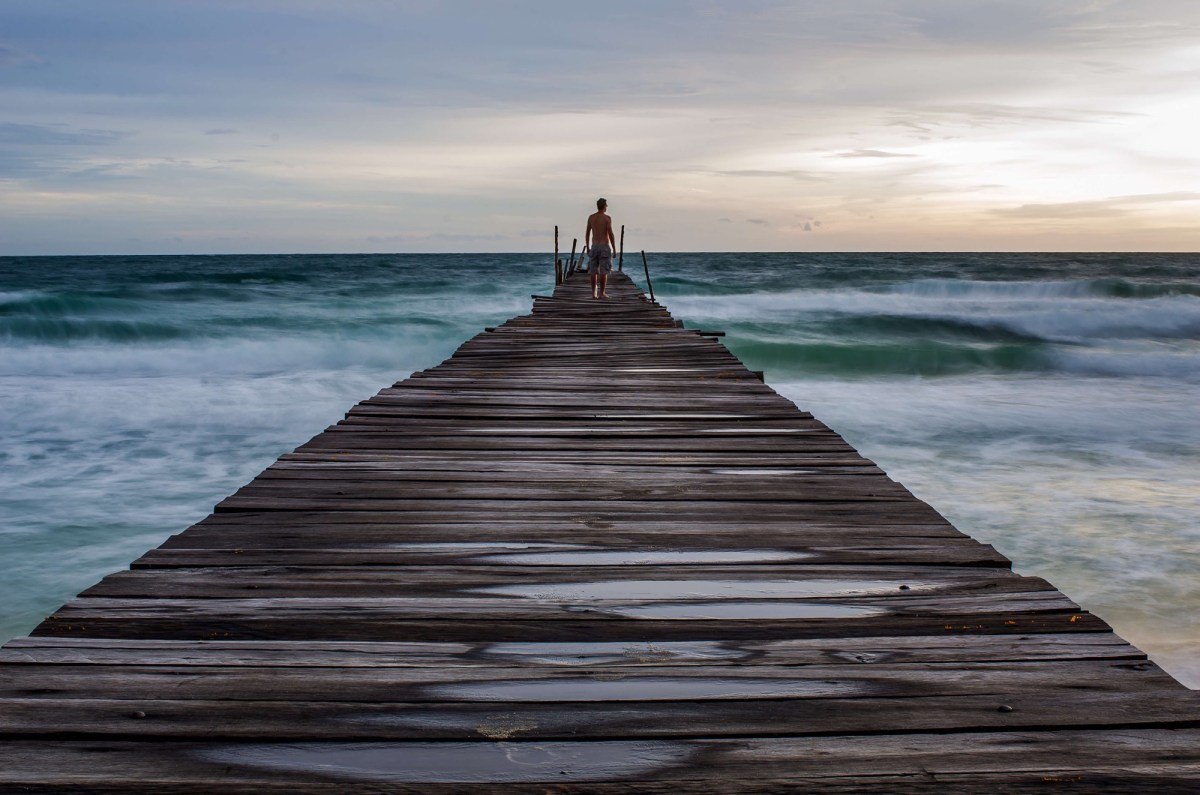
 At different times we both turned our backs on that story for different lives, we turned our backs on the sea breeze of a salt water people; or at least we stopped looking. For so many years mountains have been our home, where we feel we belong. In the mountains the gulls don’t cry, the world doesn’t exist to the static backdrop sound like when you put your hands over your ears; the air has no salt. A supportive post dislodged at the base swings and clatters against the waves below this jetty that moves with the sea more than it should; salt water stains the worn timber with a temporary lustre it doesn’t deserve but handsomely boasts. There’s more sky than we’re used to nowadays, it reaches so far down to a horizon so comically flat. And the salt roars at me borne on wind over an ocean too vast, salt water bearing down on us from as far away, as far back as the salt water people.  

Charlie Winn

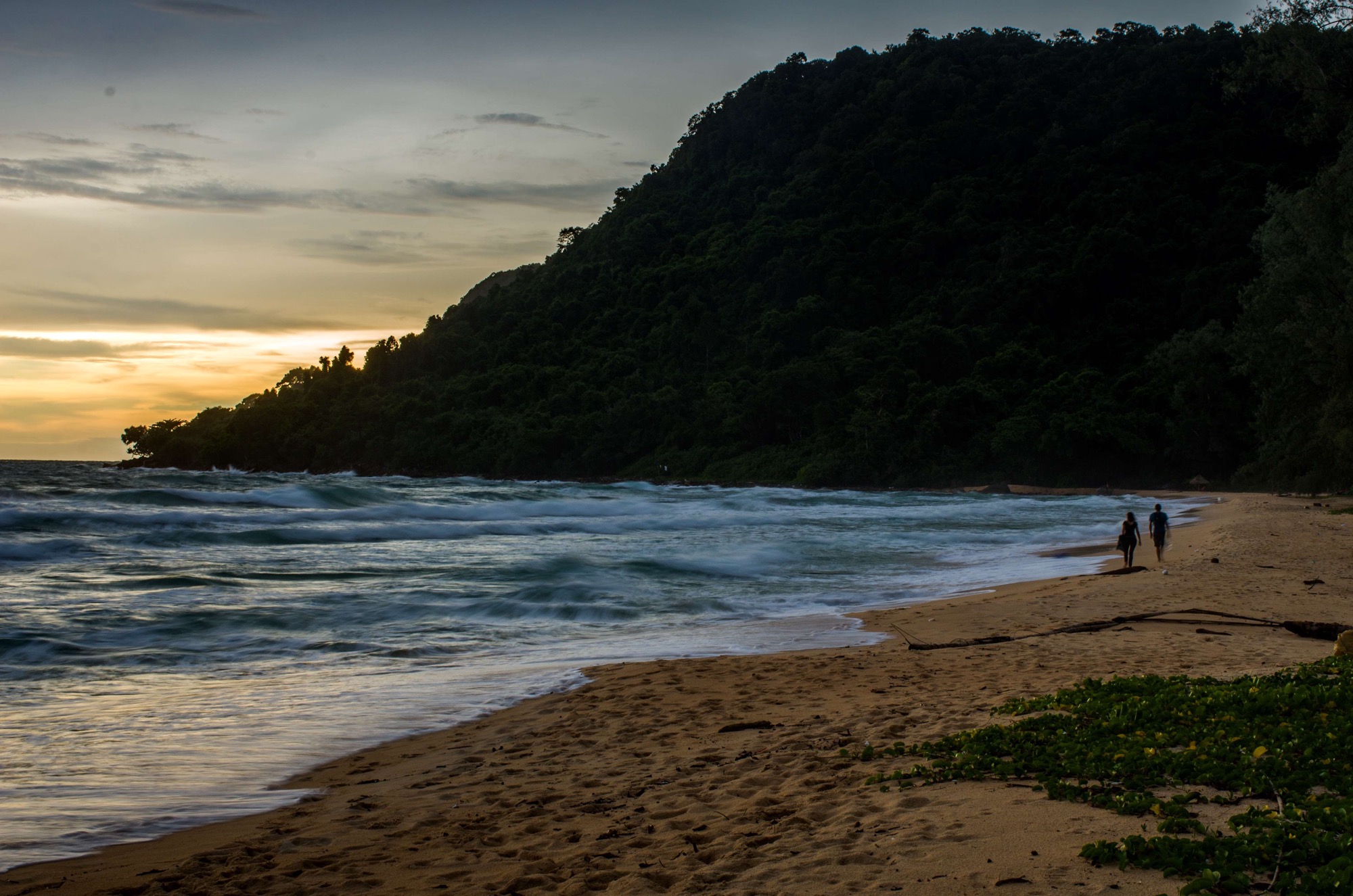
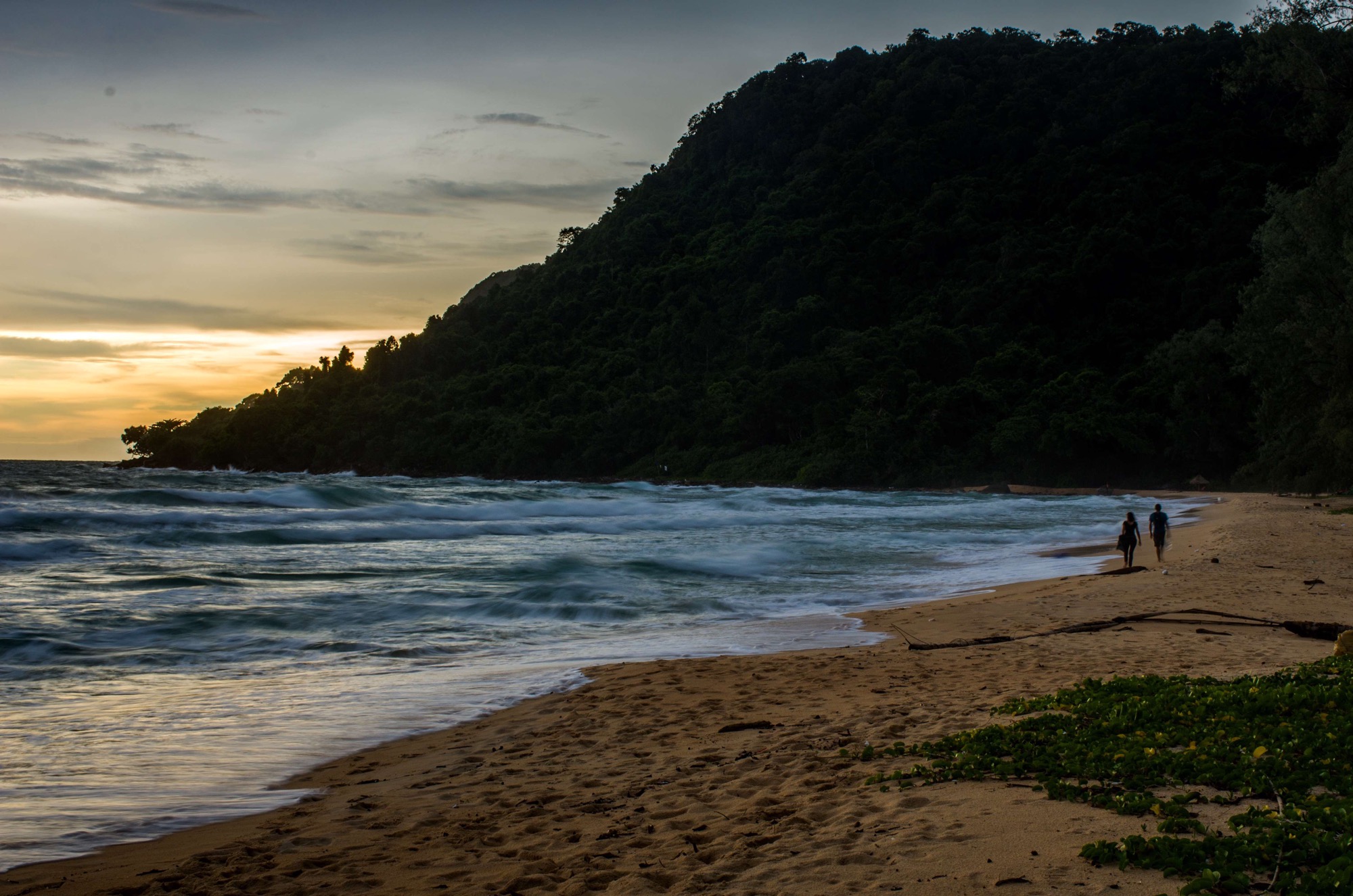
Walking down Sunset beach at sunset, Koh Rong Sanloem, Cambodia

  It’s a silent moment that carries on for longer than I could put a number to, for as long as it takes the sun to go from up to down. Charlie’s sitting right beside me and for a moment, after years of looking away from the story of our nation, we know that we never really turned our backs on it at all, not entirely. No words pass for that time it takes the sun to go from up to down and no words are needed, who needs to speak when there’s too much to listen to? Such a rare commodity nowadays, listening. But listen we do, to whispers on a salty wind not talking to just us, but to a nation scattered so far and wide; we listen to a story that adulthood called an end to, but refuses to slide away as dreams so often do.

 A little etherial, a touch poetic, downright wanky? Yes it’s all of these things and for one piece of inspired silence it doesn’t seem to matter. The story doesn’t belong to any one people, it’s a story that calls to anyone with a little bit of salt in their veins and right now it’s our story, carried on the wind and solid just for a moment before the waking instant again slides into discretion. For us our saltwater story doesn’t exist in waters gentled, it roars from a churning world so alive that It makes putting your hands over your ears just feel like emptiness, with no story at all.  

Charlie Winn

Watching the ocean at dusk, Sunset beach, Koh Rong Sanloem, Cambodia

  That water churns below us only occasionally reaching up to kiss our feet that dangle over the edge, this pose so reminiscent of a childhood that dreamed no stories of mountains. The salt wind calls from the salt water, to the salt water. And we follow. Sirens wail a seductive song and we’re pulled in, the water is warmer than our stories wrote but it’s the same home we know; alive, surging, relentless. There’s other people on the beach, barely willing to tempt wet knees in the wild choppy water that sucks and drags us hither and thither; they’re like tourists at home but now it’s us that are the tourists. We were the tourists, in a world girt by sea. A rip sucks us sideways like an old friend taking us only as far as the next waves that won’t stay gentle, salt water threatens all those around that don’t know the story. 

 Romance carries us all away occasionally, I say it’s romance and not spiritual but everyone has their own story; this is ours. For so long romance has come to us from other places without salt in the air, or water, but in a silent moment followed by a sucking rip the old book is opened so abruptly. I was born in a hospital where the eastern and northern walls were crusted white from the sea breeze pounding over the golf course, salt air was my first breath; from Charlie’s first steps the ocean was a roll down the hill away. So easy it is to reject this flighty romantic story in favour of the yolk of bluff masculinity that my country is now only climbing from, for now we’re not too tough to be brave; we’re in the storm where these two stories began. It’s taken a trip across the ocean to open a book dusty with the red sands of home but we don’t read, we listen; can you hear it? It’s the story of a salt water people. 

Newer Posts
Older Posts